

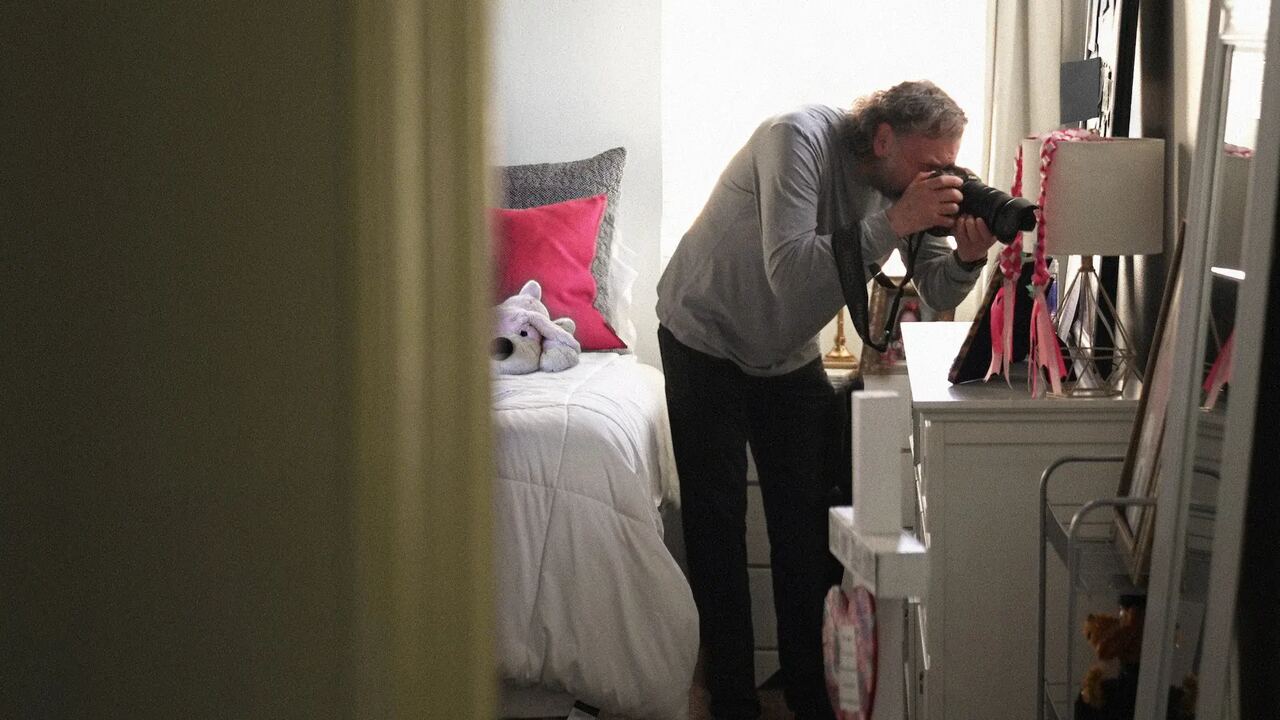
Here's a documentary—coming after The White House Effect—that I think everyone should watch. If it were up to me, it would be compulsory viewing. In Joshua Seftel's All the Empty Rooms, we follow journalist Steve Hartman and photographer Lou Bopp as they capture images of rooms once occupied by children who are no longer alive due to school shootings. When Hartman began documenting these tragedies, the figure was 17 deaths per year; that number has now risen to 132. As a young broadcast journalist, Hartman enjoyed love and success as the guy who brought hopeful news to people during dark times. His reports served as a light at the end of the tunnel—one that helped the public stay optimistic. But Hartman, in All the Empty Rooms, admits that he had been whitewashing the truth. There came a point at which he could no longer find anything positive to say in the aftermath of a tragedy. He says there is nothing upbeat to mine from the subject of school shootings. Needless to say, he's absolutely right.
In All the Empty Rooms, we see Hartman contacting the parents of victims to ask for permission to photograph their children's rooms. This 35-minute short focuses on three victims: Hallie Scruggs, Jackie Cazares, and Gracie Muehlberger. Through brief conversations with their parents, we learn what kinds of lives have been lost—what dreams will now never be realized. Hallie could have become a professional basketball player; Jackie wanted to be a veterinarian; Gracie was about to attend her first high-school dance and had already chosen her outfit.
This is what the documentary does best: it places all the attention on the victims, giving us the length and breadth of the pain that hits a family when someone close to them is taken away. Hartman, after all, blames the media for sensationalizing these incidents by focusing on the shooters. He could very well be criticizing the mainstream, sensationalist crime podcasts, shows, and documentaries that dominate popular culture.
I also liked how Seftel turned his camera on Hartman and Bopp, making them part of the narrative. Their personal lives, especially with their daughters, are foregrounded so they don't come across as detached observers documenting other people's pain. Hartman even gets a character arc: he begins as someone bringing good news to the public, and by the end of the documentary, we see him in the studio about to share something deeply troubling.
In All the Empty Rooms, Seftel gets close to something so intimate and personal that the short achieves a kind of universality. It ends up not being just about the victims of school shootings; it becomes a critique of any crime that takes a human life. All the Empty Rooms is not merely about America and its gun problem—it's about us and our suffering, suffering caused by people who don't value humanity. It's a profoundly moving documentary.
Final Score- [8/10]
Reviewed by - Vikas Yadav
Follow @vikasonorous on Twitter
Publisher at Midgard Times

Hi Everyone, after a due consideration, we have decided that we will be open for donations to help us in managing our website. We will be greatful for any kind of amount we receive. Thanks!
— Midgard Times 🎬 (@Moviesr_net) January 4, 2026
PayPal- [email protected] pic.twitter.com/DlNNz5Npm5
Get all latest content delivered to your email a few times a month.
Bringing Pop Culture News from Every Realm, Get All the Latest Movie, TV News, Reviews & Trailers
Got Any questions? Drop an email to [email protected]


 © Copyrights MOVIESR.NET All rights reserved