

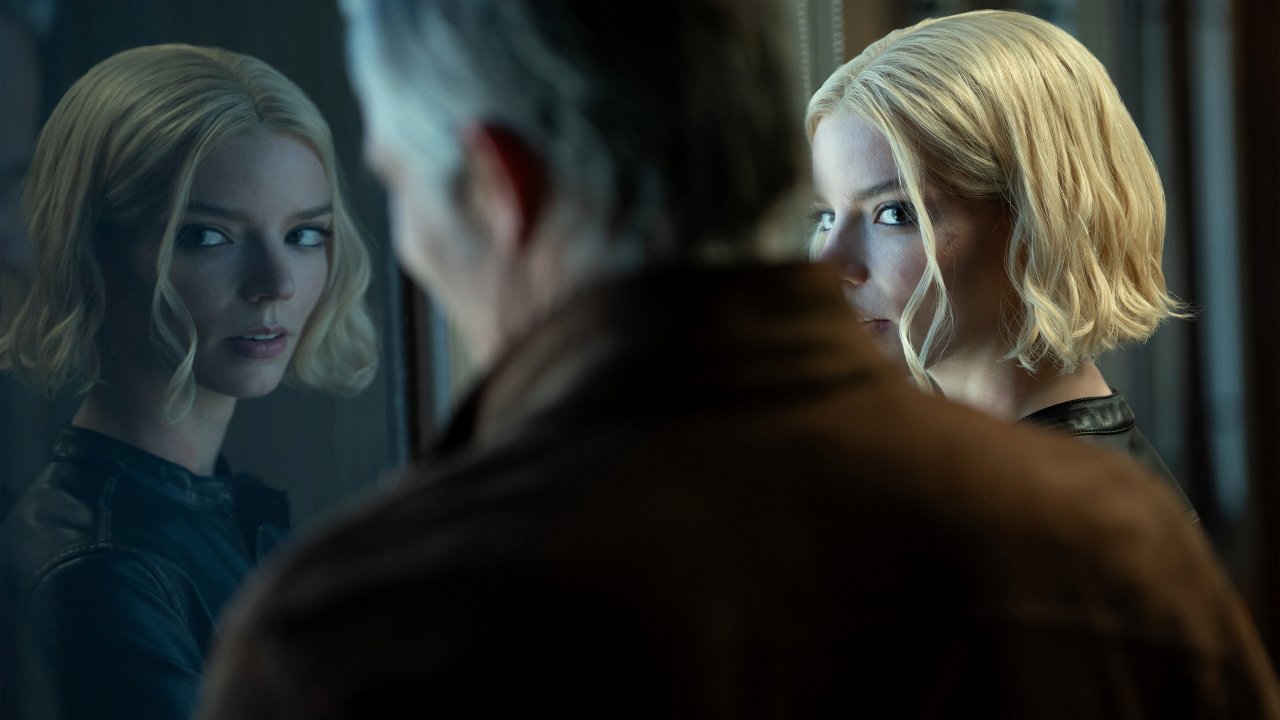
As Lucky plans what comes next, the people and choices she thought she'd left behind begin closing in again, pushing her toward a final reckoning with who she is—and who she wants to be. There is something almost cruelly appropriate about an episode called “Wherever You Go, There You Are.” Lucky has spent most of this series running, hiding, lying, stealing, and generally treating geographical distance as a substitute for emotional growth. Six episodes in, the show finally makes her sit with the inconvenient possibility that the problem might not be where she is. It might be her. And, for once, Lucky is considerably more interested in that question than in making her sprint away from another crime scene.
After the emotional fallout of the previous episode, this instalment deliberately slows things down. That could have been a problem this late in a seven-episode thriller, but the restraint mostly works because the season is finally aligning its various strands. Lucky's relationship with her past, her complicated family history and the increasingly unavoidable consequences of the heist are no longer separate storylines. They're beginning to look like different versions of the same problem.
Lucky cannot keep reinventing herself every time the truth catches up. Anya Taylor-Joy remains the reason the whole thing holds together. She has made Lucky compelling even when the character's decisions are spectacularly questionable, and here she gets to play a different kind of tension. There is less of the frantic survival instinct we've seen earlier in the season and more calculation—someone trying to imagine a future while knowing perfectly well that her past is still sitting in the passenger seat.
Taylor-Joy is particularly good at making Lucky's confidence feel fragile without making her seem helpless. That's important. Because Lucky works best when it remembers that its protagonist isn't a superhero con artist; she's someone who learned very early that deception was a survival mechanism and has become so good at it that honesty is now almost more frightening.
The episode also continues to benefit from Annette Bening's Priscilla. Their relationship remains one of the show's most interesting elements precisely because it refuses to settle into a straightforward mother-daughter conflict. There is affection buried underneath years of manipulation, resentment and mistrust, and every interaction carries the sense that both women know far more about each other than either is willing to admit. Bening can make a pause feel like a threat. It's a useful skill in a show where everyone has something they're not saying.
Aunjanue Ellis-Taylor's Agent Billie Rand provides the other side of the increasingly tight net around Lucky. The FBI pursuit has always been more interesting when Rand is treated as an intelligent person rather than simply "the cop chasing our protagonist," and the episode continues that approach. Rand understands Lucky's instincts, but she also understands that catching her and understanding her are two different things. That distinction gives their cat-and-mouse dynamic some welcome texture.
The episode's biggest strength, however, is its thematic focus. The title isn't merely a cute philosophical statement. It captures what the series has been building toward: Lucky's physical escape was never going to resolve the deeper question of whether she could actually leave the person she had become behind. Everywhere she goes, she carries the same instincts. The same willingness to manipulate people before they can manipulate her. The same desperate desire to control the situation. And that makes the episode feel less like another chapter in a chase and more like the beginning of an ending.
Unfortunately, that also exposes one of the show's recurring weaknesses. Lucky can be frustratingly uneven when it moves between its psychological drama and its crime-thriller machinery. The character material is often stronger than the mechanics of the plot, and whenever the episode shifts into logistical explanations or another stage of the criminal scheme, some of the emotional momentum disappears. It's a little like watching a genuinely fascinating conversation get interrupted because somebody remembered there's supposed to be a heist happening.
The pacing is also noticeably slower than earlier instalments. I didn't dislike that—in fact, I think the show needed this breathing room—but there are moments where the episode feels as though it's preparing for the finale rather than functioning as a fully satisfying chapter in its own right. And with only one episode left, that distinction matters. Still, the restraint ultimately pays off. The best moments aren't the ones involving danger. They're the ones where Lucky has to consider what happens after the danger. What does she actually want? What does she owe the people around her? Can someone raised inside a criminal world choose an ordinary life without simply becoming another version of the person who raised her? Those questions make Lucky considerably more interesting than its basic "woman runs from criminals, and the FBI" premise suggests.
The series has always had style. Anya Taylor-Joy has never looked more like she belongs in an expensive Apple TV thriller, and the show's glossy visual language, sharp locations, and carefully controlled tension remain effective. But this episode reminds us that underneath all that polish is a much simpler story. A woman trying to decide whether she can finally stop running. And honestly, Lucky looks exhausted. So do I. But unlike Lucky, I only have one episode left.
“Wherever You Go, There You Are” is a thoughtful penultimate chapter that trades some of the series' frantic momentum for character and thematic payoff. Anya Taylor-Joy continues to anchor the show with a performance that makes Lucky's contradictions believable, while Annette Bening and Aunjanue Ellis-Taylor add depth to the two relationships that increasingly define her choices. The episode occasionally feels more like preparation for the finale than a complete story in itself, and the crime mechanics remain less compelling than the character drama, but the slower approach gives the series room to confront the question it has been circling all season: escaping your past is considerably easier than becoming someone who no longer needs to run from it.
Final Score - [8/10]





Hi Everyone, after a due consideration, we have decided that we will be open for donations to help us in managing our website. We will be greatful for any kind of amount we receive. Thanks!
— Midgard Times 🎬 (@Moviesr_net) January 4, 2026
PayPal- [email protected] pic.twitter.com/DlNNz5Npm5
Get all latest content delivered to your email a few times a month.
Bringing Pop Culture News from Every Realm, Get All the Latest Movie, TV News, Reviews & Trailers
Got Any questions? Drop an email to [email protected]



 © Copyrights MOVIESR.NET All rights reserved