

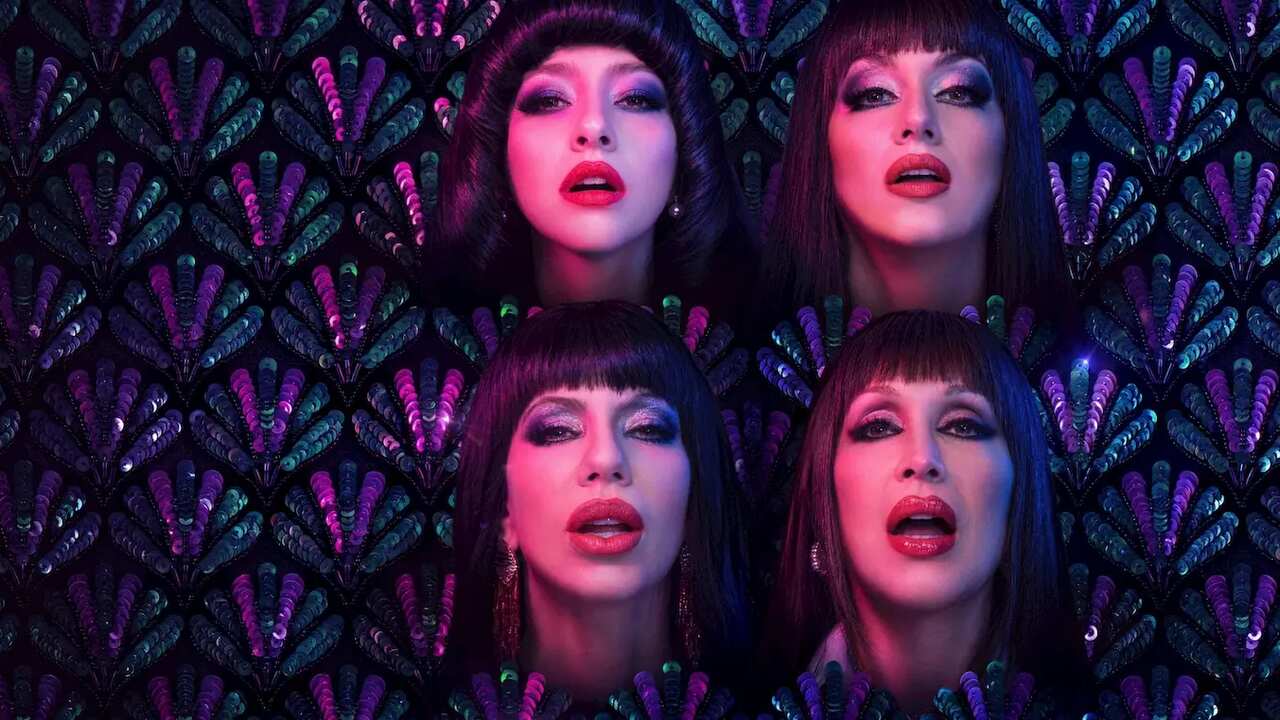
Some biopics try to tell you who a famous person really was. Moria is much more interested in asking who gets to decide which version of a famous person becomes the truth. That's a much more interesting proposition, particularly because Moria Casán isn't merely a celebrity whose life happens to contain enough drama for a television series. In Argentina, she is the performance: the persona, the catchphrases, the controversies, the woman who turned herself into a cultural institution and then spent decades refusing to behave like one. So making a conventional biopic about her would almost defeat the point. Instead, Javier Van de Couter's eight-part series treats Moria's life as something closer to a stage production—one that she can enter, interrupt, rearrange and occasionally mock herself. Netflix describes her as the "puppeteer" of her own fictionalised story, and that conceit gives the series its strongest structural idea.
It also gives the three actresses playing her an unusually difficult assignment. They're not supposed to impersonate Moria; they're supposed to inhabit her. Sofía Gala Castiglione, Moria's daughter, takes on the younger version of her mother, while Griselda Siciliani and Cecilia Roth portray later stages. Roth has spoken about deliberately avoiding a simple imitation of Moria's mannerisms and instead trying to find the private person underneath the public construction. Siciliani approached the role similarly, treating it as an attempt to capture Moria's essence rather than reproduce her celebrity persona. The result is much more interesting than three actresses competing to see who can deliver the most convincing Moria impression. Each performance feels like an interpretation, and because the series itself is constantly questioning the boundary between Moria Casán the woman and Moria Casán the creation, that feels exactly right.
Castiglione is particularly fascinating. There is something almost inherently strange about watching Moria's own daughter play her mother at the beginning of her career. The casting could easily have been treated as a publicity gimmick, but it gives the early sections an intimacy that would be difficult to reproduce otherwise. She isn't merely studying an iconic performer; she's playing her own mother before she became the mother she knew, which adds an unexpected emotional layer to the performance. Siciliani, meanwhile, handles the period in which Moria's public identity becomes increasingly formidable with tremendous confidence. She captures the charisma without making the character permanently larger than life. There is calculation underneath the flamboyance: an understanding that attention can be currency and that provocation can be a form of control. Roth's older Moria is perhaps the most conceptually interesting of the three because she represents the point at which the person and the myth have become almost impossible to separate.
Moria isn't particularly interested in pretending that fame was simply a reward for talent. It shows the machinery: revue theatre, cinema, television, the public scandals, the relationships, the constant scrutiny and the reinvention required to remain relevant in an industry that is perfectly happy to replace you. Moria's transgression isn't presented merely as an aesthetic choice; it becomes survival. That's one of the series' strongest ideas, and it is directly reflected in Netflix's description of the character as a woman who made transgression a way of surviving and became an icon of Argentine popular culture in the process.
The show is therefore at its best when it refuses to separate the outrageous Moria from the vulnerable one. Those aren't necessarily contradictory versions of her; they may be the reason one exists. There is a particularly compelling tension between how much control Moria appears to have over her public image and how little control she sometimes has over the circumstances surrounding her. The series moves through success, adversity, and the moments that lead to the loss of her freedom, making it clear that becoming untouchable in public doesn't make someone invulnerable in private. That makes the series surprisingly moving, not because it asks us to pity Moria—it doesn't, and it shouldn't—but because it asks us to understand the machinery behind the myth.
The production design is another major strength. Because the series spans decades of Argentine entertainment history, recreating the environments in which Moria's career developed is essential. The period detail gives the show a sense of cultural specificity that prevents it from feeling like a generic international celebrity biopic with Spanish dialogue. This is very deliberately an Argentine story, and Moria is also a celebration of Argentine popular culture rather than simply a celebrity profile. The series isn't only asking what made Moria famous; it's asking what Moria represents: the woman who could be glamorous and vulgar in the same breath, the performer who could turn scandal into publicity, the celebrity who understood that being talked about could be more valuable than being universally liked, and the figure who repeatedly challenged the conventions of what an Argentine female star was supposed to look and behave like.
In that sense, Moria becomes a history of changing cultural attitudes toward women, sexuality, celebrity and power. Not a subtle history, necessarily, but an interesting one. The series also benefits enormously from its humour. A story about Moria Casán without humour would be like making a biopic about a comedian and removing all the jokes. Moria knows that the subject herself is funny, sometimes intentionally and sometimes because life has apparently decided that subtlety is overrated. That self-awareness prevents the heavier material from becoming oppressive, and it makes the more serious moments hit harder because the show isn't permanently announcing how important they are.
There are weaknesses, however. The biggest is inherent in the concept: a fictionalised biography of someone who has already spent her career controlling her own mythology is never going to provide an entirely objective portrait. The series is fascinated by Moria, and occasionally that fascination becomes indulgence. There are moments where the show seems so enamoured with the legend that the woman underneath it becomes harder to see. The episodic structure can also feel uneven. Eight episodes provide enough space to explore the major stages of her life, but the series sometimes moves between periods and emotional registers so quickly that certain relationships or events feel more like stops on a timeline than fully developed chapters. And if you know very little about Moria Casán beforehand, some of the cultural significance will inevitably be lost. The series assumes that the myth already means something, which isn't necessarily a flaw, but it does make Moria feel more rewarding for viewers willing to meet it halfway.
Ultimately, though, the series' greatest achievement is that it understands its subject. Moria Casán became famous by refusing to behave as though fame required her to become smaller, so the series refuses to make her smaller either. It doesn't sanitise her, turn her into a saint or pretend that every decision was admirable, and it doesn't try to explain away the contradictions that make her fascinating. Instead, it puts those contradictions on stage: the woman and the persona, the survivor and the provocateur, the mother and the celebrity, the person and the myth. And, appropriately, it lets Moria pull the strings.
Moria is an ambitious, stylish and unusually self-aware celebrity biopic that understands its subject is far too theatrical for a conventional life story. The three performances by Sofía Gala Castiglione, Griselda Siciliani and Cecilia Roth give different stages of Moria Casán's life distinct personalities without reducing the exercise to imitation, while Javier Van de Couter's decision to let Moria function as the puppeteer of her own fictionalised history gives the series a clever narrative identity. Its episodic pacing occasionally feels compressed, and its fascination with its subject can verge on hagiography, but its willingness to explore the machinery behind Moria's public persona—and the transgression that became part of her survival—makes it considerably more interesting than a standard rise-and-fall celebrity biography. The cleverest thing about Moria is that it doesn't really ask whether the legend is true. It asks what happens when the legend becomes the truth.
Final Score- [8.5/10]
Reviewed by - Anjali Sharma
Follow @AnjaliS54769166 on Twitter
Publisher at Midgard Times




Hi Everyone, after a due consideration, we have decided that we will be open for donations to help us in managing our website. We will be greatful for any kind of amount we receive. Thanks!
— Midgard Times 🎬 (@Moviesr_net) January 4, 2026
PayPal- [email protected] pic.twitter.com/DlNNz5Npm5
Get all latest content delivered to your email a few times a month.
Bringing Pop Culture News from Every Realm, Get All the Latest Movie, TV News, Reviews & Trailers
Got Any questions? Drop an email to [email protected]

 © Copyrights MOVIESR.NET All rights reserved