

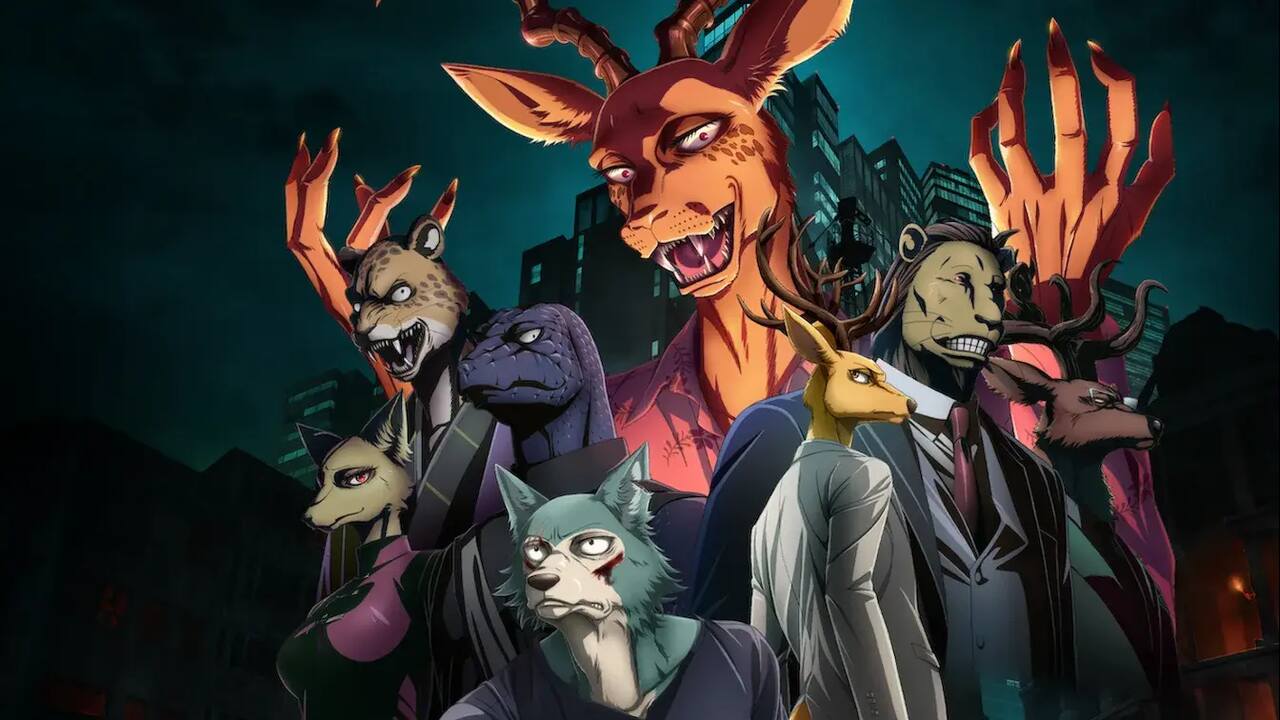
I finished Beastars Season 3 Part 2 with two distinct feelings: admiration for how boldly weird and thoughtful this show remains, and mild exhaustion from how much it tries to cram into its final stretch. The second half of the final season, episodes 13 through 24, serves as the long-awaited conclusion to Netflix’s adaptation of Paru Itagaki’s manga. It delivers plenty of the qualities that made the series fascinating from the start: strange philosophical conversations between animals, tense social commentary disguised as drama, and an oddly sincere wolf who keeps trying to be a good person in a world that clearly isn’t designed for that.
The story resumes with Legoshi living outside Cherryton Academy, trying to function as an adult in a society that distrusts him. His criminal record stemming from the infamous fight with Riz and the moment when Louis sacrificed his foot to help him win still follows him everywhere. Legoshi works mundane jobs, lives in a tiny apartment, and attempts to maintain a relationship with Haru while figuring out what responsibility actually means. Meanwhile, the larger world grows more dangerous as the current Beastar, Yahya, hunts the unpredictable hybrid criminal Melon, whose rise in the underworld threatens to destabilize the fragile peace between carnivores and herbivores.
This part of the season leans heavily into crime drama territory. The Shishigumi crime syndicate is no longer just background flavor; it becomes a central battleground. Melon, the gazelle–leopard hybrid who takes control of the gang, is one of the most unsettling antagonists the show has produced. He embodies the series’ long-running theme about identity conflict—someone born from two species who belongs to neither and responds to that confusion with violence and nihilism. His unpredictability keeps the tension high in several late episodes, especially as his clashes with Yahya and Legoshi escalate toward a chaotic final confrontation.
One thing I genuinely appreciate about these final episodes is how committed the show remains to its strange moral discussions. Beastars has always used its animal setting to talk about prejudice, instinct, and social expectations, and the finale continues that tradition. Legoshi’s conversations with Yahya about justice and responsibility feel surprisingly mature for a show that, on paper, features a wolf who once had a spiritual awakening while talking to a moth. The writing often treats ethical dilemmas seriously, especially when characters debate whether carnivores can truly overcome instinct or whether society is simply pretending they can.
Legoshi himself remains the emotional center of the series, and his character arc lands more gracefully than I expected. Throughout the final season, he slowly stops seeing himself as a walking disaster and begins to accept that his strength and instincts don’t automatically make him dangerous. That internal shift is subtle but meaningful. Instead of obsessing over being “pure,” he starts focusing on responsibility and restraint. It’s a small philosophical adjustment, but it represents years of character development.
Studio Orange deserves credit as well. The animation style—CGI mixed with traditional anime techniques—still looks distinctive and expressive. Facial animation in particular is excellent; characters communicate huge emotional shifts with minor changes in posture or eye movement. Action scenes, especially the confrontations involving Melon and the Shishigumi, are fluid and intense without becoming chaotic. The visual language of the show remains confident and stylish, even during quieter conversations.
The voice performances continue to be strong across the board. Legoshi’s soft-spoken delivery balances awkwardness and sincerity, while Louis maintains his sharp, confident presence. Melon’s voice acting deserves special praise; the character constantly shifts between charming and unsettling, and the performance sells that unpredictability well.
All of that said, the final stretch of Beastars is far from perfect. The biggest problem is pacing. These last twelve episodes attempt to resolve several complicated arcs simultaneously: Legoshi’s personal growth, Yahya’s pursuit of Melon, Louis confronting his father and his role in society, the future of the Beastar system, and the state of carnivore–herbivore relations. Individually, these are compelling threads. Together, they sometimes feel like too many plates spinning at once.
Some plot developments happen so quickly that they barely have time to land emotionally. Major confrontations are occasionally resolved within an episode or two, which reduces the impact of conflicts that have been building for seasons. The story seems eager to reach its philosophical conclusions, but that urgency sometimes sacrifices the slower character moments that earlier seasons handled so well.
Haru, unfortunately, continues to suffer from reduced narrative importance. In the first season, she was a central figure, and her complicated relationship with Legoshi grounded the story in something personal and relatable. By the time the final episodes arrive, she often feels like a supporting character in her own relationship. She still has meaningful scenes, especially when confronting Legoshi about their future, but the series never quite restores the balance between the two characters that once defined the show.
The world-building also becomes a bit messy near the end. The politics of the Beastar system and the broader social structure are introduced as major elements, but the show doesn’t fully explore them before the finale wraps up. Some ideas feel more like hints at larger themes than fully realized storylines. And yet, even with these flaws, I found the ending surprisingly satisfying. The final episodes lean into the idea that societal change is slow and messy. There is no miraculous moment where carnivores and herbivores suddenly understand each other. Instead, the series closes with characters who are still struggling but who have learned to live with their contradictions.
That conclusion fits Beastars perfectly. From the beginning, the show was never about solving the world’s problems; it was about individuals learning how to exist within them.
By the time the credits rolled, I realized something amusing: this is a show where a wolf tries to build a healthy relationship with a rabbit while helping track down a hybrid crime lord, debating philosophy with a horse, and occasionally getting into fights with mafia lions. Somehow, it manages to treat all of that seriously without losing its sense of humor or humanity.
The final season isn’t the smoothest ride, but it remains thoughtful, strange, and surprisingly heartfelt. For a series that started as a bizarre high-school drama about animal instincts, it ends as something much bigger: a messy, ambitious story about identity, responsibility, and the difficulty of being decent in a complicated world. And honestly, that feels like a fitting farewell.
Final Score- [6/10]
Reviewed by - Anjali Sharma
Follow @AnjaliS54769166 on Twitter
Publisher at Midgard Times

Hi Everyone, after a due consideration, we have decided that we will be open for donations to help us in managing our website. We will be greatful for any kind of amount we receive. Thanks!
— Midgard Times 🎬 (@Moviesr_net) January 4, 2026
PayPal- [email protected] pic.twitter.com/DlNNz5Npm5
Get all latest content delivered to your email a few times a month.
Bringing Pop Culture News from Every Realm, Get All the Latest Movie, TV News, Reviews & Trailers
Got Any questions? Drop an email to [email protected]



 © Copyrights MOVIESR.NET All rights reserved