


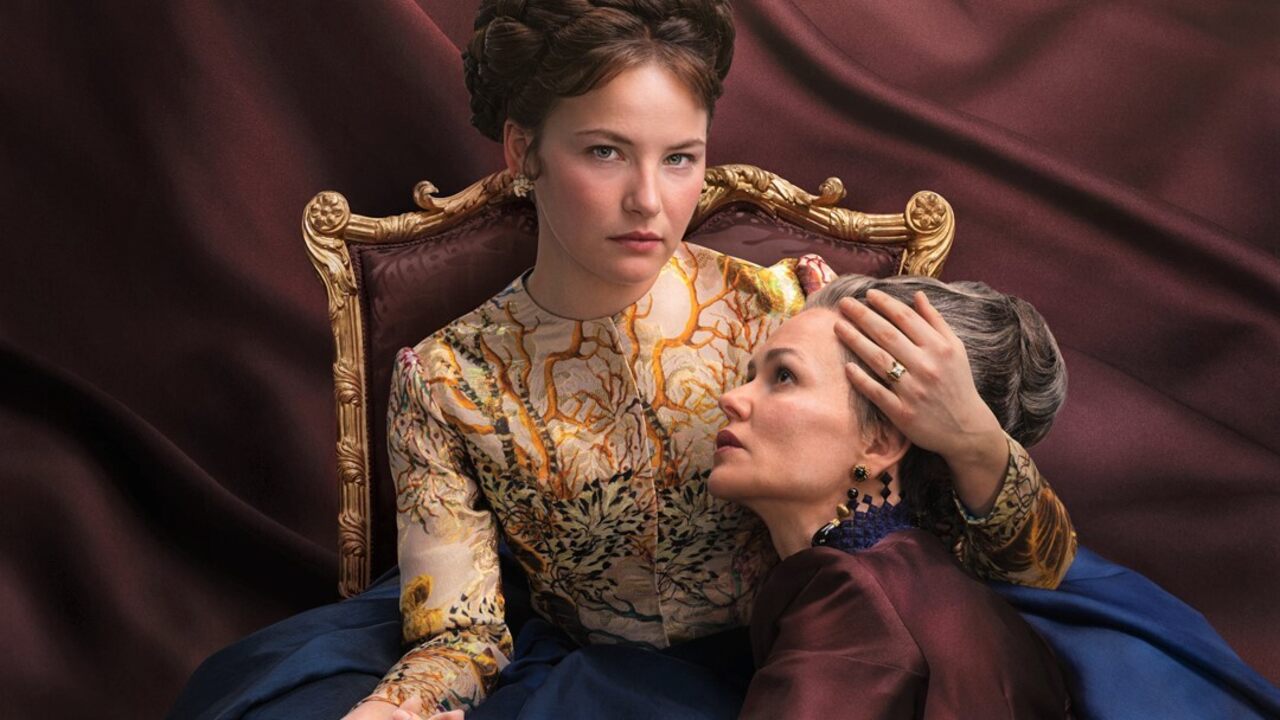
The Empress (original title: Die Kaiserin) is one of those shows that peaked during its first season, which wasn't all that good to begin with. The second season, on the other hand, merely ate up its time and left you as distressed as the titular empress, Elisabeth (Devrim Lingnau), who spent much of the season mourning and crying over her infant's untimely death. Now comes the third and final season, which once again suggests that creator Katharina Eyssen isn't quite sure what to do with this story or its historical characters. The only instinct guiding her this time around seems to be: "I need to wrap everything up because there isn't going to be a fourth season." That sense of hastiness infects Season 3 like a plague and reduces vast events to quick expositions. Elisabeth goes to an island to recover her health, Maximilian (Johannes Nussbaum) becomes Mexico's ruler, Franz (Philip Froissant) fights on the frontlines, the Prussians emerge as a threat, and Elisabeth negotiates with the Hungarians for their help. The series, however, doesn't depict these developments with the political intrigue, dramatic invention, or captivating mind games required to make them feel invigorating or urgent. Rather, it presents them as markers, as bullet points that merely convey that a particular thing has happened.
Season 3 opens with Franz returning from the war as a changed, cold, and distant man who finds it difficult to warm up to his wife, Elisabeth. When she tries to have sex with him, he becomes rough with her, as if she were an enemy who must be dominated. Needless to say, Elisabeth walks away angry and irritated. This emotional distance throws Franz into the arms of another woman, Terese (Marlene Burow), with whom he eventually has two children, and the affair ultimately serves to highlight something very trite: society has different standards for a man's extramarital affair and a woman's. Because, you see, Elisabeth too ends up sleeping with Count Gyula Andrássy (Dejan Bućin), for which she is confined to her room at the castle. But if you still don't get the point, relax. The series has got you covered. It makes itself even more obvious by having Franz tell Elisabeth that men can have affairs without consequences because that's the rule everywhere. Then again, such in-your-face messaging wouldn't have been much of a problem if the series had bothered to explore what the affair means to Franz, what he thinks of the two children, and how his mistress goes through her day-to-day life while remaining anonymous. Is she allowed to go outside and mingle?
Season 3, however, never allows any moment, scene, feeling, or action to linger. It speedruns through everything, making it difficult for the viewer to stay invested. Maximilian's rule in Mexico is largely stripped of the political detail that might have established him as a ruler—his plans, policies, calculations, and relationship with the people over whom he now presides. There is little sense of daily court life, either. What promises did Maximilian make to the people? How many of them were fulfilled? Instead of building his reign through such details, Season 3 increasingly sees him as a desperate husband who sends his wife, Princess Charlotte Marie of Belgium (Josephine Thiesen), to have sex with one of his men so that she can produce an heir for his kingdom. But that man reveals that he has been harboring a crush on Charlotte for years, which makes their sexual encounter something more complicated than a mere favor. I am sure a situation like this could create considerable complications between the people involved, especially for the man who has been enamoured of Charlotte. And when Maximilian sends the two of them to a safe place together until the child is born, I can only imagine the sexual and romantic tension that must have permeated the air. Season 3, however, doesn't delve into those complications. What does Charlotte make of the man's crush? How does he keep himself together after what happens between them, and after all the sweet words she whispers to him before they have sex?
Eyssen, alas, isn't interested in exploring her characters' relationships and thoughts and merely brushes past their stories with both swiftness and personal indifference. The experience is that of watching a show move through its pages with the mechanical enthusiasm of "this happened, then this happened, then this happened." In the final episode, The Empress becomes overly sentimental and applies cheap emotional tactics—a mother sensing her son's death, a bedridden Franz remembering a dead Elisabeth, and Maximilian giving a servant his ring before being betrayed by him—that attack your tear ducts with fervor in order to elicit a warm response to these expository chess pieces. If only a fraction of the effort had been put into the script instead of spending so much of it on costumes and sets, Season 3 wouldn't have needed to exert itself to swell your heart. The real Elisabeth became an enduring figure because of her beauty, independence, charity, and strength, among other qualities. I suspect even she would find herself yawning at this dull Netflix adaptation. She might look at the screen and say, "I lived a better, more adventurous, and exciting life than whatever is shown here."
Final Score - [3.5/10]
Reviewed by - Vikas Yadav
Follow @vikasonorous on Twitter
Publisher at Midgard Times




Hi Everyone, after a due consideration, we have decided that we will be open for donations to help us in managing our website. We will be greatful for any kind of amount we receive. Thanks!
— Midgard Times 🎬 (@Moviesr_net) January 4, 2026
PayPal- [email protected] pic.twitter.com/DlNNz5Npm5
Get all latest content delivered to your email a few times a month.
Bringing Pop Culture News from Every Realm, Get All the Latest Movie, TV News, Reviews & Trailers
Got Any questions? Drop an email to [email protected]


 © Copyrights MOVIESR.NET All rights reserved