

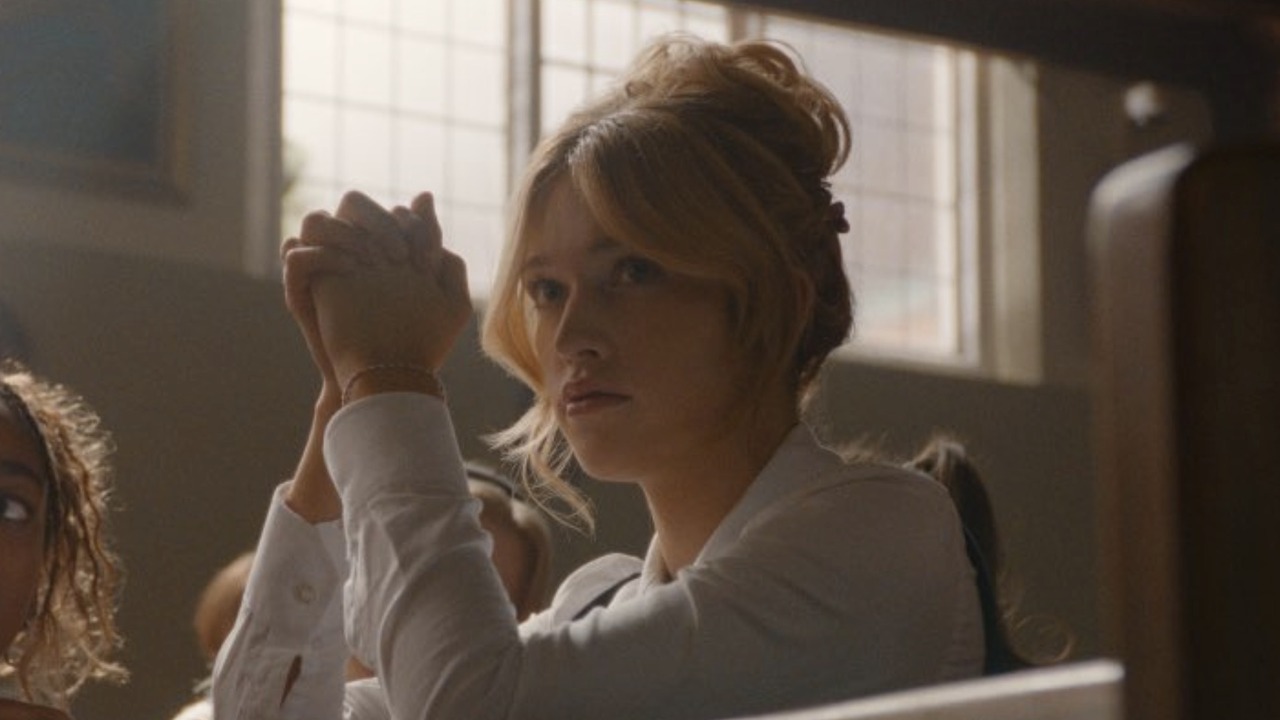
First things first, writer-director-creator Quinn Shephard deserves to be congratulated for assembling a fantastic ensemble of young, fresh faces and then giving each of them amusingly distinct personalities to distinguish them from one another. The Body, a dark comedy horror thriller, is one of those shows where you remember every character, no matter how long or short their screentime, because no one is a bore and no one simply exists like a piece of furniture. What makes everybody memorable—and by everybody, I mostly mean the young people—is how they act as if they are high and spaced out 24/7. There is Tyler (Marcel Ruiz), who supplies drugs to everyone and who himself seems drugged out whenever he opens his mouth. He will ask you if you are horny with a straight face, and you don't know whether his inquiry is genuine or if he will proceed to giggle. There is Katie (Bella Neuspiel), who is similar to Tyler in her directness, but her mind isn't as dirty as his, and she often talks sense while exuding a blithe demeanor that suggests zoned-out indifference. Then there are the twins, Brit and Bailey Bradley (Kyra and Phallon Pierce), who look so alike that no one is able to distinguish them from one another. Even Father Franklin (Nnamdi Asomugha), during an interrogation, has to ask if he had talked to the person sitting opposite him a few minutes earlier.
All these girls (and there are others as well) study at a Catholic school and are part of a dance group named Lions. Anya (Kristina Bogic) and Elise (Sara Boustany) are the captains of this group, and they are also in love with each other. But since they are part of a conservative, Jesus-loving community, they cannot openly come out as lesbians. Well, Elise doesn't mind being seen as Anya's partner. It's Anya who strongly opposes this notion, and to hide her sexual preference, she plays the role of Steven's (Orlando Norman) girlfriend. Steven—and everyone else—doesn't know about Anya and Elise's relationship, so when he makes out with her or goes down on her and she isn't turned on by his efforts, he blames himself for being bad at sex. Anya is one of those people so deeply conditioned by conservative values that she is constantly torn between pursuing Elise and embracing the teachings of Catholicism. In one of the scenes in Episode 1, when Steven goes down on Anya in his car, she looks at a crucifix locket hanging from the rearview mirror and tries to turn herself on in an attempt to "reverse" her lesbianism and become "normal." This, in fact, is one of the ideas on which The Body rests: the guilt and tension that arise when people are caught between their religious beliefs and their carnal or otherwise "sinful" desires.
If Anya probably wonders whether Jesus would punish her for liking girls, Leo (Jackson Kelly) almost breaks down in remorse for getting an erection. When he gets aroused by Grace's (Sofia Wylie) advances—she leans towards him for a kiss, and possibly more than just a kiss—he stands up, hurriedly walks out of the room on the pretext of using the bathroom, and then behaves all guilty in the corridor (he even comes right there). Scenes like these are both pathetic and hilarious. Shephard makes a joke out of the self-reproach, shame, and humiliation produced by rigid moral conditioning, showing how futile it is to attach guilt and resentment to activities that are simply biologically natural. The series' point is clear: there is nothing inherently shameful about masturbation or sex. Moreover, people who sermonize otherwise risk looking like naive clowns, which is why some of the self-serious lines here about sex and religion become automatically, ridiculously comical. But Shephard also doesn't really attack her characters for being immature. Her attack is directed towards the ideas implanted in them. You laugh at the lines and the ideas while feeling sorry for the people.
What's more, Shephard doesn't merely stop at sex and religion. She also brings psychosis, fanaticism, and hysteria into the mix through the hardcore religious groups' obsession with miracles. This is where we must mention Lisbeth (Geena Meszaros), the "awkward, isolated" girl whom everyone finds creepy and who is always desperate for friends. Lisbeth doesn't have eyebrows (they are trimmed), and, like the new Carrie, she doesn't have social media accounts, a mobile, or a computer. Lisbeth is also referred to as Lizzie—uh-huh. Unlike Carrie, however, Lisbeth doesn't have telekinetic powers. Still, she has a power, all right—the power of persuasion and manipulation. With her authoritative voice and chutzpah, Lisbeth is able to exploit the characters' weaknesses, be it their embarrassment or shame at breaking a Catholic rule or their discomfort around sex. But the main reason she is able to make them her targets is their complete trust in superstition. This is also where Lisbeth vastly differs from Carrie. She is wise enough to see through all the superstitious mumbo jumbo, probably because she has grown up watching people being fooled in the name of God—her father was one of those phony priests who put on circus-like shows with snakes and whatnot and passed them off as magical miracles.
Look closely, and amidst all the cries of faith and orgasmic moans, you will sense that if Lisbeth ends up manipulating the girls, that's because manipulation is all she has learned given the kind of upbringing she had. She was passed off as "God's child" in her father's hokey church. At the same time, Lisbeth does find friendship and acceptance—or at least the illusion of them—when she begins delivering speeches about angels and demons like her father. There is a solid, feverish scene in the fifth episode where the series cuts between confession, sex, and exorcism. Yet it's also worth noting that Lisbeth is almost pushed into this role. It all starts at a Halloween initiation party where Grace's body is found lying outside in the dark by Lisbeth and Anya. Lisbeth makes the sensible suggestion of calling an ambulance, but Anya shoots down the idea, fearing that the police's involvement might land her in serious trouble (it's Anya who gave Grace ecstasy for the initiation). Since Lisbeth is desperate to be friends with this cool girl, she helps Anya cover up the incident, which leads to both of them secretly taking Grace to her house and quietly laying her on her bed. Oh, did I mention that Grace dies on the way in the car? Fret not; she starts breathing again but remains unconscious. How? Who knows? What's more shocking is that the medical tests don't reveal the presence of drugs inside her. Now how is that possible?
Simply put, Shephard has created a pretty addictive, horny comedy horror mystery that will keep you thoroughly entertained and invested. Nonetheless, you also emerge from the series feeling that a tighter, nastier, giddier version of The Body might exist with a lesser episode count or as a two- or two-and-a-half-hour-long feature. Given the ground the first season covers, it all could have been done with more edge and discipline. The eight long episodes develop a tendency towards repetition, which is most evident in the way the girls are "reset": one moment, they will intensely discuss supernatural terrors and tremble, and the next, they will laugh and gossip and throw around snarky comments before returning to body-shaking fear. I get that the intention is to underline how everybody is simply putting on a show—in that respect, they are not so different from Lisbeth's dead father—but the point could easily be driven home more effectively without going through the same motions.
You can extend a similar argument to Anya and Elise's on-and-off relationship, which ultimately becomes a cycle of Elise getting annoyed by Anya's lies and bitchiness, only to warm up to her by the next scene or within seconds, before they go through the same routine again later. It does get a bit annoying after a while. Are these creators compelled by their bosses to unnecessarily pad their series to meet a specific number of episodes and generate bigger viewership numbers? I would also have liked to know what Lisbeth thought about her father's church when she was an active participant there. Did she sneer at the crowd, or did she enjoy the attention? And how did she manage to develop a different view from that of her brother if both were raised in the same environment? Similarly, how is Elise so confident about her sexuality, so much so that she doesn't mind being seen as Anya's girlfriend? How did she accept herself? Are her parents more open-minded? These aren't necessarily plot holes, but they are questions the series leaves hanging when it could have deepened its characters by answering them.
In its vision of mass hysteria, where even a non-believer becomes a believer—Grace's father, played by Motell Foster, initially rejects the theory that Grace can do miracles but eventually embraces the idea when he claims to see Grace the way others do—The Body reminds you of Ritwik Pareek's Dug Dug. Its tendency to mock religious organizations that instill absurd moral notions into the minds of their followers, meanwhile, brings to mind Benedetta, directed by Paul Verhoeven. But Shephard, unlike Verhoeven, doesn't dismiss every authority figure. She sees Father Franklin as a genuine Jesus devotee and doesn't convert him into a mere target of her pranks—a deformed, silly, clownish figure. When he says that he naively bought into the girls' supernatural sightings and visions, you don't just chuckle; you also feel sorry for what he goes through in this world of poseurs. That, I think, is Shephard's biggest achievement: she creates an unholy mix of sex, faith, lies, guilt, cheerful vulgarity, and violence without scoffing at her creations. Shephard is more interested in seeing what forms rigid beliefs take and how far people will go to validate inane superstitions. She never loses sight of her real target, which is why you don't ever hate any character. At the same time, you also wish the show hadn't been eight episodes long, since that length gives it the appearance of a one-line joke or idea being stretched, beaten, battered, squeezed, and wrung out to the very last drop until it no longer sounds quite as much fun. Still, that ending is quite enjoyable—a delicious cliffhanger. I won't be surprised if many people end up screaming and demanding a second season. Hey, I could be one of those people.
Final Score - [7.5/10]
Reviewed by - Vikas Yadav
Follow @vikasonorous on Twitter
Publisher at Midgard Times


Hi Everyone, after a due consideration, we have decided that we will be open for donations to help us in managing our website. We will be greatful for any kind of amount we receive. Thanks!
— Midgard Times 🎬 (@Moviesr_net) January 4, 2026
PayPal- [email protected] pic.twitter.com/DlNNz5Npm5
Get all latest content delivered to your email a few times a month.
Bringing Pop Culture News from Every Realm, Get All the Latest Movie, TV News, Reviews & Trailers
Got Any questions? Drop an email to [email protected]

 © Copyrights MOVIESR.NET All rights reserved