

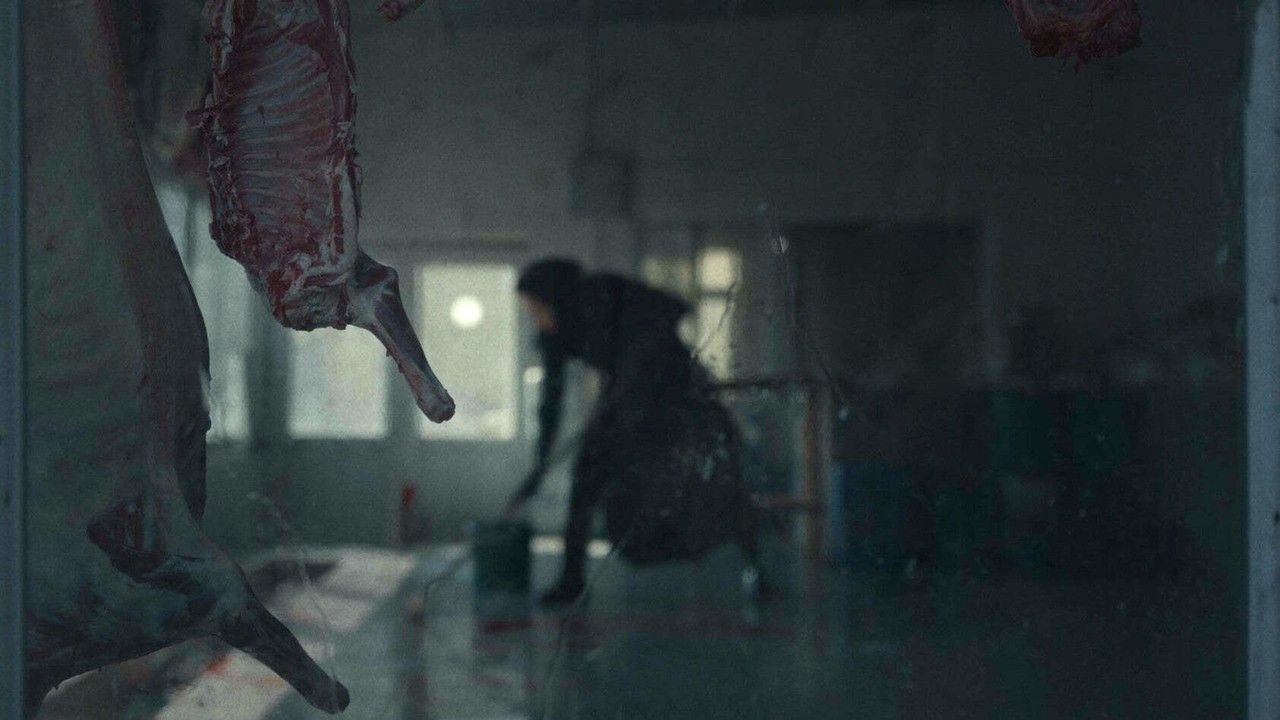
I have a rather uncomfortable question after watching VITAL: how much of your own body would you consider expendable if it meant keeping your child alive? I don't mean this as one of those hypothetical questions people ask at dinner, confident that their answer reveals something profound about their character. I mean it literally. A part of you, removed, sold, converted into money, and measured against the possibility of your child's survival. The film puts this thought in front of us almost immediately. Its opening text and image had me unsettled within ten seconds. I hadn't even found my footing as a viewer, and already I was thinking about the peculiar cruelty of a world in which a parent's body might become the last thing left to offer. That feeling never quite left me.
Amir Zargara's 14-minute short follows two parents in very different circumstances. In Iran, Fereshteh (Mahtab Servati) considers selling her organs to pay for her daughter's treatment. In the United States, Dariush (Reza Akhlaghirad), a doctor, faces an ethical dilemma in his own attempt to save his daughter. Two parents, two daughters, two systems, and one terrible common denominator: the lengths to which people might go when someone they love is running out of time.
What makes this premise so affecting is the way it takes a familiar idea (parental sacrifice) and makes it disturbingly physical. We use the word everything rather casually when talking about love. A parent would give everything, do anything, make any sacrifice. It sounds noble because we rarely have to specify what everything entails. VITAL does. What if the sacrifice involves an organ? What if the body itself becomes negotiable? There is a point at which the language of devotion begins to conceal something much uglier: the conditions that make such a sacrifice seem necessary.
I found myself thinking particularly about the difference between making a choice and having a genuine choice available. We tend to discuss consent as though it exists in a vacuum. Someone agrees, someone refuses, and we assess the decision. But desperation has a way of narrowing the available options until the remaining one begins to resemble consent. Fereshteh's predicament makes that distinction difficult to ignore. It would be easy to describe her consideration as an extraordinary act of maternal love. I am less comfortable with that reading. It risks turning a desperate situation into an inspirational story and allowing the circumstances responsible for it to escape scrutiny. Her love may be extraordinary. The fact that it could demand such a price is something else entirely.
Dariush's presence complicates the picture. His professional position and geographical circumstances differ from Fereshteh's, but his daughter's vulnerability places him in an ethical predicament of his own. The two parents do not have identical choices, and that inequality is precisely what gives their parallel stories significance. They are joined by the same fear, but fear does not make their access to solutions equal. One person's professional standing, financial resources, and location can alter the shape of a crisis without making the crisis any less intimate.
The contrast between Iran and the United States is also worth considering carefully. Iran has a regulated system of compensated kidney donation; the United States prohibits the sale of organs, while patients continue to face shortages and long transplant waiting lists. Neither context offers a neat moral conclusion. A compensated system raises questions about economic pressure and the vulnerability of donors. Prohibition, meanwhile, does not make the demand for organs disappear. VITAL touches on an uncomfortable contradiction: we can insist that the human body should never be treated as a commodity, yet remain unable to guarantee that everyone has access to the medical resources they need. The moral principle and the lived reality do not always meet.
There is something almost grotesque about the economics of this situation. We speak of the human body as priceless, but its individual parts can acquire an extraordinary monetary value when another person's survival depends on them. A kidney becomes more than an organ; it becomes money, treatment, time, possibility. The person who has one may suddenly possess something another person cannot live without. And the person who needs it may have very little power over the terms on which it becomes available. That imbalance is what I find hardest to shake.
Zargara's personal connection to the subject gives the film another dimension. He has spoken about a childhood memory in Iran, when he learned that a family friend was trying to buy a kidney for his mother. He has also described how his life between Iran and North America informed his interest in the different systems surrounding organ donation. The film's geographical movement therefore feels connected to a question he has spent time considering himself: what does it mean to leave a country while continuing to carry its memories and contradictions? This background makes the subject feel less like an issue selected for dramatic effect and more like something the filmmaker has a personal stake in examining.
The filmmaking serves that underlying concern. Jelan Maxwell's cinematography, Iman Tahsin's editing, and Kamyar Behbahani's score contribute to the film's effort to bring two separate parental experiences into the same emotional and ethical conversation. Mahtab Servati and Reza Akhlaghirad have the difficult responsibility of keeping these characters human rather than allowing them to become convenient representatives of opposing systems. The film's strongest impulse is to keep the audience close to the people living through the dilemma, even as the questions surrounding them extend into law, economics, and healthcare.
There is one aspect I found myself wanting more from: the relationship between the two parallel narratives. The contrast between Fereshteh and Dariush is central to the film's argument, but I would have liked the distinction between their circumstances to carry even greater complexity. Their situations establish an effective comparison, yet the ethical implications of that comparison are so rich that certain questions remain at the level of the premise. In particular, the relationship between economic vulnerability, professional privilege and personal agency could have been made more sharply felt. I don't think the film needed more time; I think it could have extracted even more from the contrast it had already established. That is a relatively small reservation, but a worthwhile one given how compelling the central idea is.
I keep returning to the opening. Perhaps because it made me think about a promise we hear so often — I would do anything for my child — and what happens when that promise is taken literally. We like to imagine that love can overcome almost anything. But love cannot manufacture access to healthcare, erase financial inequality, or guarantee that a treatment will be available in time. A parent can be willing to sacrifice everything and still have no control over the outcome. That is where VITAL leaves me: with the uncomfortable thought that the people most willing to give everything are not necessarily the people with the most power to save someone. I found the film haunting because it makes that inequality intensely personal. The body is supposed to be the one thing we inhabit without having to negotiate its value. Here, even that certainty begins to fall away.
Final Score- [8/10]
Reviewed by - Anjali Sharma
Follow @AnjaliS54769166 on Twitter
Publisher at Midgard Times


Hi Everyone, after a due consideration, we have decided that we will be open for donations to help us in managing our website. We will be greatful for any kind of amount we receive. Thanks!
— Midgard Times 🎬 (@Moviesr_net) January 4, 2026
PayPal- [email protected] pic.twitter.com/DlNNz5Npm5
Get all latest content delivered to your email a few times a month.
Bringing Pop Culture News from Every Realm, Get All the Latest Movie, TV News, Reviews & Trailers
Got Any questions? Drop an email to [email protected]

 © Copyrights MOVIESR.NET All rights reserved