

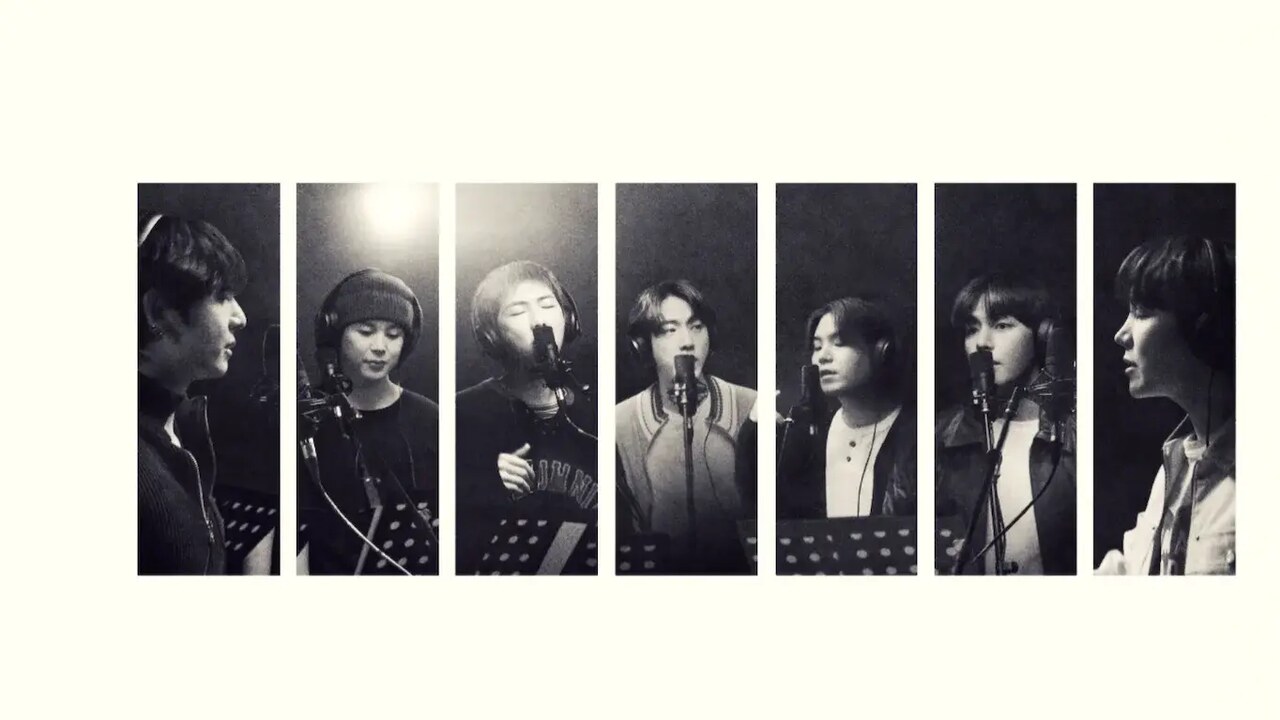
I went into BTS: The Return expecting a polished, celebratory documentary about one of the biggest bands in the world stepping back into the spotlight. What I got instead was something far more reflective and, at times, surprisingly restrained. This is not just a comeback film; it is a careful observation of a group in transition, figuring out how to exist again as a unit after years of distance, growth, and pressure.
The film opens with a quiet but symbolic reunion moment that immediately sets the tone. There is no rush into spectacle. Instead, the camera lingers on small interactions; hesitation, laughter, the slightly awkward rhythm of people reconnecting after time apart. From there, the narrative moves into their creative process in Los Angeles, where most of the album takes shape. The structure is fairly linear, following studio sessions, writing discussions, and the gradual development of ARIRANG, but it never feels rigid. The pacing allows conversations to breathe, which works in the film’s favor.
What stood out to me most is how intentionally the documentary avoids turning BTS into distant icons. Director Bao Nguyen clearly prioritizes proximity over scale. The camera is often static, observational, and unobtrusive, which gives the film a grounded quality. There are moments where members film themselves, adding a layer of authorship that makes the storytelling feel collaborative rather than imposed. This approach builds a sense of trust between the subjects and the audience, and it pays off in the more vulnerable sequences.
The creative tension within the group is one of the film’s strongest elements. There is a particularly memorable discussion around the track “Body to Body,” where RM, J-Hope, and V disagree on the direction of the song and how heavily it should lean into traditional Korean elements like “Arirang.” It is not dramatized, but it is not softened either. You see hesitation, disagreement, and eventual compromise. These moments give the film narrative weight without needing external conflict. It is simply about artists negotiating meaning.
Performance-wise, what’s fascinating is how distinct each member feels within the ensemble. RM comes across as deeply introspective, often carrying the burden of articulation. Jung Kook brings a kind of restless energy, especially when discussing the pace of production. Jimin and V offer emotional nuance in quieter ways, while Suga’s presence feels measured and analytical. Jin and J-Hope provide balance, often diffusing tension with humor or perspective. The film does not over-explain these dynamics; it trusts the viewer to pick up on them.
Technically, the documentary is clean and effective. The cinematography leans toward natural lighting and tight framing, which enhances the sense of immediacy. Studio spaces feel lived-in rather than staged. The editing is smooth, though occasionally it lingers longer than necessary on transitional beats. The soundtrack, unsurprisingly, is a highlight, not just because of the music itself, but because of how it is integrated into the storytelling. You hear songs in fragments as they evolve, which makes their final versions feel earned rather than presented.
What I appreciated most is the film’s willingness to sit with discomfort. There are discussions about burnout, creative fatigue, and the pressure of returning after such a long hiatus. At one point, the idea that even suggesting a break feels wrong is brought up, and it lands with weight. These are not framed as dramatic revelations but as ongoing realities. The documentary does not resolve these tensions neatly, and that honesty makes it more compelling. If you are expecting a comprehensive look at BTS’s entire journey or a deep dive into their past, you might find this somewhat narrow in scope. It is firmly focused on the present moment, which means the broader context is only lightly touched on. For newer viewers, some emotional beats might not land as strongly without prior familiarity.
There are also moments where the film feels slightly too controlled. Even though it aims for authenticity, you can sense the boundaries of what is being shown. Certain conflicts are introduced but not fully explored, and some transitions between emotional highs and lows feel a bit abrupt. I found myself wanting just a little more messiness, a little less polish in those instances.
The pacing, while generally effective, can feel uneven in the middle section. The repetition of studio scenes—writing, revising, discussing—starts to blur together slightly. While this accurately reflects the creative process, it does test patience at times. A tighter edit in that segment could have strengthened the overall flow without sacrificing depth. Despite these minor issues, the film succeeds in what it sets out to do. It captures a specific moment in BTS’s timeline with clarity and care. It is less about spectacle and more about process, less about performance and more about identity. By the time the documentary moves toward the album’s completion and the anticipation of their comeback performance, there is a quiet sense of progression rather than a dramatic payoff.
What stayed with me after watching is how grounded it feels. For a group of this scale, it would have been easy to lean into grandeur. Instead, BTS: The Return chooses intimacy. It shows seven individuals trying to align their personal growth with a shared legacy, and it does so without overstating its significance. In the end, this is a film that respects both its subjects and its audience. It trusts that the story of returning—of figuring things out again—does not need embellishment. It just needs to be observed. And for the most part, it is.
Final Score - [7/10]
Reviewed by - Anjali Sharma
Follow @AnjaliS54769166 on Twitter
Publisher at Midgard Times



Hi Everyone, after a due consideration, we have decided that we will be open for donations to help us in managing our website. We will be greatful for any kind of amount we receive. Thanks!
— Midgard Times 🎬 (@Moviesr_net) January 4, 2026
PayPal- [email protected] pic.twitter.com/DlNNz5Npm5
Get all latest content delivered to your email a few times a month.
Bringing Pop Culture News from Every Realm, Get All the Latest Movie, TV News, Reviews & Trailers
Got Any questions? Drop an email to [email protected]



 © Copyrights MOVIESR.NET All rights reserved