


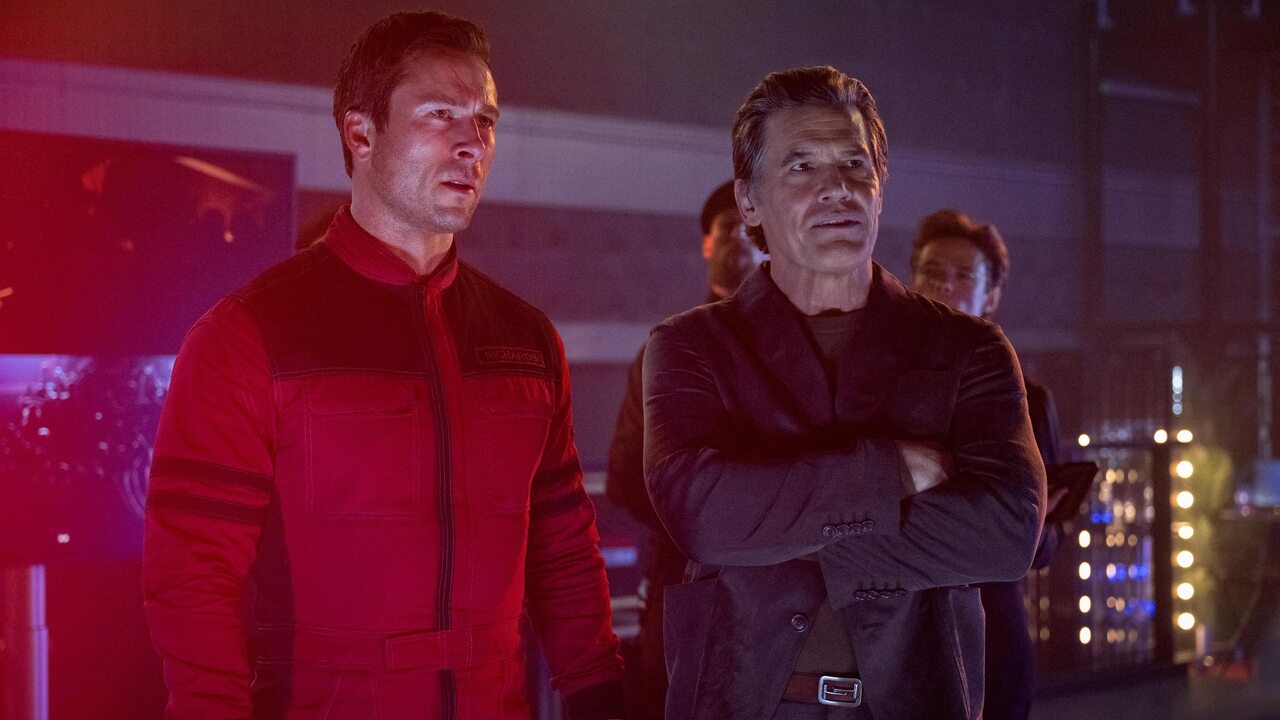
Steven Spielberg's Disclosure Day opens with a wrestling match in which the camera is placed inside the ring and then kicked, punched, and vigorously shaken by a wrestler, producing a jolting effect. It's the kind of trick that might have been effective had Disclosure Day been a 3D film—it would have been superficially pleasing. But given the current circumstances and the placement of such a shot at the beginning, what ends up being revealed is that all Spielberg can do as a director now is pump up his fans by behaving like a fake magician who's hired for birthday parties to entertain the kids. In terms of the narrative, there is no real reason why Disclosure Day should begin like this. However, as you continue watching the movie, an explanation emerges automatically: Spielberg wants to impress you with his technical skills because he doesn't have a handle on the story.
And so you are left admiring the reflections on the window of a moving car and neat tricks, such as grass in a field forming circles as if by magic. Still, nothing in Disclosure Day comes across as stunning or awe-inspiring. Every second of 1941 (Spielberg's best film) is more comically charged and astonishing than that scene in Disclosure Day where enemy soldiers, unable to see anything except an empty warehouse and a glowing object in the middle, keep bumping into a reconstructed house and a fire engine. Even Spielberg's directorial debut, The Sugarland Express, has better car scenes than anything you see in this film. The Spielberg of Disclosure Day seems like a hack trying to capture Spielbergian magic. Or perhaps he's simply a 79-year-old director feeling nostalgic for the vigor and technical mastery he once brought to his movies as a young filmmaker newly arrived on the scene.
The Spielberg of Disclosure Day certainly looks his age. He feels old and fatigued. When Daniel (Josh O'Connor) and Margaret (Emily Blunt) crash into a moving train and have to jump onto it before being crushed by another train, you don't experience an adrenaline rush or lean forward in your seat, nervous about Daniel and Margaret's fate. The young Spielberg would have made a meal out of this sequence; he would have injected it with suspense and genuine high-stakes excitement. But the Spielberg of today shoots it weakly and without tension. Not a single soul in the theater thinks the two characters are going to get hit by the train. It's the sort of predictability you would never expect from a filmmaker of Spielberg's stature. Spielberg reportedly was inspired by the 2017 article "Glowing Auras and 'Black Money': The Pentagon's Mysterious U.F.O. Program," published in The New York Times, and while it rekindled his interest in UFOs, it fails to evoke the passions and energies of the filmmaker who once made E.T. the Extra-Terrestrial.
Is this why the aliens in Disclosure Day not only have an unimaginative design but are also displayed without a hint of wonder, curiosity, or exaltation? The aliens resemble the extraterrestrial creatures that five-year-old kids draw in their notebooks or imagine after watching, say, Koi... Mil Gaya on TV. Their figure, their form, is such a massive cliché that it's hardly surprising Spielberg chose not to reveal them in the trailers. When you finally see them in the film, part of you wonders whether Spielberg is attempting to make a parody of E.T. You want to laugh, but the sentimentally sweet tone wants you to be moved and ecstatic. Spielberg does get the mood right; you sense someone or something striving to move you emotionally. But the entire scene is shaky because nothing that comes before it supports it or gradually leads you toward that mood of grand ethereality. Disclosure Day consistently remains unconvincing. It's also incredibly unengaging, unstimulating, and rather uncreative, given that it relies on a telepathic device to keep the plot wheels spinning. The villain, played by Colin Firth, uses it to trace his targets—until he surrenders without much of a fight, rendering the device little more than a convenient mechanism for the director to move forward his story.
What makes Margaret and Daniel special? Why were they chosen by these higher-intelligence beings? Were they selected at random? Did the aliens somehow know they would grow up to become Emily Blunt and Josh O'Connor—that is, conventionally attractive leads? Blunt and O'Connor are good actors, but Spielberg does nothing especially memorable with them. He uses them blandly, adequately. Why, he even neuters the fierceness of an actor like Eve Hewson, who can take the screen by storm with her sharp, volatile presence and wit (watch her in Bad Sisters). I think the main issue with Disclosure Day is that Spielberg simply doesn't have a strong story—or even a good one. In Spielberg's world, the public is dumbfounded when it hears on the news that aliens exist. The spectacle in the archival footage and the sight of an alien encountering humans up close leave people speechless and teary-eyed. This may be Spielberg asking you to be in awe of him because he can still stage spectacles like the train-collision scene—albeit badly. It should not come as a surprise, then, that during the film's final moments, a frail old alien whispers something into Daniel's ear, who in turn whispers something into Margaret's ear. Margaret then stands in front of the camera and says, "Listen." Listen to what? The movie cuts to black, and the end credits begin rolling. Take this as a confession from Spielberg, an indication that he has nothing left to say to his fans, his audience, or the public. That may be why Disclosure Day feels so empty and devoid of an authoritative voice.
Perhaps the point of Disclosure Day is to disclose that Spielberg no longer possesses the passion or excitement required to tell stories. The movie may be his way of signaling that retirement is on his mind. What's more, given how the early reviews from Cannes called Disclosure Day Spielberg's best film to date, what the movie ultimately discloses is that film festivals should be populated not by hype-generating influencers but by real movie critics. Disclosure Day can be the best Spielberg film only for people who have watched two or three Spielberg films or for those so enamored of his image that they are willing to swallow anything. The movie is staid from the beginning, and it drags through rough patches that appear mainly whenever characters deliver exposition, whenever they speak. Disclosure Day is almost excruciating. It bored me out of my mind.
Final Score - [2.5/10]
Reviewed by - Vikas Yadav
Follow @vikasonorous on Twitter
Publisher at Midgard Times



Hi Everyone, after a due consideration, we have decided that we will be open for donations to help us in managing our website. We will be greatful for any kind of amount we receive. Thanks!
— Midgard Times 🎬 (@Moviesr_net) January 4, 2026
PayPal- [email protected] pic.twitter.com/DlNNz5Npm5
Get all latest content delivered to your email a few times a month.
Bringing Pop Culture News from Every Realm, Get All the Latest Movie, TV News, Reviews & Trailers
Got Any questions? Drop an email to [email protected]



 © Copyrights MOVIESR.NET All rights reserved