

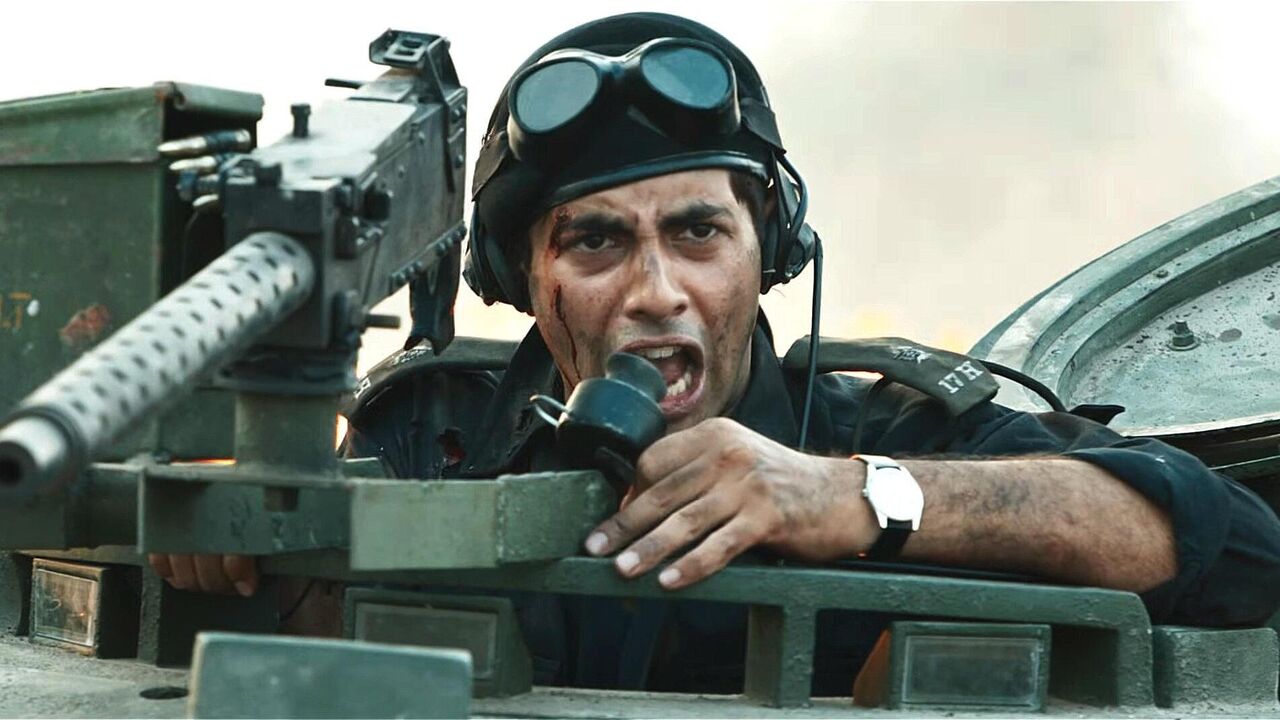
In Richard Linklater's Nouvelle Vague, Jean-Luc Godard (Guillaume Marbeck) says something to the effect that the best way to criticize a film is to make one yourself. With Ikkis, Sriram Raghavan does precisely that. He criticizes war movies for painting a rosy picture of war and violence. Through Second Lieutenant Arun Khetarpal (Agastya Nanda), Raghavan reveals how young people are brainwashed by pretty ideas about death, blood, and big metallic weapons—ideas nurtured by their glorification in cinema and literature. Arun is fascinated by battlefield action and screams like an overexcited kid whenever he sees tanks on screen. His notions of patriotism, then, are weak, borrowed, and sensational. When Arun informs his mother (Suhasini Mulay) that he has been called to fight in the war, he does so with utmost eagerness.
Ikkis is about how that smile disappears when Arun comes close to real bloodshed—when he witnesses firsthand the deaths of his friends and comrades. Arun, a stickler for rules, rats on one of his own teammates for smuggling alcohol into the academy. The same Arun, however, loses his sense of morality when he comes face-to-face with the beheading of an animal. If fictional violence once gave him a high, real violence leaves him paralyzed.
It's commendable that Raghavan doesn't succumb to the great aura of his subject. Instead of presenting Arun as a saint, he makes him a flawed human being. Here is a boy—a leader—who doesn't think twice before submitting a complaint against a teammate for drinking beer. But the same boy, the same leader, also doesn't think twice before breaking the rules to meet Kiran (Simar Bhatia), his girlfriend. Arun might be a dedicated soldier, but he is also a boy with hormonal urges—urges that Raghavan censors, sanitizes, and repackages as a neutered, old-school romance (all we get is a kiss that lasts a few seconds).
Raghavan is surely a forward-looking filmmaker, but perhaps due to the story's setting, he works within an aesthetic that feels backward. His frames have a warm, soft glow, yet what's missing is obsession—madness. With the help of cinematographer Anil Mehta, Raghavan produces clean, clear images. These images, however, remain plain and merely keep the action on the surface. Raghavan can be labeled a veteran of the thriller genre, a filmmaker who delights in playing with the audience through breathtaking twists and tight suspense. Badlapur, though, was a glorious exception—such a high point in his career that he has never again managed to reach that peak of excellence (at least, not yet).
Even a minor Raghavan, however, is a watchable Raghavan—within the confines of a crime thriller. Things become puzzling when the same filmmaker applies his thriller tricks to the format of a war drama. Ikkis, too, is a suspense story, told through characters who function more like marionettes than flesh-and-blood humans. Brigadier Jaan Mohammad Nisar (Jaideep Ahlawat) has something to say to M. L. Khetarpal (Dharmendra), Arun's father, but he withholds it until the very end—both because his family urges him to remain silent and because the plot demands it. His thoughts aren't difficult to guess, though one isn't sure whether this feeble "suspense" is intentional.
Arun and Kiran are in love, but their relationship is marked by superficial exchanges. They read books and watch films together, and all this activity yields only one insight: Arun loves violence. Did they ever watch a thriller or a romance in a theater? Did Simran suggest anything beyond a Hemingway novel? Raghavan doesn't bother finding out, nor does he allow them the space for intellectual conversation. Simran may be a devoted bookworm who has read great novels, but for Raghavan, she is little more than a pretty figure who helps Arun see his blind spots and nudges him to open up to his friends and teammates. Her inner life and professional ambitions are treated as footnotes—an omission that suggests Arun himself never cared to have deep personal conversations with his girlfriend.
What this also reveals is that Raghavan has created shallow characters whose sole purpose is to satisfy the logic of a rigid narrative schema. The non-linear structure exists merely to preserve the central suspense—Mohammad Nisar's confession. Even this device feels ornamental. It is so flimsy that, without it, the entire film would collapse, exposing a story whose substance is largely informational. Raghavan doesn't paint his scenes with strokes of drama; he flips through them in a brisk manner. The romance is established through brief, flirty, unimaginative exchanges. Arun's conflict with his roommates at the academy is resolved within minutes, his isolation never allowed to linger. Sikandar Kher's character tells Arun that he must earn the trust of his tank crew, yet the bonding happens instantly—without friction, debate, or tension. Even Arun and Simran's meeting and breakup simply… happen. Raghavan's filmmaking here follows a flat logic: This happened, then this happened, then this happened.
Of course, the non-linear structure is justified by the claim that Ikkis is a film about memory and recollection. There is, however, only one scene that truly does justice to this idea. It's the moment when Mohammad Nisar recalls an old experience and points out that a river once wasn't there. This is followed by shots of rustling leaves—images that lend his words the weight of a nostalgic afternoon memory. What Raghavan conjures in this brief stretch is so evocative that its absence elsewhere becomes all the more disappointing.
Raghavan, alas, is so preoccupied with being a paragon of peace that he forgets to be a brilliant filmmaker. In the present-day sections, he repeatedly emphasizes that not all Pakistanis are bad, that they celebrate, listen to music, and welcome guests with warmth and affection. Nisar's family, after some initial reluctance (the wife [Ekavali Khanna] suggests that Khetarpal stay in a hotel), embraces their Indian guest. The same generosity is extended by the people now living in Khetarpal's former Pakistani mansion. Raghavan doesn't seem to trust these scenes to communicate his point, which is why he inserts a ridiculous confrontation involving Deepak Dobriyal's character. The scene spells out the film's intentions in blunt terms, no different from the in-your-face dialogue that underlines everything Raghavan wants to say.
Dharmendra's Khetarpal ultimately functions as Raghavan's mouthpiece. When Nisar remarks that Arun charged ahead to defeat his enemies, Khetarpal politely asks, "Kaun dushman?" At this moment, the 62-year-old director metaphorically places one hand on his heart, holds a microphone in the other, and declares: War is terrible, and not all Pakistanis are bad. It's a well-intentioned, necessary, yet utterly banal argument—one that almost guarantees critical acclaim. Critics are unlikely to ask what, exactly, they are celebrating. It won't matter to them that Raghavan, by refusing to give voice to Arun's inner conflict on the battlefield, plays it exceedingly safe.
As bodies pile up and the rose-tinted view of violence collapses, Arun's face grows less enthusiastic and more somber. He begins—perhaps—to question his inherited notions of patriotism. I say "perhaps" because Raghavan has no interest in articulating this change. What does Arun now believe? Does he confide his confusion, his doubts about the futility of destruction, to anyone? All we get is a stray comment from Arun, who asks whether the war is really over after a radio station announces a ceasefire.
If Arun did undergo any transformation, Raghavan promptly undoes it in the climax. The Arun who emerges victorious is the original Arun—the one who enjoys violence, who thrills at hitting targets with his tank. The Param Vir Chakra is awarded not to a conflicted young man but to the same boy who adored war movies and internalized their vision of the "enemy." "No, sir, I will not abandon my tank. My main gun is still working, and I will get these bastards," he declares in his final moments.
Ikkis, then, is a film at war with itself. Raghavan has one foot in each boat, trying to appeal to everyone—and ends up nowhere. For most of its runtime, the film depicts war as routine carnage, filled with casualties and corpses. But in the end, Raghavan gives in to temptation (or perhaps to the demands of the mass audience) and stylizes violence with a slow-motion shot of a missile piercing Arun's tank. There is no other way to read Ikkis than as a joke on the left wing and pseudo-liberals—those who will be blinded by the glow of a thin, well-meaning peace message.
What Ikkis ultimately demonstrates is that one should never seek role models in popcorn, mainstream-pandering filmmakers—those who urge you, in trailers, to "gift yourself courage," only to conclude their films with absurd disclaimers that thoroughly undermine their own intentions.
Final Score- [4/10]
Reviewed by - Vikas Yadav
Follow @vikasonorous on Twitter
Publisher at Midgard Times




Hi Everyone, after a due consideration, we have decided that we will be open for donations to help us in managing our website. We will be greatful for any kind of amount we receive. Thanks!
— Midgard Times 🎬 (@Moviesr_net) January 4, 2026
PayPal- [email protected] pic.twitter.com/DlNNz5Npm5
Get all latest content delivered to your email a few times a month.
Bringing Pop Culture News from Every Realm, Get All the Latest Movie, TV News, Reviews & Trailers
Got Any questions? Drop an email to [email protected]



 © Copyrights MOVIESR.NET All rights reserved