

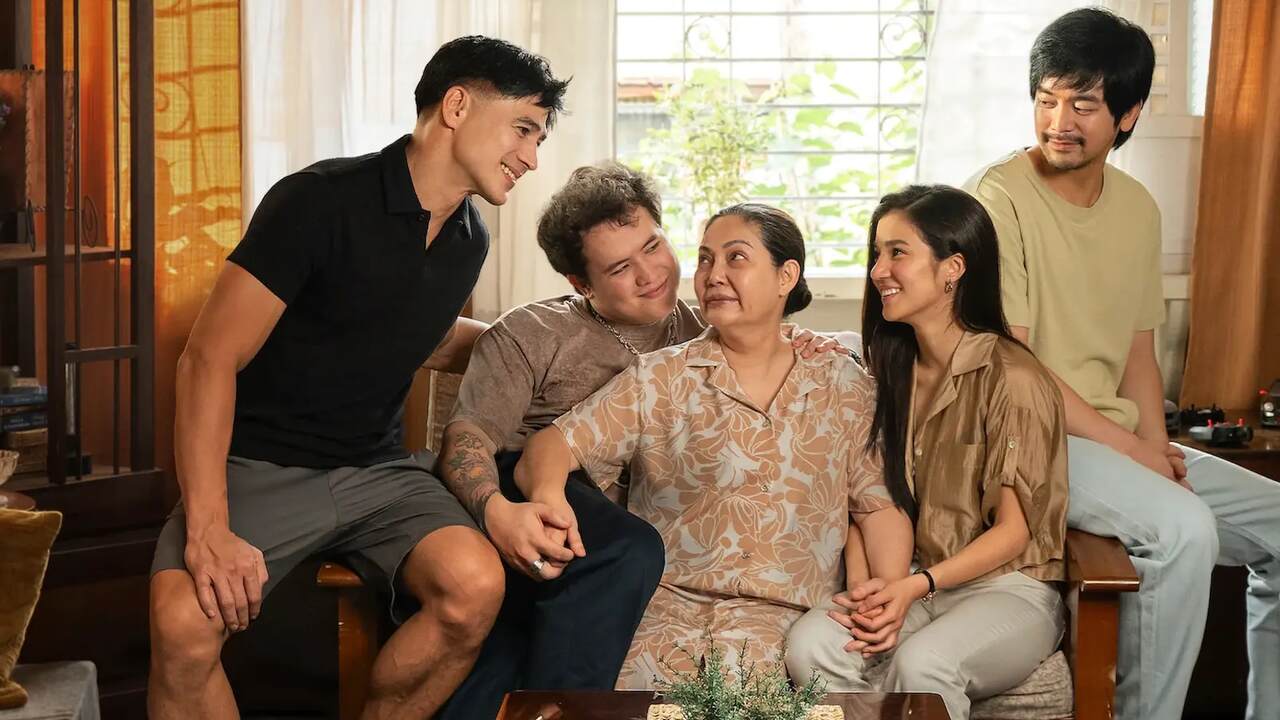
I went into Meet, Greet, & Bye expecting a familiar Filipino family drama, and in many ways it delivers exactly that. Directed by Cathy Garcia-Sampana and led by a cast that blends veteran presence with younger stars, the film leans heavily on emotional storytelling, intergenerational conflict, and the messy intimacy that comes from being part of a family that loves each other but struggles to communicate. What surprised me most wasn’t the plot itself, which is straightforward, but how the film balances sincerity with moments of quiet humor and realism, preventing it from feeling too heavy for its own good.
The central premise is simple but effective: Baby Lopez-Facundo, played by Maricel Soriano, has lost hope after her diagnosis and refuses chemotherapy, choosing instead to focus on one last wish—meeting a Korean celebrity she admires. Her four children, each carrying different emotional baggage, reluctantly agree to help organize the meeting, but only if she promises to continue treatment afterward. This setup creates a ticking clock narrative that keeps the pacing focused, even when the film drifts into longer emotional exchanges.
Maricel Soriano anchors the entire film with a performance that feels lived-in rather than theatrical. She plays Baby not as a saintly matriarch but as someone stubborn, tired, and occasionally frustrating, which makes the character feel authentic. There are scenes where she leans into humor through her K-drama obsession, which softens what could have been a relentlessly sad storyline. I appreciated how the film allows her to be flawed, especially in scenes where she challenges her children’s attempts to control her decisions about her own health.
Piolo Pascual’s Tupe, the eldest sibling, represents the voice of rationality in the family, often clashing with Brad, played by Joshua Garcia, whose desperation leads him toward alternative solutions that blur the line between hope and denial. Their dynamic provides some of the strongest dramatic tension in the film. Garcia’s performance stands out because he avoids turning Brad into a purely emotional stereotype; instead, he conveys the quiet panic of someone who feels powerless. Belle Mariano’s Geri Ann offers a more grounded perspective, often acting as the emotional mediator, while Juan Karlos Labajo’s Leo brings energy and vulnerability, though I found his character slightly underdeveloped compared to the others.
The script does a solid job building sibling relationships through dialogue that feels conversational rather than overly polished. Some confrontations unfold in long, uninterrupted scenes, which allows the actors to breathe and gives the audience time to absorb the emotional stakes. However, the writing occasionally leans into familiar tropes of the genre. A few conflicts feel predictable, especially if you’ve watched other Star Cinema family dramas, and there are moments where the emotional beats arrive exactly when you expect them.
Visually, the film is more restrained than I anticipated. Dan Villegas’s cinematography keeps the focus on faces and domestic spaces, using close framing to highlight the characters’ reactions rather than relying on dramatic camera movement. The Manila settings feel grounded, and the scenes involving fan events and public spaces add a sense of scale that contrasts nicely with the intimacy of the family’s home life. The editing maintains a steady rhythm, though I did feel that some transitions between comedic and serious scenes could have been smoother.
One aspect I genuinely enjoyed was how the story explores the ethical tension around medical decisions without turning it into a lecture. The children’s attempts to persuade their mother create layered conversations about autonomy, fear, and the desire to hold onto someone longer than they may want to be held onto. These discussions give the film emotional weight beyond the basic “last wish” narrative. That said, the pacing slows slightly in the middle act, where a few subplots involving side characters and romantic hints don’t feel as essential to the main storyline.
The cameo involving a Korean celebrity is handled with surprising restraint. Instead of turning it into a gimmick, the film treats the meeting as a catalyst for emotional closure rather than a spectacle. I appreciated this choice because it keeps the focus on the family’s internal journey rather than external fan service. The music, meanwhile, supports the emotional tone without overpowering scenes, though at times it feels a bit too eager to signal when the audience should cry.
Where the film occasionally struggles is in balancing all four siblings equally. While Brad and Tupe receive strong arcs, Geri Ann and Leo sometimes feel like they exist to reinforce the central conflict rather than evolve independently. A few dramatic reveals land effectively, but others feel slightly rushed, as if the film wants to wrap up emotional threads quickly before the runtime runs out. I also found certain dialogue exchanges overly explanatory, particularly when characters verbalize feelings that were already clear through performance.
Despite these issues, the film remains engaging because it understands its audience. It doesn’t try to reinvent the genre; instead, it refines familiar elements with strong performances and emotional clarity. Garcia-Sampana’s direction emphasizes sincerity over spectacle, allowing the actors to carry the narrative. Even when the story dips into melodrama, it rarely feels insincere, largely because the cast commits fully to the emotional stakes.
By the time the story reaches its final act, I felt the film had earned its emotional payoff. The resolution avoids feeling overly neat, acknowledging that family conflicts don’t disappear simply because a major event forces reconciliation. The ending left me reflecting on how the film frames love not as grand gestures but as persistence—the willingness to show up, argue, forgive, and stay present even when outcomes are uncertain.
Overall, Meet, Greet, & Bye is a heartfelt family drama that succeeds more often than it stumbles. It relies heavily on performance and emotional dialogue rather than narrative surprises, which may not appeal to viewers looking for something structurally innovative. Still, its sincerity, strong acting ensemble, and grounded exploration of family dynamics make it a compelling watch. I finished the film feeling emotionally drained in a good way, the kind of quiet exhaustion that comes from spending time with characters who feel imperfect, real, and deeply human.
Final Score- [7/10]
Reviewed by - Anjali Sharma
Follow @AnjaliS54769166 on Twitter
Publisher at Midgard Times




Hi Everyone, after a due consideration, we have decided that we will be open for donations to help us in managing our website. We will be greatful for any kind of amount we receive. Thanks!
— Midgard Times 🎬 (@Moviesr_net) January 4, 2026
PayPal- [email protected] pic.twitter.com/DlNNz5Npm5
Get all latest content delivered to your email a few times a month.
Bringing Pop Culture News from Every Realm, Get All the Latest Movie, TV News, Reviews & Trailers
Got Any questions? Drop an email to [email protected]



 © Copyrights MOVIESR.NET All rights reserved