

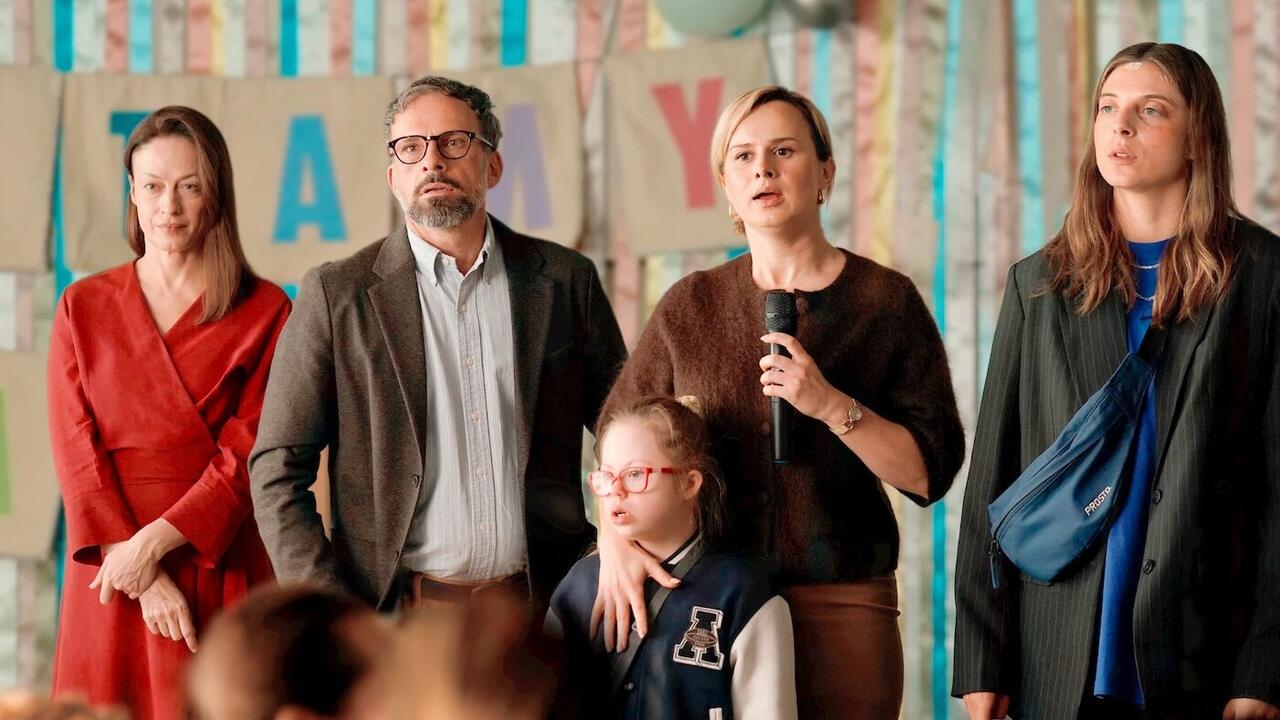
What I really liked about the first season of The Mothers of Penguins (aka Matki Pingwinów) was how effectively it captured the daily stresses of parents trying to raise children who require special attention. The focus wasn't limited to parents, though. The show also demonstrated how difficult it can be for teachers to educate children who struggle to sustain their attention and behave like little, dynamic balls of chaos. That same hectic atmosphere returns in the second season, which once again reminds us that parenting is no easy job. Parenthood demands all your energy and effort, both physical and mental, which is why so many parents appear perpetually exhausted. Raising a child without special needs is already demanding. Now imagine what parents of children with special needs go through as they juggle their family responsibilities and professional lives. Anyone who looks at children through a romantic, dreamy lens and speaks of them in superficially sweet terms should watch this show. It's quite possible that it will leave them disillusioned.
This doesn't mean that The Mothers of Penguins is akin to a memorandum advising people never to have children. Rather, it offers as realistic a depiction of parenthood as possible, giving viewers a sense of what they're signing up for when they decide to have a child. Having a child isn't a hobby, nor is it a fashion statement to be made simply because everyone around you is doing it. It's commendable that the series doesn't shy away from showing its adult characters growing irritated with their children, including those with special needs. No one is portrayed as a saint. These are human beings who, despite their best efforts, sometimes break down under the immense demands their children place on them. Paweł (Mateusz Damięcki) shows little patience for his daughter's cat-like behavior, while Jerzy (Tomasz Tyndyk), visibly frustrated, tells his daughter to express herself in words.
The children, too, are portrayed as mischievous pranksters, and their pranks sometimes turn cruel. A boy and a girl record one of their classmates screaming with joy and edit the footage into something sexual. At her previous school, another girl is bullied by her classmates, who record her while forcing her to act like an animal. The Mothers of Penguins is one of the few shows willing to depict the mean-spiritedness that children can display, whether intentionally or otherwise. It recognizes that they are capable of cruelty and doesn't shy away from showing their hurtful actions or the consequences that follow. This makes for a welcome change from the kiddish cuteness that pervades so much other media. At the same time, the series doesn't portray the children as inherently evil. Their behavior is shaped, at least in part, by their environments: they encounter bullies, receive inadequate attention from their parents, or find themselves caught up in family complications beyond their control.
Having said that, I must admit that these elements felt fresh and interesting in the first season. Repeated here, they no longer absorb you with the same fervor. Yes, we understand that raising a child is no laughing matter. But what comes next? Why aren't the other storylines given more room to develop? Kamila (Masza Wągrocka) has a health condition that threatens her MMA career. Ula (Barbara Wypych) has started dating Kamila's father (Mirosław Zbrojewicz). Jerzy's partner tells him that they need to move into a bigger apartment. Meanwhile, Tatiana (Magdalena Różczka) tries to reclaim her independence by meeting new people. Yet none of these storylines detonates on screen with anything approaching the impact of the series' central concerns: raising, teaching, and caring for children. The latter dominates the show so thoroughly that it drowns out the dramatic potential of everything else.
When Tatiana's lover and her husband come face-to-face, the encounter lacks the heated quarrels one might expect, and the scene never develops any real hostility or resentment. Franek (Maksymilian Obst), Ula's son, blackmails her by threatening to reveal her affair to his father. Only later does another character suggest that Franek might be acting out because Ula devotes so much of her attention to her daughter, who has Down syndrome. Yet the series resolves the issue, along with Franek's broader behavioral problems, rather perfunctorily. Ula sits down to talk to him, but the conversation is brief and barely addresses his actions. The result is a feeling that the show has handed us a parenting manual complete with bullet points and practical tips. Nothing in the second season feels sufficiently dramatized or creatively charged. Even Kamila's medical condition and her final decision in the ring fail to deliver much emotional impact. Much of the show, alas, seems dutiful, as though it's merely going through the motions. What lingers is a vague aftertaste of chaos and exhaustion, which itself begins to resemble a lesson in parenting: children can be a chore to look after.
This is why the second season is easier to admire from a distance for what it attempts than to embrace for what it ultimately achieves. It's good to see these children playing video games, navigating the early stages of romance and heartbreak, singing songs, and getting excited about the announcement of a martial arts class. It's also intriguing, if somewhat uncomfortable, that the show suggests Michał (Maksymilian Młodawski) might have developed an interest in pornography after seeing his mother half-naked, although the idea is quickly brushed aside and abandoned. Still, the season is more content to reduce subjects such as parental controls, pornography, and sex education to talking points for parents than to use them as starting points for a series with a broader tonal range, fully developed implications, and a palpable dramatic charge. It's not a bad season, but at times it feels overly tailored to a particular audience, prioritizing relatability and online discourse over dramatic depth. This may explain why watching it feels less like experiencing a story told with conviction than watching a show simply do its job, without much force or vigor. Sure, raising children can be stressful; it can feel like a chore. But that doesn't mean a show about parenting must also feel like...a chore.
Final Score - [5.5/10]
Reviewed by - Vikas Yadav
Follow @vikasonorous on Twitter
Publisher at Midgard Times





Hi Everyone, after a due consideration, we have decided that we will be open for donations to help us in managing our website. We will be greatful for any kind of amount we receive. Thanks!
— Midgard Times 🎬 (@Moviesr_net) January 4, 2026
PayPal- [email protected] pic.twitter.com/DlNNz5Npm5
Get all latest content delivered to your email a few times a month.
Bringing Pop Culture News from Every Realm, Get All the Latest Movie, TV News, Reviews & Trailers
Got Any questions? Drop an email to [email protected]


 © Copyrights MOVIESR.NET All rights reserved