

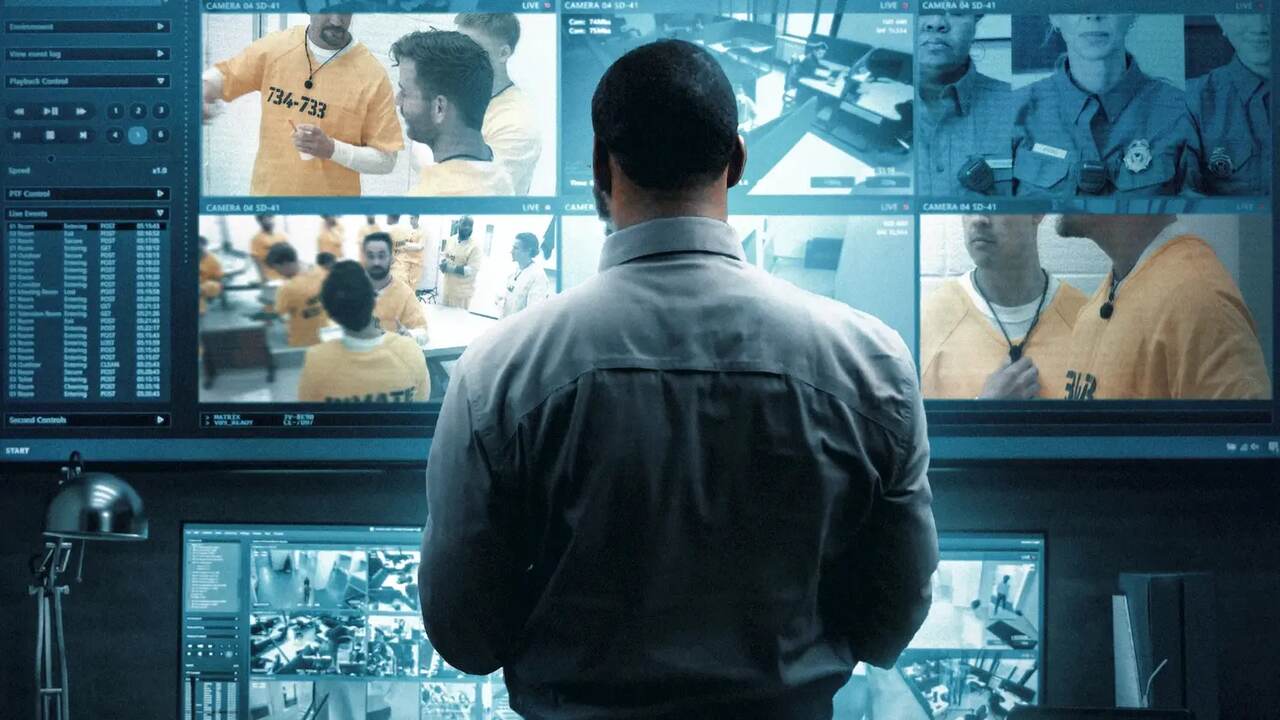
The New Stanford Prison Experiment revisits one of psychology’s most controversial studies. Inspired by the infamous 1971 Stanford Prison Experiment, the show explored how ordinary people respond when authority, control, and personal freedom become a part of social hierarchy. The original Stanford Prison Experiment, led by Philip Zimbardo, made an attempt to examine how people behaved when assigned the role of prisoners and guards. What was initially supposed to last two weeks ended just after six days as the treatment of participants started to raise some serious ethical concerns. Decades later, the study continues to remain controversial, with questions being raised about the methodology used and the influence of researchers complicating its conclusions. For The New Stanford Prison Experiment, the makers reimagine the attempts to revisit these questions with a new group of participants and a different approach.
This time around, 30 volunteers enter a real prison in Georgia, where they are divided into guards and inmates. Unlike the original study that involved college students, the new participants come from different types of backgrounds. This means that they bring their own experiences and motivations to the whole setup. Some see the experiment as an opportunity to challenge themselves, while others appear interested in testing their limits or discovering how they respond to authority.
The setting of the prison immediately establishes an atmosphere of discomfort and uncertainty. Guards receive positions of authority while the inmates must navigate restrictions and decisions made by others. That arrangement creates opportunities for tensions, disagreements, and shifting alliances, particularly when participants begin questioning the fairness of rules. The roles are also reversed between the guards and the inmates so that each party can know and feel what the other side looks like.
In all fairness, The New Stanford Prison Experiment feels more like any other reality show rather than an attempt to revisit the study. After a point, there is hardly any difference between the show and the basic format of reality shows that we often get to watch. The drama, the bending and violations of the rules, etc., all feel the same. Somewhere between showcasing the study and this, the core theme of the study is lost. Just like any other reality show, the participants know that they are being filmed, and this impacts how they behave in front of the camera. Some appear to be unaffected by the fact that there is a camera, while some appear to be giving a performance in front of it. Because the environment is artificial in spite of the realistic setting, the behavior we get cannot easily establish universal conclusions about power, authority, or the psychology behind incarceration.
The biggest challenge apart from what is discussed above comes with pacing. The New Stanford Prison Experiment witnesses a highly uneven pacing. Some episodes are fast while some are awfully slow. That breaks the momentum of your watching.
For those of you who are interested in watching social experiments and human behavior, The New Stanford Prison Experiment offers some really good thought-provoking moments. However, those expecting anything groundbreaking should simply avoid watching it as it can prove to be not that worth the expectations you will set. Some questions are still left unanswered, and if, as viewers, you like psychology, then you will be left deeply unsatisfied with the result of this show. The research might feel incomplete, and the attempt to recreate something from the past fails miserably here. Hence, watch at your own risk.
Final Score - [5/10]
Reviewed by - Neerja Ch
Follow @NeerjaCH on Twitter
Publisher at Midgard Times


Hi Everyone, after a due consideration, we have decided that we will be open for donations to help us in managing our website. We will be greatful for any kind of amount we receive. Thanks!
— Midgard Times 🎬 (@Moviesr_net) January 4, 2026
PayPal- [email protected] pic.twitter.com/DlNNz5Npm5
Get all latest content delivered to your email a few times a month.
Bringing Pop Culture News from Every Realm, Get All the Latest Movie, TV News, Reviews & Trailers
Got Any questions? Drop an email to [email protected]



 © Copyrights MOVIESR.NET All rights reserved