

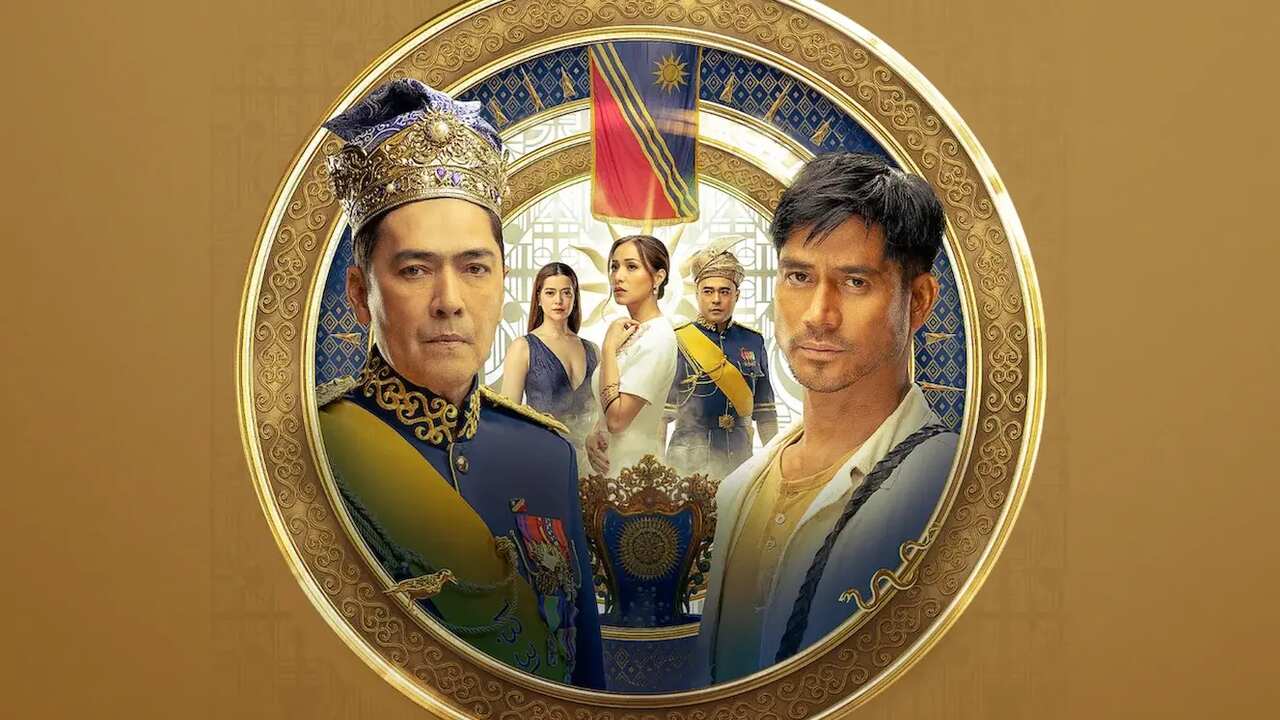
Watching The Kingdom feels like witnessing Filipino cinema confidently say, “What if we just went for it?” And then actually going for it. Hard. This is a movie with ambition pouring out of every frame, sometimes elegantly, sometimes messily, and sometimes like it tripped over its own royal cape but stood back up pretending nothing happened. I enjoyed it. I also rolled my eyes, often within the same scene.
The premise alone deserves credit. An alternate Philippines that was never colonized, governed instead by a monarchy with its own political systems, internal conflicts, and cultural continuity, is a bold narrative choice. It immediately signals that this is not a small, safe story. The film builds its fictional Kingdom of Kalayaan with confidence, presenting a world that feels structured, ceremonial, and deeply hierarchical. There is power in the idea that history took a different turn, and the film clearly wants you to sit with that idea, admire it, and maybe even argue with it a little.
At the center of this kingdom is Lakan Makisig, an aging ruler contemplating succession. He is calm, reflective, and burdened by the consequences of past decisions, which is refreshing because the movie does not try to turn him into a cartoon king. He feels human, restrained, and quietly tired in a way that makes sense. His children, however, are where the drama really kicks in. The heir, Magat Bagwis, carries the emotional weight of expectation like it’s welded to his spine. He’s intense, serious, and visibly shaped by the pressure of legacy. Dayang Matimyas, the daughter with unresolved romantic and political entanglements, adds emotional friction, while Dayang Lualhati, the youngest, becomes the narrative catalyst when her impending marriage and sudden kidnapping throw the entire kingdom into crisis.
The kidnapping plot could have easily felt like a cheap device, but here it works mostly because it forces multiple storylines to collide. Political rebellion, family loyalty, and questions of national identity all get stirred into the same pot. Enter Sulo, a former outcast pulled back into the heart of the kingdom’s affairs. His arc is one of the stronger elements of the film. He represents the uncomfortable truth that power structures often rely on the very people they marginalize. His journey is not flashy, but it is emotionally grounded, and it gives the story a needed counterbalance to all the palace politics.
Visually, the movie is impressive. The production design clearly had money, time, and intent behind it. Costumes are detailed without feeling gimmicky, and the architecture of Kalayaan looks intentionally designed rather than generically “royal.” The cinematography knows when to go wide and when to sit still, which helps sell the scale of the kingdom without drowning the characters in spectacle. There are moments where the film genuinely looks stunning, especially when it leans into ceremony and public rituals. You can feel the filmmakers wanting to show pride in what they’ve built, and honestly, they should.
That said, the movie also wants to do everything. And I mean everything. Political thriller. Family drama. Action rescue. Romantic tension. Commentary on nationalism. A bit of philosophical reflection on leadership. Sometimes it works. Sometimes it feels like the script is nervously checking a list and saying, “Did we cover this yet?” The result is a narrative that occasionally feels overstuffed. Certain scenes linger longer than they need to, while others rush through moments that deserved more breathing room.
Pacing is the film’s most noticeable weakness. At over two hours, it’s not excessively long, but it is uneven. There are stretches where the story moves with confidence and urgency, especially during confrontations and action sequences. Then there are quieter political discussions that repeat ideas we already understand, just with different characters standing in slightly different rooms. These moments aren’t bad, but they test your patience. You can feel where a tighter edit would have sharpened the impact.
There’s also an interesting but slightly distracting tension in how the film handles its alternate history. While the premise insists on a non-colonized Philippines, certain cultural and linguistic choices still feel very familiar in ways that raise questions. It’s not that the film is wrong for doing this, but it does break immersion if you think about it too hard. The world feels imagined, but not always fully reimagined. This is one of those issues that won’t bother everyone, but if you’re paying close attention, it nags.
Performance-wise, the cast largely delivers. The acting is serious without tipping into melodrama, which is not easy in a story full of royal titles and dramatic declarations. Some supporting characters could have used more development, as a few of them feel introduced with importance only to fade into the background later. It’s clear the film is setting up a larger universe, possibly even testing the waters for future installments, and that sometimes comes at the cost of fully resolving secondary arcs.
One slightly amusing frustration is how technology is handled. The film exists in a space that is modern enough to recognize but old-fashioned enough to conveniently avoid instant communication when the plot needs tension. This leads to a few moments where you quietly think, “Surely someone could have solved this faster,” but the movie just keeps moving and hopes you won’t question it. It’s not a fatal flaw, but it does feel like narrative convenience wearing traditional clothing.
Despite all this, I genuinely enjoyed watching The Kingdom. It is earnest, ambitious, and clearly made by people who believe in the story they’re telling. Even its flaws come from trying too hard rather than not caring enough, which is a much better problem to have. The humor, when it appears, is subtle and character-based, and the emotional beats mostly land without manipulation.
By the end, I didn’t feel exhausted or annoyed. I felt intrigued. I wanted to see more of this world, even if I wanted it to be a little more disciplined next time. The Kingdom may stumble, but it stumbles forward, not sideways. It’s a film that invites discussion, disagreement, and curiosity, and in a cinematic landscape that often plays it safe, that alone feels like a small victory.
Final Score- [7/10]
Reviewed by - Anjali Sharma
Follow @AnjaliS54769166 on Twitter
Publisher at Midgard Times
Hi Everyone, after a due consideration, we have decided that we will be open for donations to help us in managing our website. We will be greatful for any kind of amount we receive. Thanks!
— Midgard Times 🎬 (@Moviesr_net) January 4, 2026
PayPal- [email protected] pic.twitter.com/DlNNz5Npm5
Get all latest content delivered to your email a few times a month.
Bringing Pop Culture News from Every Realm, Get All the Latest Movie, TV News, Reviews & Trailers
Got Any questions? Drop an email to [email protected]


 © Copyrights MOVIESR.NET All rights reserved