

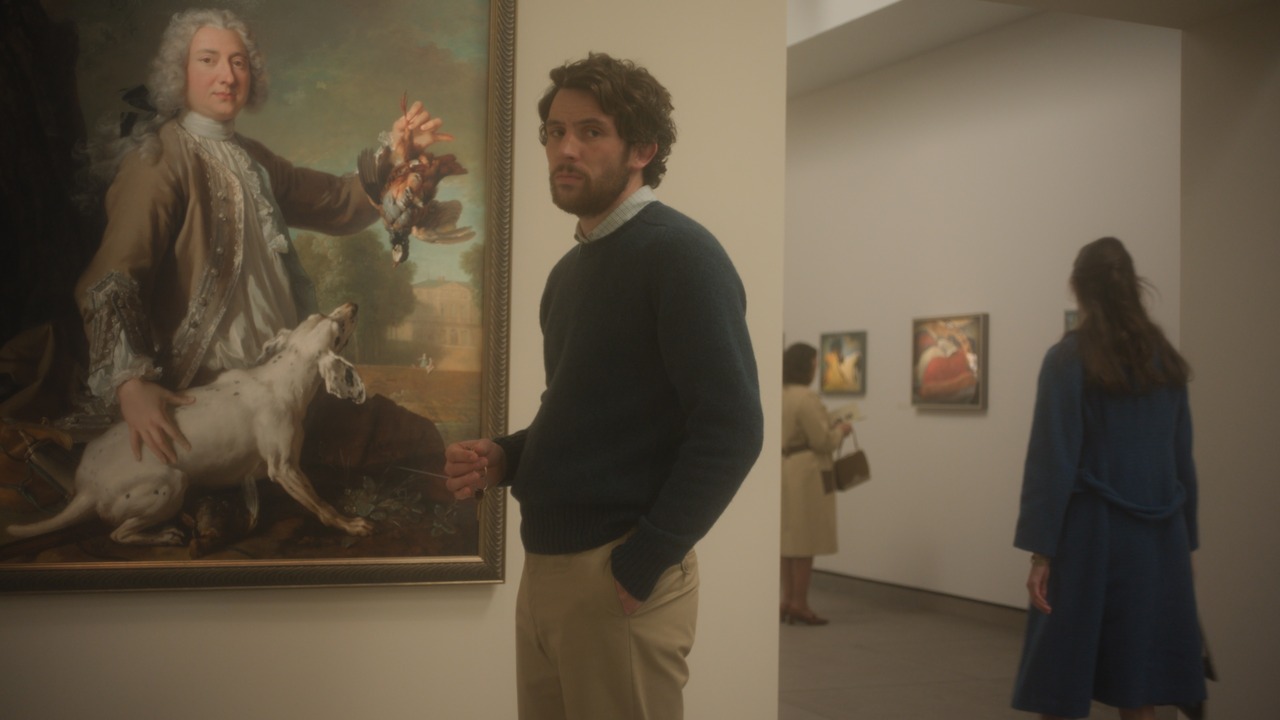
In The Mastermind, Kelly Reichardt takes apart the conventions of the heist movie. Where most films settle for slick style and meticulous planning, treating the robbers as suave gentlemen who know how to handle their shit, Reichardt displays a sincere curiosity about the perpetrators of crime. She wonders what could possibly motivate someone to steal — what such a person would look like in real life. This quest for answers brings her to a man named James Blaine Mooney (Josh O'Connor), the titular mastermind. The most important thing you should know about James is this: he is a loser, and he is unemployed.
At the dinner table, when William (Bill Camp) talks about a certain someone named Kipp and how well he's doing professionally, James launches into a rant. He claims that Kipp can't build a decent cabinet and that, by working as a top man, he is idiotically wasting his time. "Well, you seem to have a good amount of time on your hands," William replies, and with that line, we get a firm grasp of James's pathetic life.
Early in the film, James quietly steals something from a museum, and this small success brings him a small joy. It also gives him the confidence to up the stakes. With the help of two hired thieves — Larry (Cole Doman) and Guy (Eli Gelb) — James devises a plan to steal four Arthur Dove paintings from the local art museum. This is where Reichardt comically underlines that these thieves are no stick figures detached from the practicalities, routines, and accidents of real life. Larry, the driver, backs out at the last moment. Because the school is closed, James has to figure out how to keep his kids occupied until the plan is executed. While he waits for the men in the parking lot, a policeman parks beside him to eat lunch. Meanwhile, the thieves end up dealing with a girl who unintentionally bumps into them.
Reichardt films these details with a tantalizing fervor. She tickles your senses, toys with the characters' apprehensions, and fills you with such nervous excitement that you finally experience release when you laugh at one of the thieves opening the back window of the getaway vehicle.
Heist movies usually end when the robbers happily ride off into the sunset. The Mastermind, though, goes on to observe what happens after the heist is over. James's little stunt is broadcast on the news, detectives make arrests and interrogate suspects, and an accomplice, feeling the heat, demands more compensation. Reichardt no longer approaches these scenes with the same teasing gaze, but the humor remains intact. James looks like God's toy: pushed around by circumstances that seem deliberately designed to puncture his ego, his image, his — um — accomplishment. James proudly hangs one of the paintings in his room, his smile suggesting he's patting himself on the back. But when William remarks that the robbers lack a solid plan or ambition, James, clearly wounded, quietly takes the painting down and hides the stolen goods elsewhere. To make matters worse, an organized crime outfit blackmails Guy and snatches the paintings from James altogether.
Sure, crime doesn't pay for James, but it also puts tremendous strain on his marriage. The heist doesn't occur in isolation; it impacts his relationship with his wife, Terri (Alana Haim), and distances him from his children. James believes he can draw a boundary between his criminal life and his personal space. Of course, he spectacularly fails.
James also maintains a distance from the political and social upheavals around him. The Mastermind is set in the 1970s, when the Vietnam War fuels widespread protest, yet James says nothing about the war and never engages with the counterculture. He can be seen as a man of privilege — someone who has the luxury of ignoring the forces shaping his society, his environment. As the son of a judge, he even wields his father's name like an immunity badge, casually deflecting detectives who ask him to come down to the station.
Reichardt ultimately reveals that detachment from politics is an illusion: sooner or later, you'll be caught in the crossfire. This vision of crime, comedy, and comeuppance has a soft, greasy texture, and the jazzy, percussive score not only keeps you hooked but also makes the images dance with vigor. If the observant, restrained camera establishes a steady visual atmosphere, the music introduces tense, jittery rhythms. The result is a film that feels simultaneously dynamic and static — like a great improvisational performance.
With The Mastermind, Reichardt hasn't just made a marvelous heist film; she's made an instant classic. What I particularly loved is that James is not completely reduced to a punching bag. Reichardt uncovers the tragedy of his situation, the quiet sadness that O'Connor conveys with impressive restraint. If sound and image riff off one another, Reichardt and O'Connor achieve a similar harmony, operating on the same frequency, the same plane. In The Mastermind, we get the pleasure of watching an exceptional director–actor collaboration.
Final Score- [9/10]
Reviewed by - Vikas Yadav
Follow @vikasonorous on Twitter
Publisher at Midgard Times




Hi Everyone, after a due consideration, we have decided that we will be open for donations to help us in managing our website. We will be greatful for any kind of amount we receive. Thanks!
— Midgard Times 🎬 (@Moviesr_net) January 4, 2026
PayPal- [email protected] pic.twitter.com/DlNNz5Npm5
Get all latest content delivered to your email a few times a month.
Bringing Pop Culture News from Every Realm, Get All the Latest Movie, TV News, Reviews & Trailers
Got Any questions? Drop an email to [email protected]



 © Copyrights MOVIESR.NET All rights reserved