

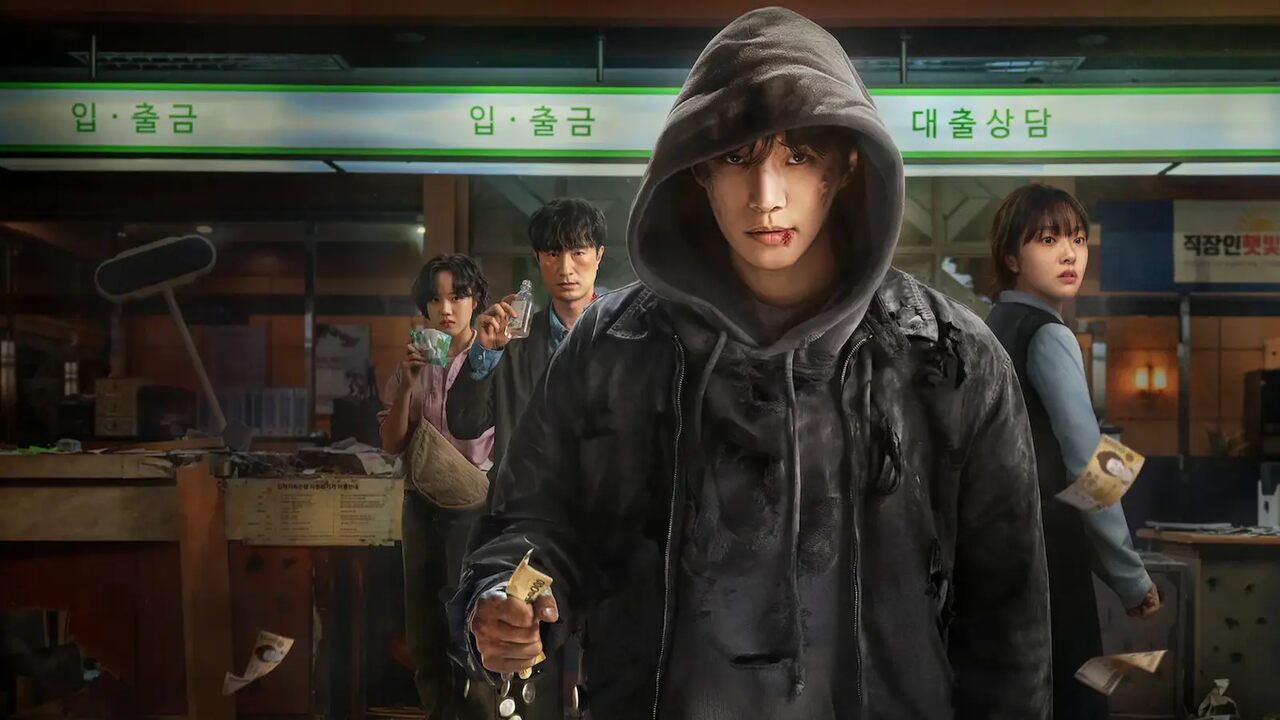
I went into Cashero expecting something light, mildly goofy, and disposable. What I got instead was a show that is very aware of how ridiculous its premise sounds and uses that awareness to its advantage. This is a superhero series that doesn’t care much about destiny, prophecy, or chosen ones. It cares about budgets, savings, job security, and the very real anxiety of watching your bank balance drop while the world demands you be brave. That tension is where Cashero lives, and most of the time, it thrives in that environment.
Kang Sang-woong is not written like a traditional hero, and that is the show’s smartest decision. He is cautious, polite, mildly neurotic, and visibly stressed by responsibility even before powers enter the picture. When his strength turns out to be directly proportional to the amount of cash he holds, the show immediately establishes its tone: funny, yes, but also deeply practical. Every punch costs money. Every heroic choice has a receipt. Watching Sang-woong hesitate before using his powers because he is mentally calculating future expenses is both hilarious and painfully familiar. Lee Jun-ho plays this with just the right balance of sincerity and awkwardness, making Sang-woong feel like a real person instead of a walking gag.
What elevates the series beyond a one-joke concept is how seriously it treats its characters’ inner lives. Sang-woong’s desire to buy a home, build stability, and live a respectable life is not mocked. Instead, it becomes the emotional backbone of the story. His powers don’t free him from financial pressure; they intensify it. The more he saves others, the more he risks losing his own future. That conflict is threaded through nearly every episode, lending weight to scenes that could have been played purely for laughs.
Kim Min-sook, his partner, is one of the strongest elements of the show. She is practical, sharp, and unromantic about heroism in the best way possible. She doesn’t discourage Sang-woong from doing the right thing, but she insists on planning, strategy, and basic financial sense. Their relationship feels grounded in adult conversations rather than dramatic misunderstandings. Much of the show’s humor comes from the two of them discussing life-or-death situations with the tone of people comparing utility bills, and it works remarkably well.
The supporting cast adds texture without turning the series into chaos. Byeon Ho-in, the lawyer whose powers activate through alcohol, brings loud, unpredictable energy that contrasts nicely with Sang-woong’s restraint. Bang Eun-mi, whose strength depends on calorie intake, injects warmth and humor while subtly reflecting another form of bodily and social pressure. Each power system feels intentionally designed to comment on everyday excess, scarcity, or dependency, and the show trusts the audience to pick up on that without spelling it out.
Tonally, Cashero walks a tricky line. It is funny, often very funny, but it never feels like it’s laughing at its own characters. The jokes come from situations, choices, and consequences rather than from mocking vulnerability. That restraint is refreshing, especially in a genre that often relies on irony or constant self-parody. The writing understands when to let a scene breathe, and when to cut it short for comedic effect, and while not every joke lands, the hit rate is high enough to keep things consistently engaging.
Visually, the series is restrained but effective. The action sequences are clean and readable rather than flashy, which suits the story. This is not a show about spectacle for spectacle’s sake. You are meant to feel the cost of every fight, not just financially but emotionally. The cinematography favors grounded framing and everyday spaces, reinforcing the idea that these extraordinary events are happening in very ordinary lives.
That said, Cashero is not without its flaws. The pacing can feel uneven, especially in the middle episodes, where multiple plot threads compete for attention. Some arcs resolve a bit too quickly, while others feel like they need more space to develop. The antagonistic forces, particularly the broader criminal organization, occasionally come across as underwritten. They serve their narrative purpose, but they rarely feel as textured or compelling as the protagonists. You sense there was room to deepen their motivations, but the series chooses momentum over complexity.
There are also moments when the social commentary edges close to being too on the nose. While the show is generally subtle about its themes of money, labor, and responsibility, a few scenes spell things out more explicitly than necessary. These moments don’t ruin the experience, but they slightly dull the sharpness of an otherwise confident script.
Despite these issues, the overall experience remains strong. Cashero succeeds because it understands that novelty alone is not enough. The money-powered superhero concept is funny for five minutes; the characters are what make it sustainable for eight episodes. By the time the series reaches its later chapters, you are no longer watching to see how the powers work. You are watching because you care whether Sang-woong will be okay, whether his sacrifices are worth it, and whether the system he is trapped in will ever give him a fair return.
The final stretch of the show leans more into emotional payoff than surprise, and that feels like the right choice. Cashero is not trying to shock you; it’s trying to leave you with a lingering sense of recognition. It asks uncomfortable questions in a friendly voice: How much should a good person give? Who pays the price for doing the right thing? And why does responsibility always seem to come with interest?
By the end, I found myself impressed not because the show reinvented the superhero genre, but because it treated everyday stress with unusual respect. Cashero is funny, thoughtful, occasionally messy, and surprisingly sincere. It understands that heroism doesn’t always look like confidence or power. Sometimes it looks like checking your wallet, taking a deep breath, and choosing to help anyway, even when you know it’s going to cost you.
Final Score- [6.5/10]
Reviewed by - Anjali Sharma
Follow @AnjaliS54769166 on Twitter
Publisher at Midgard Times



Hi Everyone, after a due consideration, we have decided that we will be open for donations to help us in managing our website. We will be greatful for any kind of amount we receive. Thanks!
— Midgard Times 🎬 (@Moviesr_net) January 4, 2026
PayPal- [email protected] pic.twitter.com/DlNNz5Npm5
Get all latest content delivered to your email a few times a month.
Bringing Pop Culture News from Every Realm, Get All the Latest Movie, TV News, Reviews & Trailers
Got Any questions? Drop an email to [email protected]



 © Copyrights MOVIESR.NET All rights reserved