

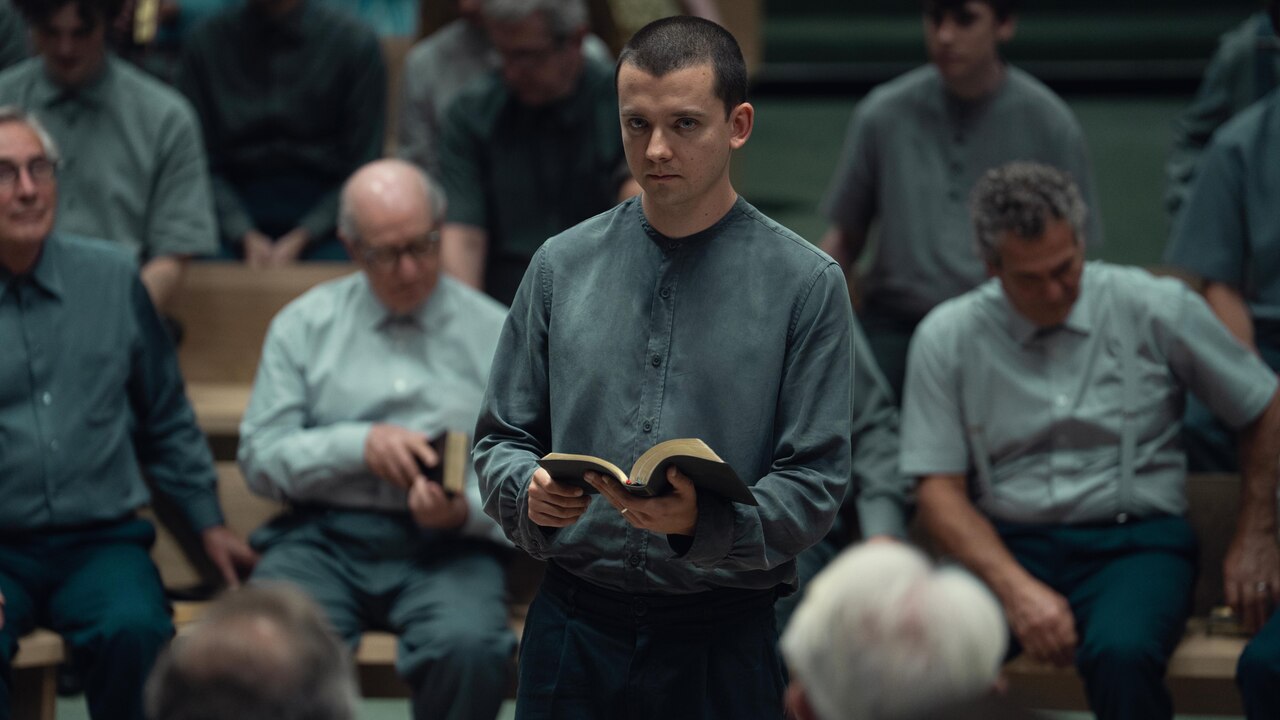
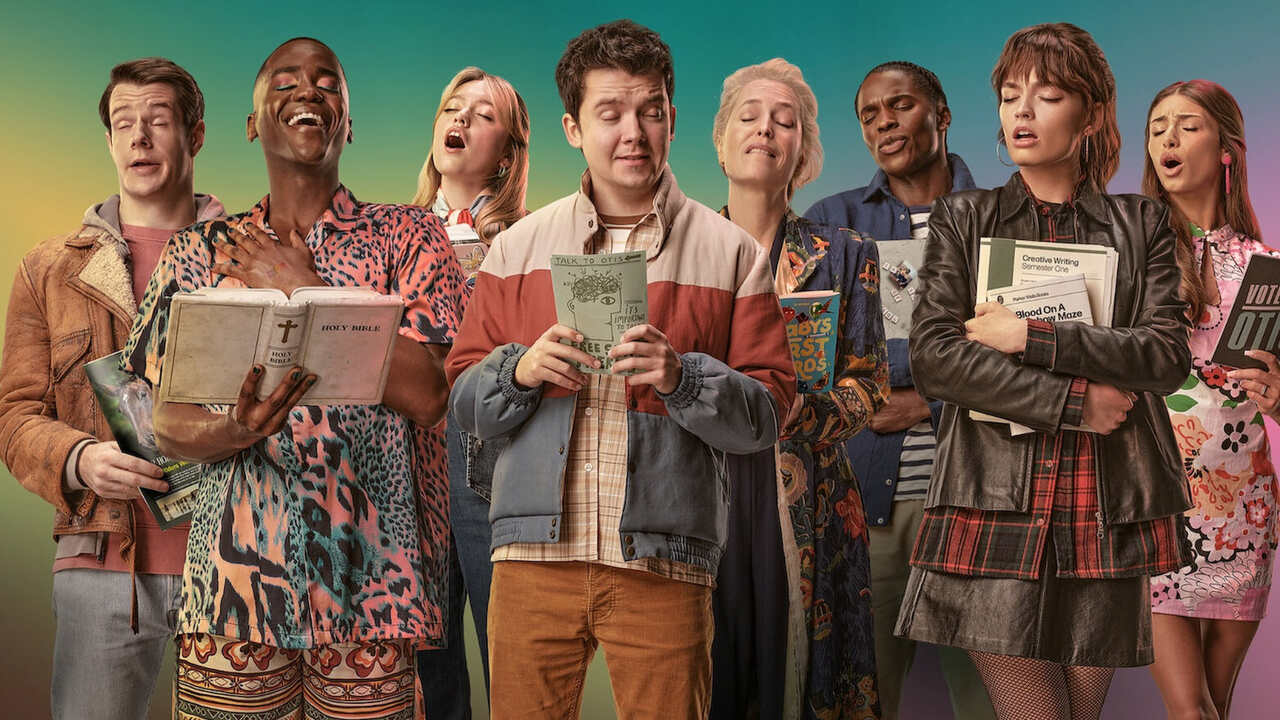
Asa Butterfield's sweet, childlike face made Otis an adorable teenager in Sex Education. His vibrant blue eyes were appealing, and they elevated Otis' cuteness, especially in scenes with Emma Mackey's Maeve. What feels so endearing about Butterfield in Sex Education is precisely what becomes off-putting in Unchosen. That same childlike face, now paired with very short hair, looks awfully timid, and those blue eyes seem faint here.
Butterfield, as Adam, is hesitant. He has a nervous demeanor but also tries to wear a brave countenance. Adam is like a child, uncertain of himself yet eager to prove his capability in front of adults. He is, in many ways, the perfect candidate to be influenced by a domineering patriarch or cult leader. That much rings true, especially since Adam wants to be seen as a devoted member of the Fellowship of Divine, a fictional religious sect as creepy and controlling as any other.
Adam, of course, doesn't find the sect or its rigid rules objectionable. Then again, men in such institutions rarely view their environment or behavior as inappropriate, since they are granted far more freedom and respect than women. Even the women, however, don't easily protest unfair treatment, owing to years of conditioning and subservience (you don't need to be in a cult to observe this; just look around). It's no surprise, then, that many female members of the Fellowship perform their duties without objection—except for Rosie (Molly Windsor), who slowly begins to question things.
It begins when Rosie and Adam's daughter, Grace (Olivia Pickering), goes missing in the forest and is rescued by a stranger named Sam (Fra Fee). The cracks in Rosie's faith appear in small but telling moments, like when she quietly insists that Grace was not rescued by Adam and his brother Isaac (Aston McAuley), as Mr. Phillips (Christopher Eccleston) claims, but by Sam.
Who is Sam? A Christ-like savior or a dangerous criminal? Is he genuinely kind, or merely pretending? Are the reports about him on the news exaggerated? Are his confessions real? And even if he is guilty, can repentance absolve him? Is Jesus truly that forgiving, or do followers invoke Him as a shield for their own abuses? Mr. Phillips, after all, uses his position to exploit women. He might as well be seeking forgiveness every week, only to repeat the same violations. When someone like Adam can quote the Bible to control Rosie—telling her to surrender herself without resistance—it's difficult to expect moral integrity from the other men in the cult.
Unchosen, in the end, raises absorbing questions but never develops them into something psychologically compelling or narratively suspenseful. Its failures begin at a basic level: the Fellowship is sketched in broad, generic strokes, making its practices feel generalized and emotionally distant. When was the cult formed? What are its objectives? How does it recruit followers? How does it leverage social media to expand its reach (despite restricted internet access)?
Creator Julie Gearey introduces the group's routines—women run the household, men attend meetings and work—and its punishments, such as isolation, but doesn't present them through a subjective lens. Rather than dramatizing the horrors through Rosie's perspective, the series depicts them in a plain, almost impersonal manner. Her expressions in scenes where she is violated or separated from her daughter don't feel deeply personal; they merely signal what someone in her position might look like during such events. The issue lies not with Windsor, but with the sterile direction that underscores the show's limited ambition: to function as a busy Netflix thriller.
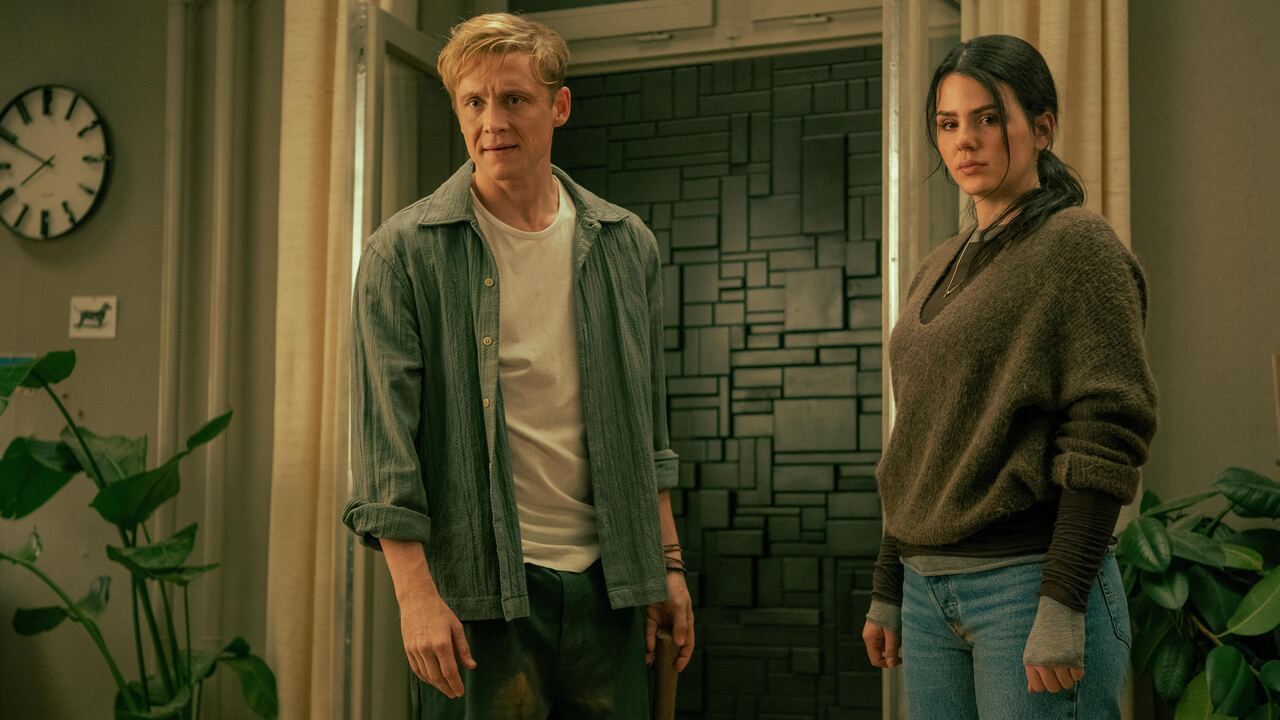
And busy it is, with unfocused shifts that constantly alter its center. What begins as a critique of cults starts to resemble a pulpy thriller after Sam's arrival, where a seductive outsider manipulates both wife and husband. By the end, it veers into home-invasion territory, with a couple fighting a threatening intruder. Eventually, everything circles back to a familiar idea: cult leaders are no less than criminals—sometimes they are literally criminals.
With more fully realized characters—ones not reduced to serving genre conventions—Unchosen could have delivered on its intentions. In its current form, however, it feels underdeveloped, unremarkable, and ineffectual. If the characters' misfortune is that they must live in a cult, the actors' misfortune is that they must perform in a show that fails to do justice to either its premise or their talent. Unchosen is not worth choosing after all.
Final Score- [3.5/10]
Reviewed by - Vikas Yadav
Follow @vikasonorous on Twitter
Publisher at Midgard Times


Hi Everyone, after a due consideration, we have decided that we will be open for donations to help us in managing our website. We will be greatful for any kind of amount we receive. Thanks!
— Midgard Times 🎬 (@Moviesr_net) January 4, 2026
PayPal- [email protected] pic.twitter.com/DlNNz5Npm5
Get all latest content delivered to your email a few times a month.
Bringing Pop Culture News from Every Realm, Get All the Latest Movie, TV News, Reviews & Trailers
Got Any questions? Drop an email to [email protected]

 © Copyrights MOVIESR.NET All rights reserved