

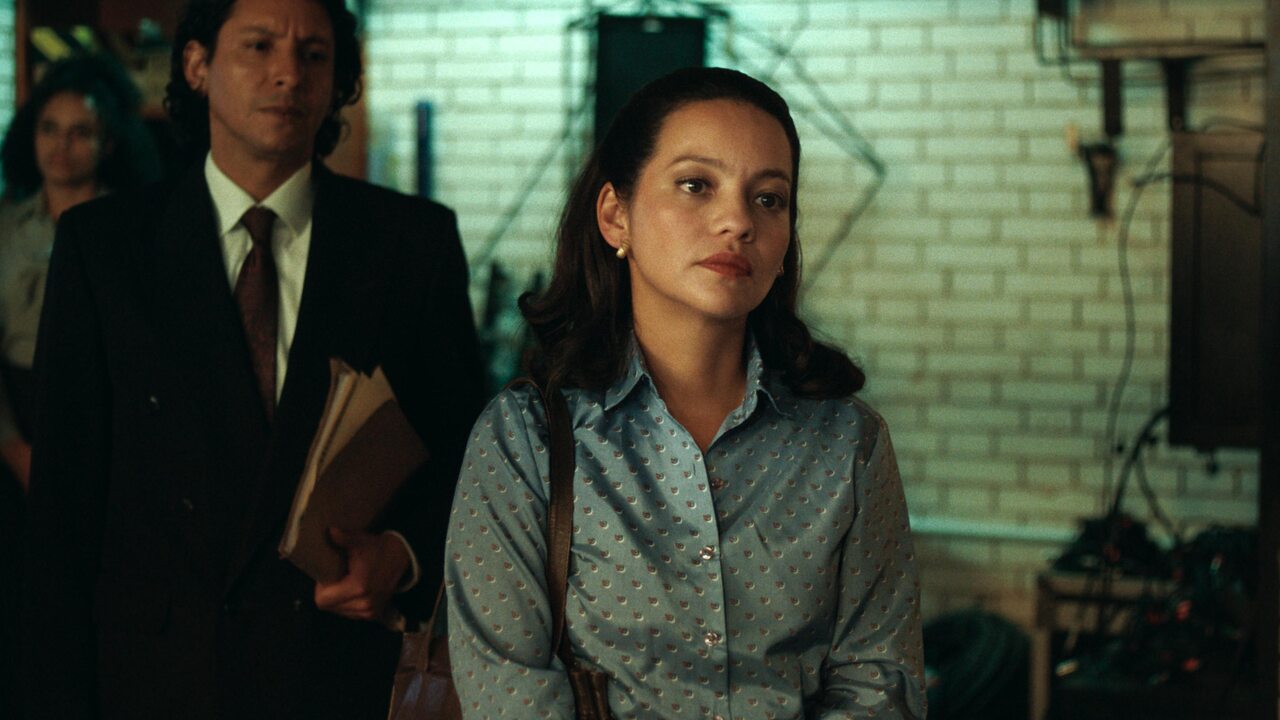
On November 6, 1985, M-19 guerrillas entered the Palace of Justice in Bogotá and took more than 300 people hostage—including Supreme Court justices—to demand a public trial of President Belisario Betancur, whom they accused of betraying a ceasefire and the peace process. The Colombian Army retook the building the following day after a roughly 27-hour siege. At least 94 people died or disappeared, including 11 of the 25 Supreme Court justices, guerrillas, soldiers, and civilians. Forty-one years later, Netflix has released Under Siege (or Palacio) on the same day, a series that both honors the victims and insists that this tragic event should not be forgotten. That sense of conscientiousness is most evident in the way the series is written. It is densely packed with factual and dramatic information, all of which is shaped into an "inspired by true events" fiction that alters and compresses details to fit an eight-episode thriller.
The Palace of Justice siege was a deeply complicated and controversial matter, so much so that one can spend an entire afternoon debating who was actually to blame. Was it the M-19 group that infiltrated and attacked the Palace? Was it the military, which was responsible for grave human rights violations during the retaking? Or was it President Belisario Betancur, who failed to heed Supreme Court president Alfonso Reyes Echandía's calls for a ceasefire? If it is impossible to place the entire blame on one individual, that is because nothing about the whole incident was simple. Everybody bears responsibility for their "contribution," but it is impossible to place the military and government on exactly the same moral footing as the M-19. The state, after all, wielded institutional power and authority to conceal or evade accountability for its own abuses. For years, state forces escaped full accountability for allegations and findings involving torture, extrajudicial killings, and forced disappearances, while the legal framework of the time made prosecution more difficult.
In Under Siege, Pilar (Natalia Reyes) represents all those civilians who had to fight for years to get answers and closure. It should be noted that not everybody has yet received either. Her husband is a waiter at the Palace cafeteria, and after the siege, he disappears. Pilar goes from hospital to hospital to find him, searches the morgue for his corpse, and joins forces with a lawyer to seek answers and hold those responsible to account. This long, arduous battle drains Pilar, but it does not diminish her determination. At one point, she mentions that the very thought of abandoning the search for her husband fills her with guilt. Later, as an older woman with teenage daughters, she also becomes bitter as she loses faith in the lawyers. Pilar eventually joins a group of grieving individuals like her and, after enough time has passed, finds a new partner. She slowly begins to move on with her life, looking beyond her missing husband without ever losing sight of him or the memories she holds dear. In one scene, when her daughters are still young, one of the girls complains that she wants her father and is tired of hearing the same assurance that he will eventually return. It offers a glimpse into the domestic tension that Pilar has to deal with while searching for a resolution.
However, it would have been much better if Under Siege had offered a few scenes depicting how a stressed-out Pilar handled her home and struggled to balance calming her children, who presumably bombarded her with questions about their father almost every day, with searching for her husband. Did one part ever overwhelm the other? The series, instead of dramatizing such a thing, leaves you with a general sense of watching a mother who has endured much. And this is where the issues lie: Under Siege is so considerate in its attempt to do justice to its subject that it incorporates every facet, every fact, with diligence. What is missing is the audiovisual creativity that could have rendered these facets and facts explosive and palpable. Consider Le Petit Soldat, where Godard turns a torture scene subjective by manipulating sound and images. Film critic Richard Brody has brilliantly interpreted this sequence in one of his articles. He argues that as Bruno is burned, waterboarded, and subjected to electric shocks, his voice-over describes his attempt to mentally escape the pain, while the torturer's radio produces no audible sound. The effect is to turn the film's soundtrack into an extension of the character's consciousness, and Godard thereby reveals the limits of conventional cinematic representation.
I am not asking filmmakers to copy Godard exactly—it would be a futile exercise. I am merely highlighting how powerful the cinematic medium can become in the hands of an original filmmaker. And once you see that potential with your own eyes, it becomes difficult to accept anything less or anything merely mediocre. This is why Under Siege lost me for most of its runtime. It fails to provide a subjective sense of what it must have been like to be trapped inside the Palace for 27 hours. The scared and sweaty bodies, the smoke, the chaos, and the sight of people firing guns are all conventionally shot. Even as an investigative thriller and a courtroom drama, Under Siege remains very conventional. The images here merely convey what is written in the script. They dutifully relay information from all fronts: a soldier sees people being tortured, feels disturbed by what he witnesses, and secretly leaks information about the military's conduct. How this experience shapes his personal life and day-to-day interactions, however, is something you are simply asked to infer.
Hence, the experience you get from Under Siege is that of a traditional documentary with talking heads. The events might as well be recounted by interviewees, while the scenes themselves could very well be recreations. Because of this blandness, the eight episodes can feel like a very taxing eight hours, which is why, when the series ends, you are as exhausted and relieved as Pilar. Under Siege might be a respectful memorial to something tragic and important. But it is not a series that leaves you especially engaged or stimulated. It is informative, it is conscientious, and it ultimately leaves you depleted.
Final Score - [5.5/10]
Reviewed by - Vikas Yadav
Follow @vikasonorous on Twitter
Publisher at Midgard Times


Hi Everyone, after a due consideration, we have decided that we will be open for donations to help us in managing our website. We will be greatful for any kind of amount we receive. Thanks!
— Midgard Times 🎬 (@Moviesr_net) January 4, 2026
PayPal- [email protected] pic.twitter.com/DlNNz5Npm5
Get all latest content delivered to your email a few times a month.
Bringing Pop Culture News from Every Realm, Get All the Latest Movie, TV News, Reviews & Trailers
Got Any questions? Drop an email to [email protected]



 © Copyrights MOVIESR.NET All rights reserved