

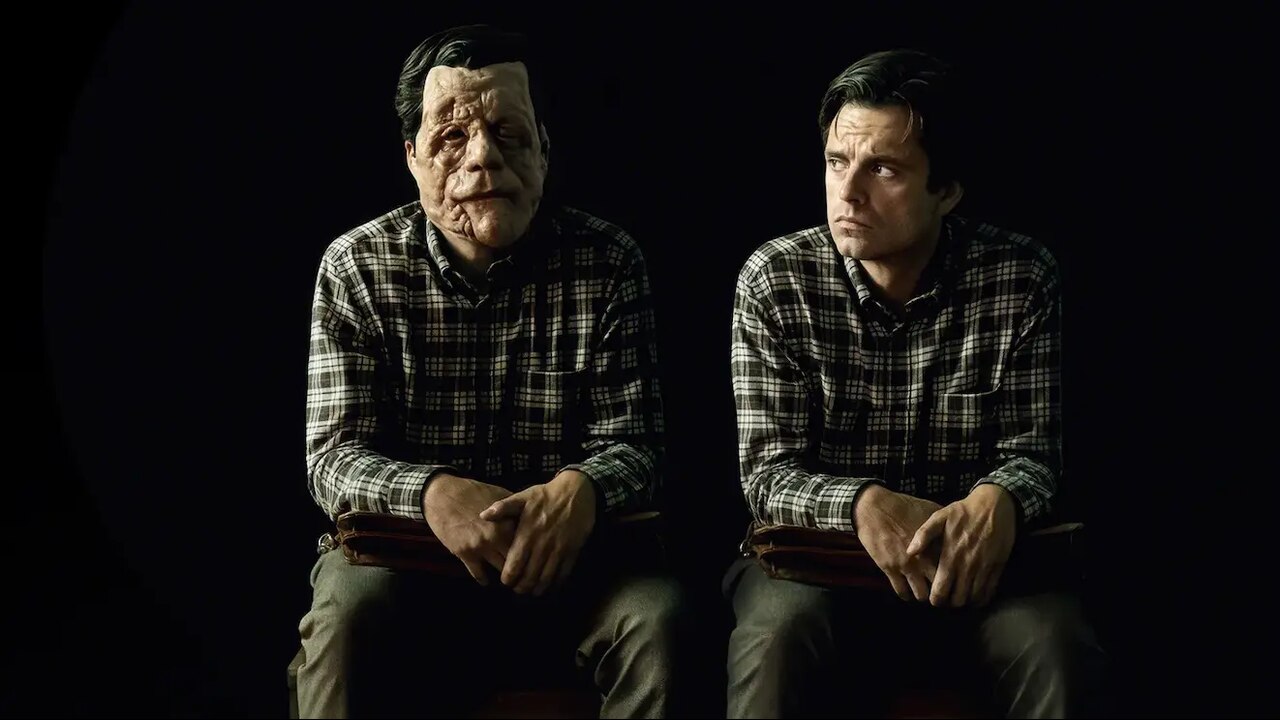
I went into A Different Man expecting an unusual indie drama, and it delivered something far more specific and lingering than that. It’s not just about physical transformation; it’s about what happens when you remove the one thing you believed was holding your life back, and then realize the problem hasn’t actually gone anywhere. That idea could have been handled in a heavy or overly symbolic way, but the film keeps it grounded in character, which is what makes it so effective.
The story centers on Edward, played by Sebastian Stan, a struggling actor living in New York with neurofibromatosis. Early on, the film establishes his routine with a kind of quiet precision. He lives alone, keeps to himself, and moves through the world with a mix of hope and resignation. His interactions feel tentative, especially when he meets Ingrid, his neighbor, a playwright who shows genuine curiosity toward him. There’s a soft, almost awkward warmth in their dynamic that becomes emotionally important later.
Edward’s decision to undergo an experimental medical procedure is framed less as a dramatic turning point and more as a quiet gamble. The transformation itself is handled in a way that’s uncomfortable but not sensational. Afterward, he emerges with a conventionally attractive face, essentially becoming a “new” person. What I appreciated here is that the film doesn’t rush into a success montage. Instead, it shows how Edward—now using a different identity—tries to build a life that matches his new appearance. For a while, it works. He finds confidence, social ease, and opportunities that were previously out of reach. But the film is careful in showing that this confidence is not entirely authentic. It’s more like he’s performing a version of what he thinks he should be. That idea becomes central when Ingrid unknowingly writes a play based on Edward’s former life, and he ends up orbiting that project in a strange, self-involved way.
This is where the film becomes especially interesting. Instead of resolving into a simple arc about self-acceptance, it complicates everything through the introduction of Oswald, played by Adam Pearson. Oswald has the same facial condition Edward once had, but carries himself with a level of ease and charisma that Edward never achieved. Watching Edward react to Oswald is one of the most compelling parts of the film. There’s admiration, resentment, confusion, and something close to envy, all mixed. And this is exactly where Sebastian Stan elevates the film from intriguing to genuinely unforgettable. His performance is not just good—it’s deeply controlled, technically precise, and emotionally layered in a way that sneaks up on you. He has to embody Edward before and after the transformation, but more importantly, he has to carry the psychological continuity between those two states without relying on obvious cues. The shift is not loud; it’s internal. The way his posture changes, how he modulates eye contact, the slight hesitation that never fully disappears even after he becomes “conventionally attractive”—it all feels incredibly intentional.
There’s a quiet confidence in how Stan approaches the role. He doesn’t overplay the vulnerability in the first half, and he doesn’t lean into vanity or arrogance in the second. Instead, he threads something more difficult: a persistent sense of incompleteness. Even at his most socially successful, there’s a subtle disconnect in how he reacts, as if he’s always a fraction of a second behind the version of himself he’s trying to project. It’s a performance built on micro-adjustments, and it rewards attention.
What makes it even more impressive is how he handles the film’s darker, more ironic moments. There are scenes where Edward’s behavior borders on uncomfortable or even self-sabotaging, and Stan commits fully without trying to soften the character. He allows Edward to be frustrating, to make questionable choices, to misread situations—and in doing so, he makes him feel real. It would have been easy to play this role for sympathy; instead, he plays it for truth. Adam Pearson, on the other hand, brings a completely different energy. His performance feels natural and unforced, which contrasts sharply with Edward’s more constructed persona. The film quietly shifts its center of gravity whenever he’s on screen. Without overexplaining anything, it uses his presence to question Edward’s entire journey.
Renate Reinsve as Ingrid adds another layer. Her character could have easily been reduced to a narrative device, but she feels like a fully formed person with her own creative ambitions and blind spots. Her relationship with Edward, both before and after his transformation, is handled with a level of ambiguity that I appreciated. There are moments where her behavior feels inconsistent, but in a way that reflects real people rather than weak writing.
Stylistically, the film sits in an interesting space. It blends dark comedy with psychological drama, and occasionally leans into something more surreal. The humor is dry and often uncomfortable, which fits the material. Some scenes almost feel like they’re on the edge of absurdity, but they never completely detach from the emotional core. The New York setting is used effectively, not as a glamorous backdrop but as a slightly worn, indifferent environment that mirrors Edward’s internal state.
The pacing is mostly deliberate, which works well for the character study. The film takes its time in showing how Edward adjusts, observes, and gradually unravels. That said, the middle section does feel slightly stretched. There are a few sequences where the thematic point is already clear, but the film lingers just a bit longer than necessary. It doesn’t derail the experience, but it does create a small dip in momentum.
The final act becomes more meta and a little chaotic, especially with the play within the story and Edward’s growing fixation on reclaiming something he can’t quite define. I found this section engaging, but also slightly uneven. The film is clearly trying to push its ideas further, and while I respect that ambition, not every thread lands with equal clarity. Some moments feel intentionally ambiguous, but others come across as underdeveloped. What stayed with me most is how the film treats identity. It doesn’t offer easy answers or a clear moral. Instead, it shows how deeply people can tie their sense of self to external perception, and how fragile that construction can be. Edward’s transformation doesn’t liberate him; it just shifts the terms of his insecurity. That’s a subtle but powerful idea, and the film trusts the audience to sit with it.
Overall, A Different Man is a thoughtful, slightly unsettling film that works because of its performances and its commitment to its central idea. It’s not always perfectly balanced in tone or pacing, but it remains engaging and intellectually sharp throughout. And at the center of it all, Sebastian Stan delivers a performance that feels carefully engineered yet emotionally raw, the kind that holds the entire film together even when its structure starts to loosen. I found myself thinking about it long after it ended, which is usually a sign that it did something right.
Final Score- [9/10]
Reviewed by - Anjali Sharma
Follow @AnjaliS54769166 on Twitter
Publisher at Midgard Times

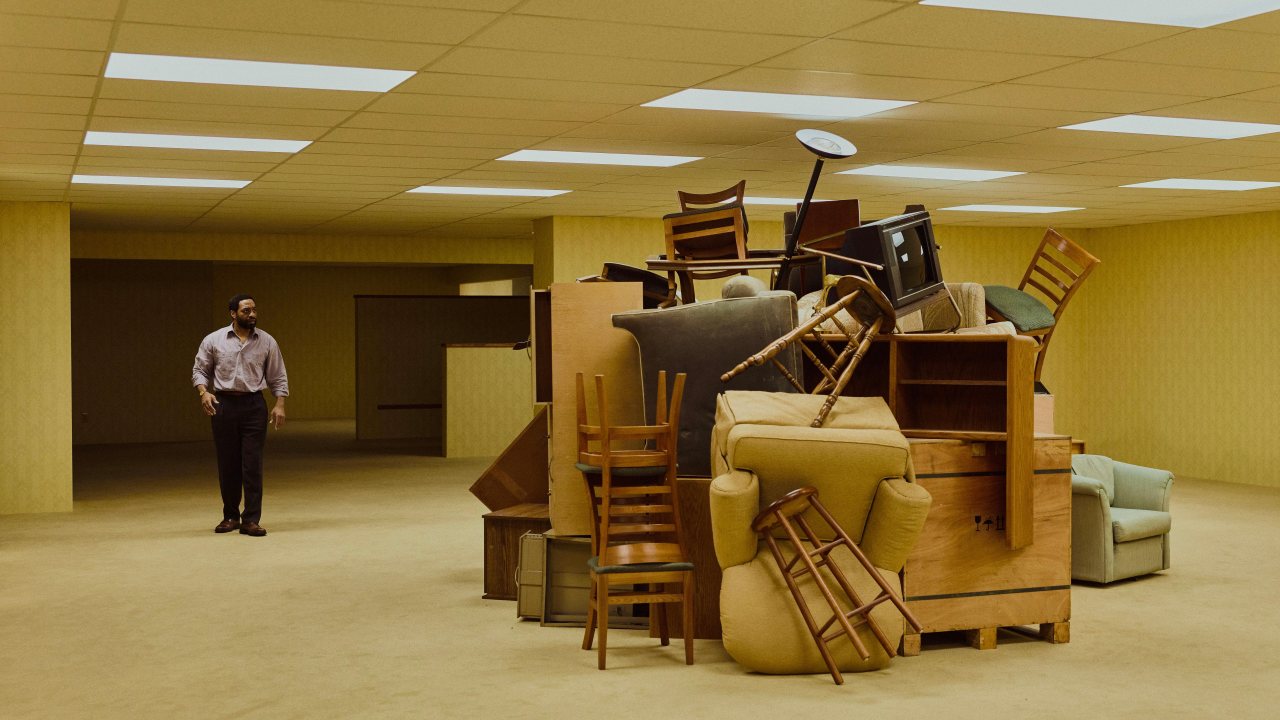



Hi Everyone, after a due consideration, we have decided that we will be open for donations to help us in managing our website. We will be greatful for any kind of amount we receive. Thanks!
— Midgard Times 🎬 (@Moviesr_net) January 4, 2026
PayPal- [email protected] pic.twitter.com/DlNNz5Npm5
Get all latest content delivered to your email a few times a month.
Bringing Pop Culture News from Every Realm, Get All the Latest Movie, TV News, Reviews & Trailers
Got Any questions? Drop an email to [email protected]



 © Copyrights MOVIESR.NET All rights reserved