

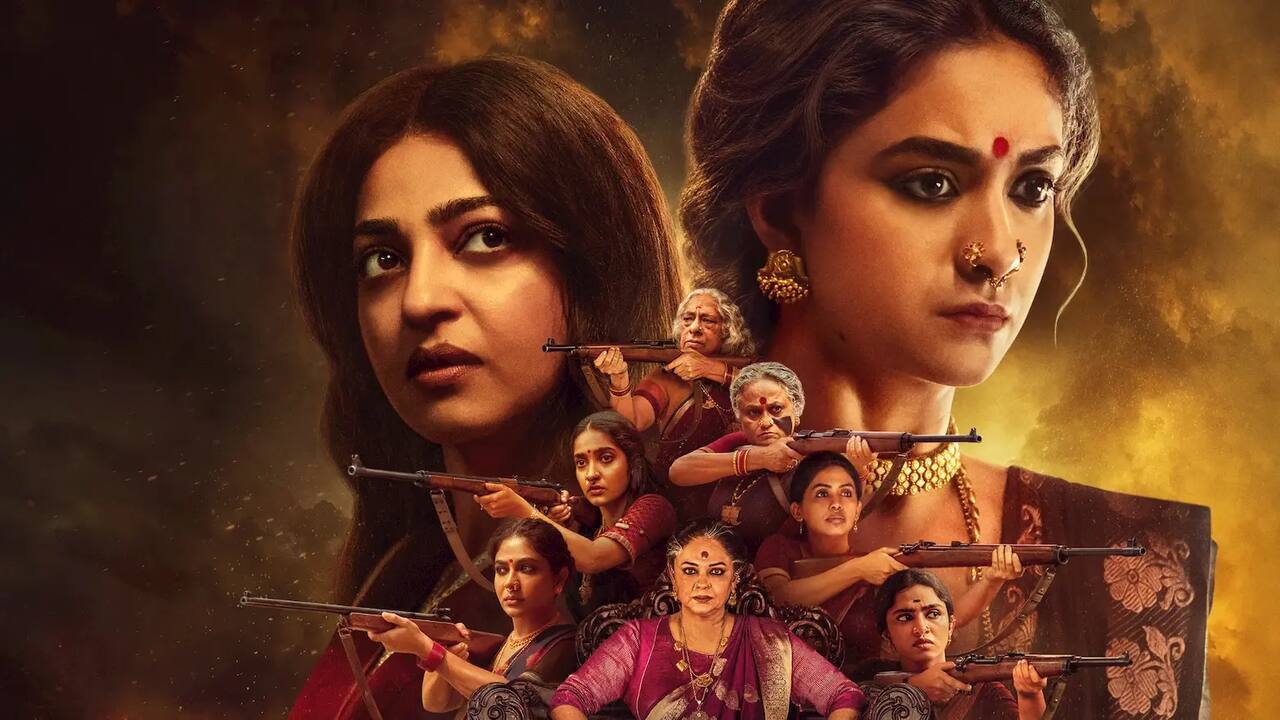
In one of the scenes in the first episode of Akka, Bhavani (Keerthy Suresh) asks a government officer this question: How many people in India, under the rule of politicians, are educated? His reply? One person out of ten. Bhavani smirks and points out that Pernuru, a fictional South Indian city ruled by matriarchs, has a literacy rate of nine out of ten, which is actually commendable. But who might that one uneducated individual be? If I had to place my bet, I would put it on two men (one appears in a flashback, while the other exists in the present-day narrative) who continuously assert that they can only live with the love of their life or get them pregnant after going through the wedding rituals. No one forces them to leave their partners; no one objects if they live under one roof together. Love all you want, but only marriage is forbidden. Well, given this open-minded situation, who would really want to waste time completing a set of rituals? Find a companion, develop mutual attraction, and do whatever you want. Where's the problem?
But those two men, one of whom is Nanda (Vishak Nair), remain fixated on taking nuptial vows, making you want to hit them over the head. Marriages, more often than not, become binding contracts that impose rigid rules and limitations on spouses, particularly women married to fairly backward men. Given how insistently Nanda talks about marriage in a society where such formalities are apparently unnecessary, I began to suspect that he was being positioned as a villain who would eventually stab Bhavani in the back. Bhavani clearly states that she loves Nanda and even expresses her willingness to have sex with him, hoping to have a baby together. What does Nanda do? He maintains that he will do the deed only after marriage. It's a variation on the sentiment of "saving oneself for a soulmate." What does he think would happen after taking "saat phere"? Will his sperm strike the egg with a hundred percent success rate? Will he become a sex god in bed? Or does he believe that Bhavani wouldn't be able to leave him and fall for any other man after being bound to him through certain rituals? As I mentioned earlier, he is that one person among the ten people in Pernuru who isn't educated.
Another kind of illiteracy affects Akka as well. I am talking about cinematic illiteracy, which reduces this crime thriller to a succession of reels, each concerned with highlights and exposition rather than the actual storytelling process. In Akka, one scene doesn't segue into another. Director Dharmaraj Shetty, instead, throws us from one big moment to another. Rudra (Radhika Apte), an outsider, enters Pernuru with the aim of undermining the position of the three female rulers-cum-gangsters, and her rise (and eventual fall) simply occurs through expository pieces. To understand what I mean by this, consider the scene where Rudra asks a priest to hype her up as an authority figure and spread her made-up, inflated heroic story among the people. The priest hesitates, saying that such a big task won't be easy to accomplish and could take a lot of time. But cut to the next scene, and Rudra has already become a cherished figure among the masses. What's more, she gives one short speech to a few members of a clan, and all of them instantly begin to sing her praises. A lot happens in Akka through a single line of dialogue. A leader of the Kathawa tribe initially tells Bhavani that she won't fight alongside her in a battle. But one character quickly says something about the fear of disappointment and asserts that Bhavani is different from her ancestors, and lo, the Kathawa leader immediately changes her stance.
Good storytelling has always required filmmakers to carefully and patiently build their narratives, characters, worlds, backstories, moods, suspense, and drama step by step. This has become a kind of lost art these days, where a show like Akka has to explode moment by moment, leaving it with no breathing space. Everything is conceived in terms of loud set pieces, which drain all the drama, all the tension, and all the connective tissue from the narrative. Akka doesn't unfold; it pounds you over the head. The images fall on you like heavy bricks, and by the end, you feel as if you have been worked over, but not for your benefit. Something is done to you, and not in a positive way. People die, duels begin and end, and someone or the other is always changing their allegiances. Yet, nothing ever truly seems to matter. A man walking out of a hospital after being lobotomized might appear in a better mood than someone emerging after having watched five episodes of this thriller. "Akka" primarily means elder or big sister. This Akka, though, is so horrendously made that you don't see it as a family member—you want to disown it, preferably through a quick, expository exchange.
Final Score - [1/10]
Reviewed by - Vikas Yadav
Follow @vikasonorous on Twitter
Publisher at Midgard Times


Hi Everyone, after a due consideration, we have decided that we will be open for donations to help us in managing our website. We will be greatful for any kind of amount we receive. Thanks!
— Midgard Times 🎬 (@Moviesr_net) January 4, 2026
PayPal- [email protected] pic.twitter.com/DlNNz5Npm5
Get all latest content delivered to your email a few times a month.
Bringing Pop Culture News from Every Realm, Get All the Latest Movie, TV News, Reviews & Trailers
Got Any questions? Drop an email to [email protected]



 © Copyrights MOVIESR.NET All rights reserved