

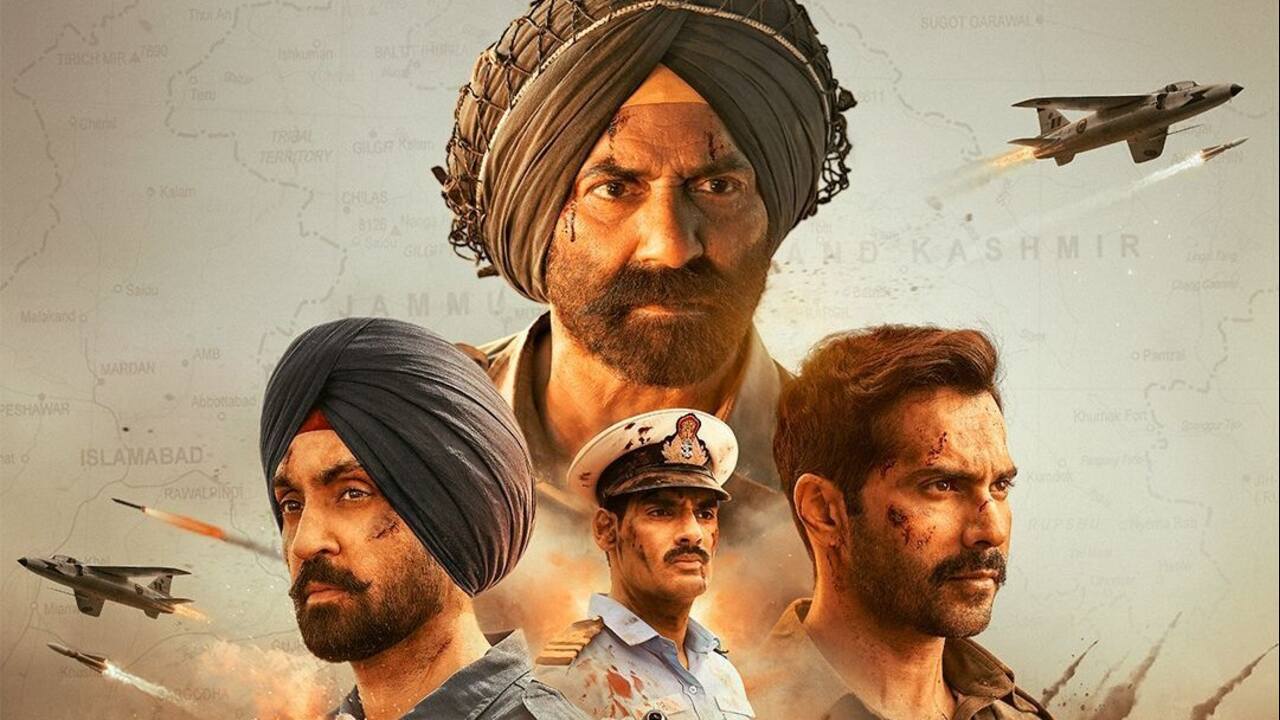
There is a scene near the beginning of Anurag Singh's Border 2 where Major Hoshiar Singh Dahiya (Varun Dhawan) and three of his men encounter a few Pakistani soldiers at a shared water source. Both sides are there for water. Hoshiar's men need it for their vehicle, while the Pakistani soldiers need it for hydration. This is where Singh could have taken the Ikkis route—by having Hoshiar declare something along the lines of, "The liquid in front of you doesn't distinguish between Indian and Pakistani soldiers." What happens instead is that Hoshiar confidently walks toward the enemy and makes one of them salute him. Singh, in other words, shows little interest in humanizing the people of Pakistan.
Yes, Lt. Col. Fateh Singh Kaler (Sunny Deol) tells a Pakistani serviceman that he, too, is a soldier, but the intention is not empathy; it is to underline the greatness of the Indian armed forces. Yes, the man who salutes Hoshiar looks—and dies—like a brainwashed kid, but the underlying message is that even the "humans," the so-called "innocent souls" in Pakistan, are physically and mentally feeble. They are not strong like our good guys, who love their wives, mothers, and children. The implication is clear: Hoshiar, Fateh, Fg. Offr. Nirmal Jit Singh Sekhon (Diljit Dosanjh) and Lt. Cdr. Mahendra Singh Rawat (Ahan Shetty) are emotionally vulnerable yet simultaneously fierce and courageous.
One could argue that Singh maintains an anti-war sentiment by foregrounding the loss of brave Indian soldiers who never return from battle, thereby breaking promises made to their mothers or sisters. But unlike a filmmaker such as Sriram Raghavan, Singh offers a vision of humanity that exists on only one side of the border. Pakistani soldiers are reduced to unidimensional stick figures, present merely to deliver blood-boiling dialogue (a character recounts with relish how he murdered Fateh's son) and to be dispatched by the Indian armed forces. Singh has no fresh or insightful commentary to offer. He simply recycles the rah-rah nationalism of directors like J. P. Dutta—who also serves as one of the producers here and directed the first Border—in a somewhat competent manner.
In Border 2, Singh singles out his primary characters not through massy introductions but through exaggerated demonstrations of character strength. Fateh, with one leg on a mine, defeats a Pakistani soldier. Nirmal, wearing a self-assured smile, guarantees that he can single-handedly overpower enemy forces. Mahendra tells a fellow soldier that they will hunt and kill the enemy rather than run from them. And, of course, there is Hoshiar's water incident.
As a director, Singh is strikingly square. Most scenes end with TV-serial-like cliffhangers—for instance, a cut just as Nirmal and Mahendra are struck with seemingly fatal wounds, prompting us to believe they are dead. Nirmal is given a few playful moments with children so that Singh can later exploit our emotions by killing them. When we learn that Simi (Mona Singh), Fateh's wife, opposes her son's desire to join the armed forces, it becomes immediately obvious that he is destined to die for emotional effect. The narrative beats are wholly predictable. Singh, like an obedient mainstream filmmaker, recycles the wheel instead of reinventing it.
That said, Singh is not incompetent. His proficiency shows in a punishment gag (Hoshiar, Mahendra, and Nirmal are ordered to run up a hill for indiscipline), the return of a poem, and the handling of visual effects. The war sequences across air, land, and water are quite convincing; nothing feels overly green-screened or artificial.
And yet, Singh repeatedly dilutes the impact of genuinely tense moments through relentless nostalgia. When Mahendra prays, "Mujhe shakti de maa," one is instantly reminded of Sunil Shetty—Ahan Shetty's father—uttering the same line in Border. Border 2 indulges heavily in nostalgia-baiting, often pulling us out of the moment. While listening to "Ghar Kab Aaoge," I couldn't help wondering why the filmmakers couldn't have come up with a new song. This, however, is a relatively minor issue. What's worse is the use of AI-driven nostalgia: the decision to insert characters from the first Border toward the end is an egregious error, a cheap tactic designed to exploit the memory of the audience.
There is another fundamental problem with Border 2: Singh is unable to sustain the momentum of its heroic moments. He comes close just before the interval, and he effectively stages the glory of Mahendra and Nirmal as they near death. But once these two men are sent to heaven, the film's energy collapses, leaving us in emotional exhaustion. By the time Hoshiar fights on the battlefield and Fateh rescues him from an enemy with a rocket launcher, our senses are so numbed that the display of valor barely registers. I was so mentally drained that I could have taken a nap in the theater. Compared to this loud exhibition of violence, the first half of Border 2 is infinitely more engaging and far superior.
Still, the film amounts to nothing of real significance. This is just another "Pakistan is bad" war movie populated by simplistic characters and built on a crude notion of patriotism. In films like Border 2, patriotism simply equals bashing Pakistan—a disturbingly thin definition of something that deserves far greater depth. By the film's standards, the man who spits tobacco on a wall, the mother who lets her child defecate on a railway track, the rapist, and the politician who gathers votes through grand promises while destroying basic infrastructure can all refer to themselves as patriots. Such war films use history and superficial ideas to rile up young viewers, functioning less as cinema and more as recruitment posters.
Yes, Pakistan has often been up to no good and has been found guilty of terrorism. But a film like Border 2 never allows us to introspect, never asks us to examine our own homes. It suggests that the rot exists only beyond our borders, that the real enemy is always far away somewhere. By refusing to fix the leaking roof in your own house and screaming at your neighbor, you do not become patriotic—you merely expose your own foolishness.
Final Score- [4/10]
Reviewed by - Vikas Yadav
Follow @vikasonorous on Twitter
Publisher at Midgard Times



Hi Everyone, after a due consideration, we have decided that we will be open for donations to help us in managing our website. We will be greatful for any kind of amount we receive. Thanks!
— Midgard Times 🎬 (@Moviesr_net) January 4, 2026
PayPal- [email protected] pic.twitter.com/DlNNz5Npm5
Get all latest content delivered to your email a few times a month.
Bringing Pop Culture News from Every Realm, Get All the Latest Movie, TV News, Reviews & Trailers
Got Any questions? Drop an email to [email protected]


 © Copyrights MOVIESR.NET All rights reserved