

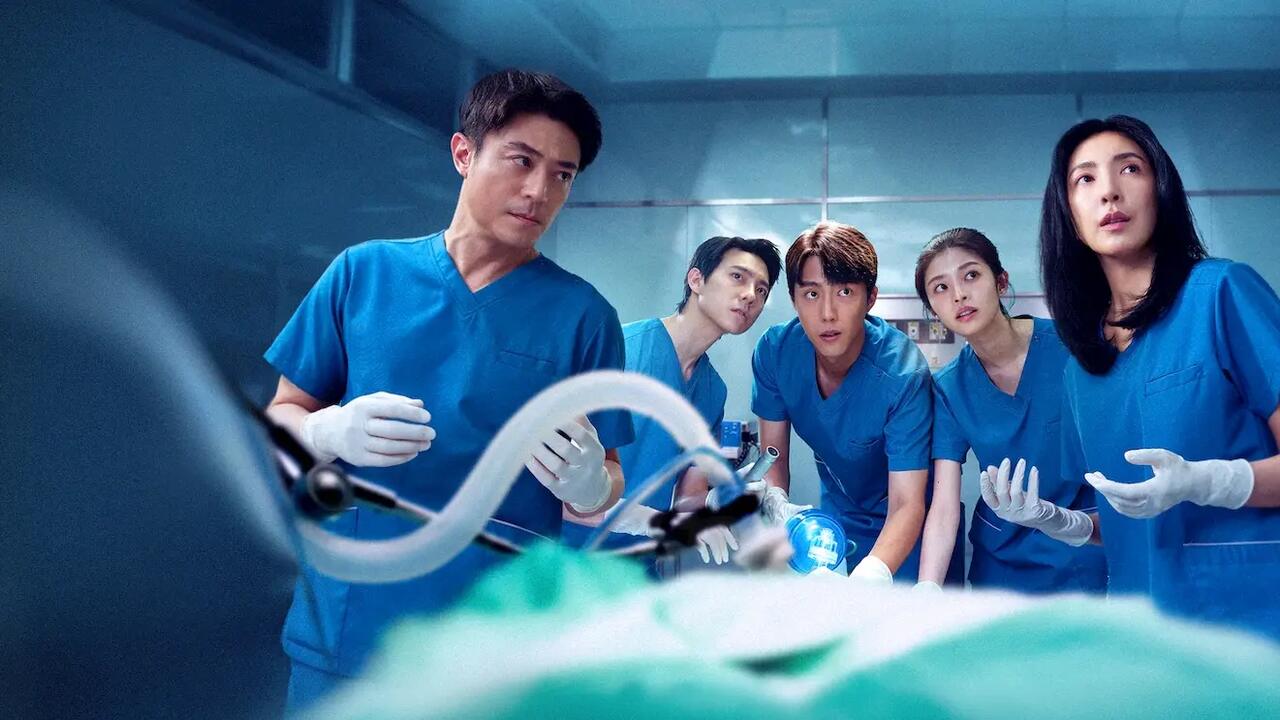
Medical dramas have a difficult balance to maintain. The emergencies need to be convincing, the medical decisions must carry enough weight to sustain the tension, and the doctors themselves need lives beyond the hospital corridors. A steady sequence of critical patients and last-minute interventions can create urgency, but it rarely makes for a compelling series on its own. What matters is whether the people treating those patients become interesting enough for us to care about what happens when the next emergency arrives. Miracles of the ER, Taiwan's new medical workplace drama, approaches this familiar territory through a group of doctors at Yang-Da University Hospital, where professional ambition, institutional pressures and the realities of emergency medicine intersect.
The central character is Lin Geng-ming (Kent Tsai), a medical graduate whose academic performance falls short of that of his peers. He receives an unexpected opportunity when Chou Cheng-chun (Wallace Huo), the hospital's associate director of emergency medicine, decides to bring him into the department. Lin joins fellow first-year residents Tang Hsi (Chan Tzu-hsuan) and Chiang Tung-yen (Payne Peng), both of whom have considerably stronger academic credentials. Under the supervision of senior physician He Yu-hua (Cheryl Yang), the three encounter the demanding realities of emergency care, where theoretical knowledge has to translate into decisions that can affect whether someone lives or dies.
I find Lin's position within this group one of the more interesting aspects of the premise. Medical dramas frequently introduce exceptionally talented young doctors whose competence is established almost immediately. Giving the central newcomer a less impressive academic record creates a different starting point. His presence raises questions about what makes a good doctor and whether examination results are an adequate measure of someone's potential in a profession that requires judgement, communication and the ability to function under pressure. It also creates an obvious comparison with his more accomplished colleagues. The challenge is to make his development feel earned rather than relying on the familiar idea that the supposedly average individual will eventually prove everyone wrong.
The emergency department is a particularly useful setting for exploring these questions. Unlike medical dramas centred primarily on long-term patient relationships or individual specialisations, an ER team encounters a wide range of situations with little time to prepare. Decisions have to be made with incomplete information; patients and families may be frightened or distressed, and the consequences of an error can be immediate. The pressure is professional, but it is also deeply personal. Doctors are expected to remain composed while dealing with circumstances that would overwhelm most people. This contradiction gives the genre much of its emotional potential.
Chou Cheng-chun, played by Wallace Huo, represents the experienced physician who has learned to operate within these conditions. His decision to accept Lin suggests that he sees something worth developing in a candidate whose academic record might otherwise have counted against him. He Yu-hua, portrayed by Cheryl Yang, offers another perspective on the profession. Her dedication to emergency medicine is complicated by institutional problems and workplace disputes, suggesting that the challenges facing doctors extend well beyond their interactions with patients. I am particularly interested in the latter dimension. Hospital dramas can become repetitive when every conflict is reduced to a medical emergency, whereas questions of institutional responsibility, professional hierarchy and workplace conditions offer a broader understanding of healthcare.
The three residents also provide an opportunity to examine different ideas about competence. Tang Hsi is an accomplished graduate whose reasons for entering emergency medicine are connected to her family, while Chiang Tung-yen is academically brilliant but emotionally guarded. Lin, meanwhile, has enthusiasm that exceeds his experience. These contrasting personalities could make for an effective ensemble, especially if their differences influence how they approach patients and difficult decisions. The most worthwhile character development would come from seeing their initial assumptions challenged by situations that cannot be resolved through academic knowledge alone.
There is, however, a risk of trying to cover too much. The series has several residents to develop, senior doctors with their own professional histories, recurring medical emergencies, ethical questions, and internal hospital conflicts. Eight episodes provide a reasonable amount of space, but an ensemble medical drama still needs to decide which stories deserve the most attention. If every episode introduces another crisis while briefly revisiting the characters' personal struggles, the result can feel like a collection of dramatic situations rather than a cohesive story. I would rather see fewer cases explored with greater emotional and ethical depth than a constant succession of emergencies designed primarily to maintain momentum.
The show's creative background is encouraging. It reunites director Isaac Li, writer-director Huang Ching-tsu, and producer Jade Lee, the team associated with Tears on Fire. The production has also drawn on research and conversations with frontline medical professionals, an approach that should help ground its depiction of emergency care. That preparation matters. Medical dramas do not need to function as clinical training material, but their emotional impact depends partly on whether the professional environment feels credible. The characters' decisions, workplace relationships and interactions with patients should reflect the complexity of the setting rather than simply provide convenient plot developments.
What interests me most about Miracles of the ER is its underlying question: how do people continue working in a profession where they are repeatedly confronted with suffering, uncertainty and the possibility of failure? The series' doctors are expected to save lives, but they cannot save everyone. They have to return to work after difficult shifts, learn from mistakes, and maintain a degree of emotional resilience without becoming detached from the people they treat. There is a meaningful story in that contradiction, and it gives the series a potentially stronger foundation than the usual emphasis on dramatic rescues.
Ultimately, Miracles of the ER enters a crowded genre with a familiar premise but some worthwhile ideas. Its strongest potential lies in the contrast between academic ability and practical competence, the relationships among its medical team and the institutional pressures that shape healthcare. The ensemble is promising, and the emergency department offers plenty of room for stories involving both professional judgement and human vulnerability. Whether these elements develop into something distinctive will depend on the depth of the writing and the consistency with which the series balances its medical cases with its characters. It has a solid foundation, even if the premise alone cannot guarantee a memorable medical drama.
Final Score- [6.5/10]
Reviewed by - Anjali Sharma
Follow @AnjaliS54769166 on Twitter
Publisher at Midgard Times



Hi Everyone, after a due consideration, we have decided that we will be open for donations to help us in managing our website. We will be greatful for any kind of amount we receive. Thanks!
— Midgard Times 🎬 (@Moviesr_net) January 4, 2026
PayPal- [email protected] pic.twitter.com/DlNNz5Npm5
Get all latest content delivered to your email a few times a month.
Bringing Pop Culture News from Every Realm, Get All the Latest Movie, TV News, Reviews & Trailers
Got Any questions? Drop an email to [email protected]


 © Copyrights MOVIESR.NET All rights reserved