

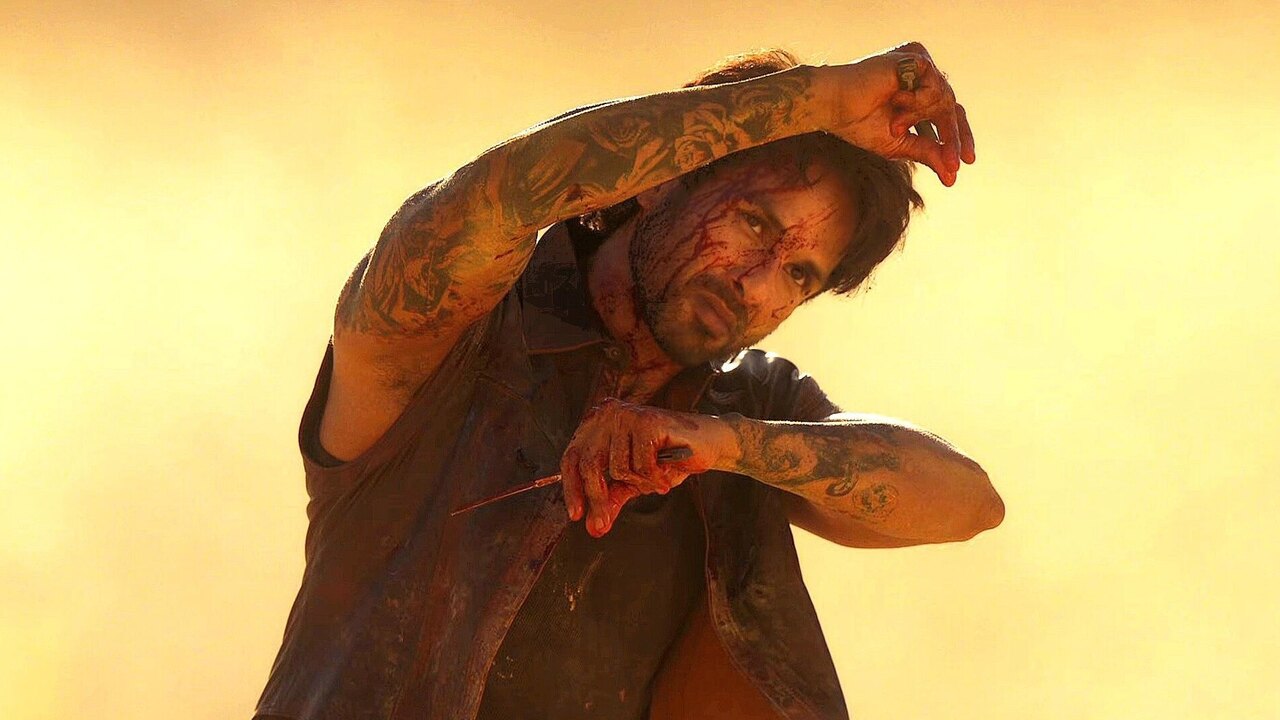
In S. Hussain Zaidi's Mafia Queens of Mumbai, gangster Hussain Ustara is presented as a love-struck Romeo who falls for Ashraf, aka Sapna Didi. He trains her, nurtures her, and prepares her for the world of crime, but is never able to make her his Juliet, as she, well, keeps him in the friend zone. All Hussain can do is kiss Sapna in his wet dreams. When he does make a move on her eventually, she accuses him of taking advantage of her vulnerability and leaves him. Perhaps they are Romeo and Juliet in some twisty way, if you think about it. Hussain often mentions that he used to sense Sapna slowly developing feelings for him, though she never acted on them, as she was too in love with her dead husband. Meaning: there was never a chance for them to unite in this mortal realm, just like those famous lovers from Shakespeare's play. It only makes sense, then, that both stories end in death.
Vishal Bhardwaj, the savant of Shakespearean adaptations, probably viewed the story through a Shakespearean lens. The director reportedly had planned a cinematic adaptation from Sapna Didi's perspective, which was shelved after Irrfan Khan's unfortunate demise. He then revived that material as O' Romeo, which is apparently a different beast altogether from the original vision. Different it might be, but it's surely a Vishal Bhardwaj project. This is the Bhardwaj of Matru Ki Bijlee Ka Mandola and Rangoon—the Bhardwaj who locks himself up in his own fantastical world and doesn't care much about audience expectations. With Mandola and Rangoon, the audience returned the favor. They didn't care about Bhardwaj's quirkiness, which honestly tested our patience. It's possible O' Romeo might meet the same fate, but it's far more accomplished and amusing than those two experiments.
What becomes clear almost immediately is that Bhardwaj has used Zaidi's text as a springboard to mount his own freakish vision. He retains Ashraf's quest for vengeance, her passionate feelings for her husband, Ustara's womanizing, and Ustara and Ashraf's training sessions. We even hear about a doctor who complimented the deep cut Ustara gave to his first victim, which earned him his moniker. These elements, though, are freely reimagined to fit into this new setting. They served as dramatic points in the book; they turn into whimsical, comical points of interest in this film. A part of me is glad that Bhardwaj had to revise the original material. I guess the initial intention was to stick closer to the source, which would have yielded a solid gangster melodrama, but the film would have been too small, too limiting, too conventional. Also, there are already many movies out there about the notorious Dawood Ibrahim. Movies desperately need new villains.
Enter Jalal, a—wait for it—matador living in—wait for it—Spain. The casting of Avinash Tiwary for this role is interesting, considering he and Triptii Dimri make O' Romeo a Laila Majnu reunion. Romeo? Laila Majnu? Oh, I think this casting is intentional. With short hair that makes his head appear bigger and a muscular body that puffs up his chest, Jalal himself looks like a big bull, capable of taming the wildest animal. But this beast of a man has a soft corner, which surfaces during his interactions with his wife. She is Rabia (Tamannaah Bhatia), and she paints to cope with the pain of a miscarriage. With Rabia, Jalal doesn't touch the sword. Rather, he picks up a brush to help his wife paint. So in love is he with her that he threatens a plumber that he will kill him if the leaking roof ends up spoiling Rabia's canvas.
The beautiful women in O' Romeo make men weak in their knees. Jalal becomes a vulnerable baby in Rabia's presence, and Ustara (Shahid Kapoor) gives up his plans of freedom for Afshan (Dimri). Ustara and his men constantly plan on escaping to Fiji or Yunan (Greece), but our contract killer doesn't want to be anywhere without Afshan. Afshan, meanwhile, won't go anywhere without killing Jalal. Like Zaidi's book, the movie, then, can only end with someone dying. But unlike the book, the movie takes a long, colorful route to its destination. In Mafia Queens of Mumbai, the narration is tightly centered on Hussain's relationship with Sapna, which gives rise to a tragic romance. Bhardwaj, on the other hand, expands the source tonally, narratively, and visually. He doesn't settle for a single genre or track; he shovels in drama, melodrama, romance, crime, thriller, comedy, Western, and action. Bhardwaj lets himself loose—he lets his freak flag fly.
Bhardwaj keeps Ustara and his men on a ship that seems to exist on a different island. The place is populated with unusual objects like a gun-shaped bottle and unusual characters like simultaneously speaking twins, a flute-playing man, and…an old woman (an underutilized Farida Jalal). What's more, people say "Ciao" and "Aye Caramba" and talk of Portugal. This is the kind of film where a fight in a movie theater is won by throwing apparently unlimited knives. And that fight is curiously scored to the song "Dhak Dhak Karne Laga." Maybe to keep this fantasy grounded in some reality, Bhardwaj introduces real-world events through newspapers that talk of, say, Mayawati. Ustara has no opinions about the news that's fed to him. Period-specific Bollywood songs are played on the radio, but Ustara doesn't speak of his favorite song, singer, actor, or film. These things merely add "flavor" to O' Romeo; they stem from the giddiness of a film geek.
This collision of fiction and reality creates a tonal tension in the film that Bhardwaj never quite resolves at any point. I guess he prefers to keep things messy. A safe, conventional director would have tidied up the mess. They would have also worked with a propulsive rhythm to keep the story "engaging." Bhardwaj, though, treats the scenes as musical notes of varied pitch. Some, like the flashback that quickly and sharply depicts Afshan and Mehmood Qureshi's (Vikrant Massey) love story and a carrom competition between Afshan and Ustara, have the graceful flow of a gentle ballad. Some, like fight sequences where Ustara moves in a circle firing bullets, have the energy of rock music. And some, such as the scene where Ustara tells Afshan to strip, hum like notes that are still finding their lyrics, their voice. There is no one mood, no single atmosphere enveloping the whole film. Watching O' Romeo, in fact, is akin to sitting in a vehicle that starts and stops at its own whims. This is why many people would struggle to tune themselves to the film's frequency. They will complain that they were unable to connect with it. Who can blame them? They are thoroughly conditioned by mediocre movies.
You are never sure what Bhardwaj will hit you with next while watching the film. I didn't expect a dance to be interrupted by Ustara's cries, and I certainly didn't expect to see his men crying with him. It's a funny scene, though it also renders these characters soft oddballs and cute puppies. Bhardwaj, with lyricist Gulzar, also has fun with the music. I was sometimes laughing, sometimes cheering, listening to lyrics like "Neeche paan ki dukaan, upar Julie ka makaan" and "Haye ishq ka itar mehnga tha par le liya / Shaam-e-gham ke liye kuch zehar le liya." As pleasing as the words are to the ears, the images, too, are pleasing to the eyes (Ben Bernhard is the cinematographer). The frames are richly embellished, all right, but they don't come across as vulgarly expensive. One can only accuse Bhardwaj of being indulgent; he indulges in scale, tone, and beauty. But it's also true that without this indulgence, O' Romeo would have become just another ordinary gangster movie.
As much as I enjoyed O' Romeo, it's one of those films I will never watch again in my life. Then again, I don't watch any movie multiple times. This is not a criticism; it's just what it is. At 178 minutes, O' Romeo is too long, and all its surprises get exhausted the first time. Nonetheless, I am glad Bhardwaj got to make this film and that it received a wide theatrical release. Whether a large section of the moviegoing audience will turn up for it remains to be seen. With O' Romeo, we get the pleasure of seeing the Vishal Bhardwaj who has observed the current violent trend in movies and then decided to give audiences the thrills they seek. It's just that these thrills are designed by Bhardwaj on his own terms; he makes his stance absolutely clear from the beginning. He serves his dish and says, "Eat it or leave it."
Final Score- [7.5/10]
Reviewed by - Vikas Yadav
Follow @vikasonorous on Twitter
Publisher at Midgard Times

Hi Everyone, after a due consideration, we have decided that we will be open for donations to help us in managing our website. We will be greatful for any kind of amount we receive. Thanks!
— Midgard Times 🎬 (@Moviesr_net) January 4, 2026
PayPal- [email protected] pic.twitter.com/DlNNz5Npm5
Get all latest content delivered to your email a few times a month.
Bringing Pop Culture News from Every Realm, Get All the Latest Movie, TV News, Reviews & Trailers
Got Any questions? Drop an email to [email protected]

 © Copyrights MOVIESR.NET All rights reserved