

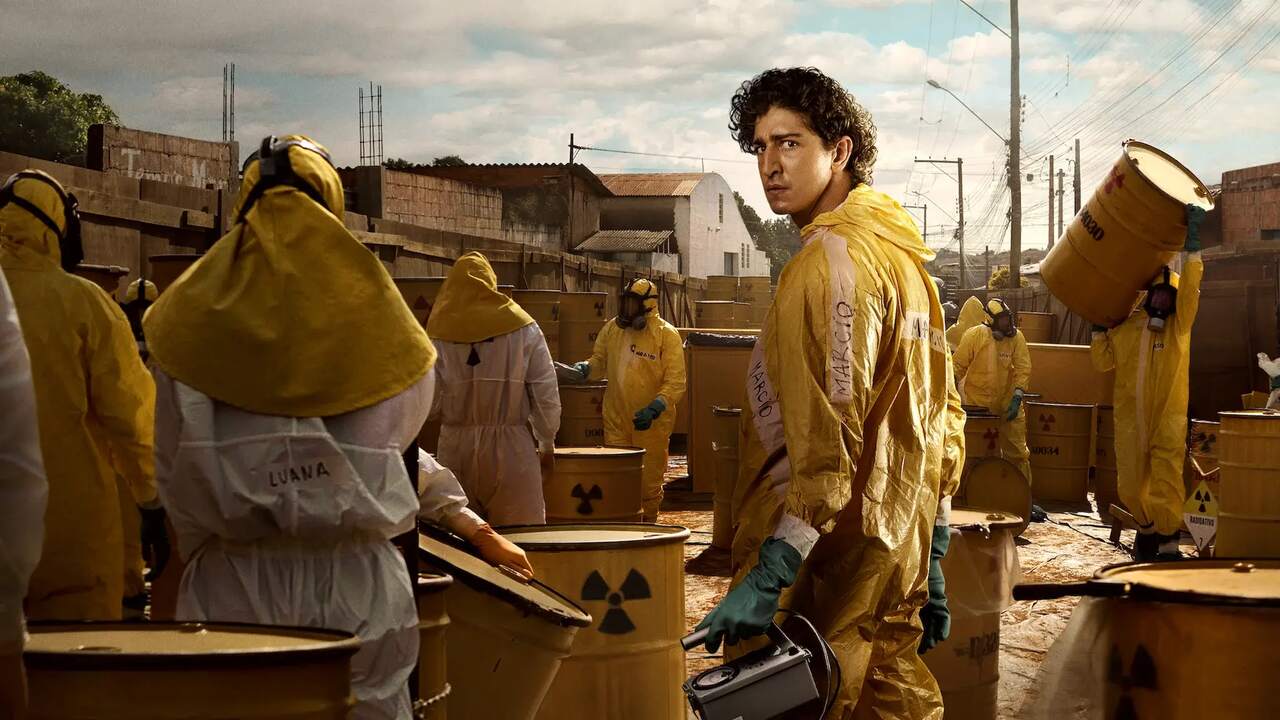
With Radioactive Emergency/Emergência Radioativa, creator Gustavo Lipsztein uses the 1987 Goiânia incident involving cesium-137 to make several crucial points. He accuses those in power of attempting to downplay the tragedy during such events to protect their reputation. But Lipsztein doesn't stop there. He also criticizes them for failing to educate the masses—for keeping them in the dark about nuclear science, particularly how to identify such substances and understand their effects on victims.
The series opens with two scavengers who discover a lead capsule in an abandoned hospital. They carry it away, force it open, and sell it to a man who becomes fascinated by the glowing blue powder leaking from the container. Had this man or the scavengers possessed even basic knowledge about nuclear materials, they would never have handled the capsule or exposed their family members to the substance. It is therefore not surprising that they refuse to trust professionals when informed about their condition. Evenildo (Bukassa Kabengele), along with his family and friends, believes that the government is trying to imprison them and destroy their homes to construct high-rise apartments.
Brazil in 1987, after two decades of military rule, was slowly rebuilding its democratic institutions. This may explain why people like Evenildo lacked full faith in the government. Then again, in which period have the underprivileged truly benefited from politicians? The governor in Radioactive Emergency, played by Tuca Andrada, is more interested in maintaining his image and pacifying the crowd—even if it means circulating incomplete or incorrect information. Yet he is no cartoon villain; he wants to protect his people, and his actions are not unlike those of many real-life politicians.
The cesium-137 incident occurred almost a year after the Chernobyl disaster, so Brazilian citizens were not entirely unfamiliar with terms like "nuclear energy" and "radioactive contamination." Whenever they are told what has happened, their first instinct is to invoke Chernobyl. Ordinary citizens understand the gravity of nuclear threats, but only in broad, generalized terms. This explains the protests when a little girl is buried—the people fear her body will poison their land and water. It is not only the public that falters. Many doctors protesting outside a hospital for better supplies and wages refuse to approach cesium victims, fearing contamination themselves.
Lack of knowledge gives rise to a crowd that panics and is filled with fear—and even resentment. One of Catarina's (Marina Merlino) friends refuses to offer her shelter, fearing contamination, even though Catarina has been declared healthy by doctors. A man watching the news bitterly suggests that all victims should be expelled. Another group prevents a secured container from being disposed of in their area, despite assurances that it no longer poses a danger.
Lipsztein is clear and firm in his objective: he calls for better education. He urges the government to fulfill its responsibility to provide the public with essential information about scientific and technological developments. After all, the two scavengers were unable to recognize the hazard sign outside the room where the lead capsule was found. Beyond slogans like "Doctors are the real heroes" and "Politicians are not worth your trust," and messages such as "The kindness of human beings can move mountains" and "During a crisis, one finds family and friends in strangers," Radioactive Emergency ultimately argues that scientific and technological progress should not occur in isolation.
The public must be educated about these advancements—their mechanisms, their materials, their risks. The glowing blue powder is a marvel in Evenildo's eyes and a poison in Márcio's (Johnny Massaro). It is the difference in education and awareness that separates them. It is this same difference that, say, determines whether tools like ChatGPT are used for misinformation or for meaningful scientific understanding. With Radioactive Emergency, Lipsztein celebrates the power of medical science while contributing to public awareness. He calls for enlightenment—he envisions a world shaped by informed, thoughtful citizens.
Final Score- [7/10]
Reviewed by - Vikas Yadav
Follow @vikasonorous on Twitter
Publisher at Midgard Times





Hi Everyone, after a due consideration, we have decided that we will be open for donations to help us in managing our website. We will be greatful for any kind of amount we receive. Thanks!
— Midgard Times 🎬 (@Moviesr_net) January 4, 2026
PayPal- [email protected] pic.twitter.com/DlNNz5Npm5
Get all latest content delivered to your email a few times a month.
Bringing Pop Culture News from Every Realm, Get All the Latest Movie, TV News, Reviews & Trailers
Got Any questions? Drop an email to [email protected]



 © Copyrights MOVIESR.NET All rights reserved