

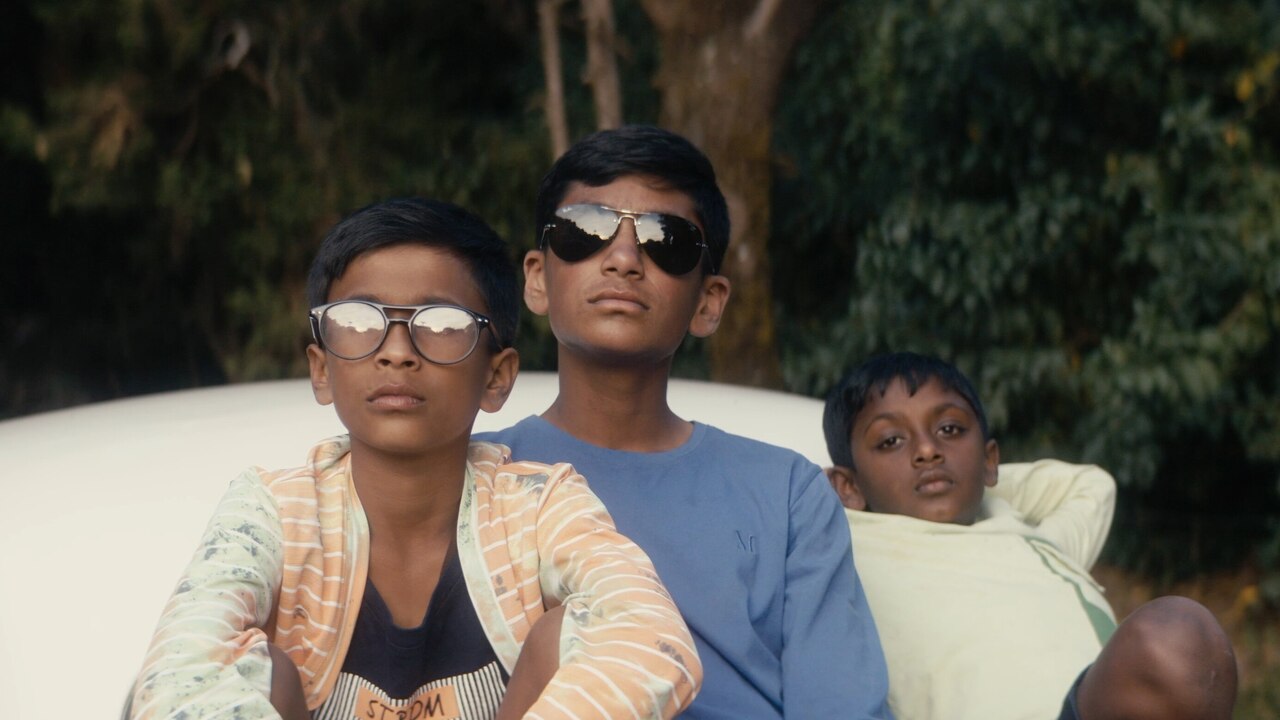
In Naangal, Avinash Prakash displays an uncanny ability to conjure specific emotions at precise moments. This partly autobiographical family drama is an epic of intimate proportions, and it reveals itself to be a beautiful, heartbreaking horror movie. The horror originates from Rajkumar (Abdul Rafe), a father of three, who appears on screen in haunting shades of black and white. The thunder and rain outside make his entry dramatic. And yet, this intimidating figure does something gentle during this introduction: he removes the glasses from one of his children, who, just seconds earlier, saw Rajkumar and peed his pants like someone who has suddenly found himself before a malevolent spirit. Prakash, through this scene, essentially sets up the central idea of his film. The children—Karthik (Mithun), Gautam (Nithin Dinesh), and Dhruv (Rithik Mohan)—see Rajkumar as a monster, but he is also capable of being kind.
Prakash's gaze is so laser-focused on this "Hitler daddy" that the character comes vividly to life on screen. His brutal methods send shivers down your spine; he reminds you of fathers and their strict, frightening side. Prakash is so effective, so precise, in conveying fear that the camera does not always need to look directly at Rajkumar for you to understand what he might be thinking. In one scene, all the director does is show Rajkumar inspecting a door with his hand and the floor with his feet, and you shrink in your seat, fearing for Gautam's safety—the camera stays on Gautam, who sweeps the floor, so you only see Rajkumar's lower body. Naangal familiarizes you with the family's routine so intimately that, like the children, you too grasp what must be done and what will be the consequences of failure. Hence, when Rajkumar slaps one of his sons for failing all six subjects, you almost quiver anxiously.
For most of the film, Daddy Dreadful is so chilling that whenever he turns vulnerable or sweet, you react with surprise. Look at Rajkumar as he sings "O Haseena Zulfonwale Jane Jahan" and dances childishly as if no one is watching. But when he cries and tells his children that he will return their childhood to them—and even tells one of the boys that it is okay to fail in life—you choke up, unable to respond to this soft side. It is like that moment when you suddenly find your father, who had been acting stern and dictator-like throughout most of your young life, weeping. What do you do? How do you console someone like this? No wonder you freeze.
The scene in which the boys greet their father as he wakes up and then lies down instantly is simultaneously funny and heartbreaking. These rug rats look like programmed robots; the joy of childhood seems spoiled. To Rajkumar, his children are like projects that must be successfully launched into life. He himself is so beaten down by failure that he does not want the same fate for them. He fears their mother's (Prarthana Srikaanth) presence would make them "soft." He fears that if they cannot achieve first rank in school, they will not achieve first rank anywhere else. Rajkumar is so afraid that he imposes strict routines on his boys, hoping to toughen them up for the challenges they will face as adults trying to make a living. What he does not realize is that his actions turn him into a rock that, tied to their legs, drowns the kids. Perhaps more tragic is the sense that Rajkumar knows he is destroying their innocence—he simply justifies it by believing his intentions are right.
There is always a limit to how much oppression someone can endure before retaliating. In Naangal, the breaking point comes when Rajkumar hits their dog, Kathy (Roxy). Karthik fights back and, in the process, strikes Rajkumar's face, giving rise to a shot that doubles as a statement: the children love the dog more than their father. This does not mean that from this point onward, Karthik, Gautam, and Dhruv begin standing up to their bully. In the same way, when the three of them are sent to their grandfather's home, leaving Rajkumar alone in the big house, he is seen frustrated by empty containers and dirty utensils. If you think this makes him realize how valuable the children were in running and maintaining the house, think again. Naangal does not become that film where, say, a husband realizes how difficult it is to run a household when his wife leaves.
People like Rajkumar aspire to greatness, envision themselves as significant figures, and grow frustrated when society shatters their illusions. Their performance of authority in front of their innocent children comes across as a coping mechanism. Rajkumar himself may have failed in life, but he confidently tells his sons that he will teach them how to flourish. It is easy to grasp this character, and Prakash's intentions could have been conveyed even within a runtime of, say, 1 hour and 40 minutes. At 2 hours and 30 minutes, Naangal can feel tedious because it does not have enough to communicate to the audience. The film's ideas about the father and his sons could easily be expressed in a shorter runtime. If you are going for a length that suggests epic scale, you should also pack more detail into your story.
After a while, your mind starts wandering to other things. The children watch Baby's Day Out near the beginning of the film, but they do not talk about it afterward. Did they like it? What did they respond to? Both Karthik and Dhruv are seen in the company of girls who make them blush, who make them smile. No boy goes about the rest of his day without thinking about such encounters or talking about them with friends. And the boys do have friends, yet Prakash does not show a single conversation between them. He also elides the political details of the period, placing Naangal in a hermetically sealed world where nothing external intrudes upon the family's life. The movie posters (Hey Ram, Baby's Day Out), the candies (Boomer), and the libraries with their Hardy Boys and Tintin—detached from the characters' inner lives—become aesthetic embellishments. This distance allows Prakash to focus more sharply on his characters' emotions, but the resulting drama feels thin. You learn everything about the family quickly and are left with plot details—like a flashback that briefly shows Rajkumar, the happy family man, becoming Rajkumar, the ambitious businessman—that largely repeat what the film has made clear already, or rather, what you can deduce on your own by simply observing the moods and the mannerisms of the family.
Prakash may be a skilled technician—the film moves smoothly between color and black and white—and a capable creator of emotion, but he is not especially introspective. He does not dig deep enough into his past to create a drama teeming with life. He looks back with limits—with terms and conditions. He reduces Karthik, Dhruv, and Gautam to their functions within the script, and Rajkumar, too, is presented simply as a man who lost everything, with details of his business dealings and professional demeanor left offscreen. Prakash neither sees his film fully through the eyes of an adult nor through those of a child. Instead, he adopts a nostalgia-ridden "poetic" lens that produces pretty, atmospheric images but traps the characters in a bubble of heightened emotion. The story unfolds within narrow confines; the film runs out of energy quickly. This is why, despite spanning multiple years and aspiring to epic scope, Naangal ultimately feels slight. It is a good drama that, by concentrating on a limited domain, never becomes a truly stellar, stunning film.
Written by - Vikas Yadav
Follow @vikasonorous on Twitter
Publisher at Midgard Times

Hi Everyone, after a due consideration, we have decided that we will be open for donations to help us in managing our website. We will be greatful for any kind of amount we receive. Thanks!
— Midgard Times 🎬 (@Moviesr_net) January 4, 2026
PayPal- [email protected] pic.twitter.com/DlNNz5Npm5
Get all latest content delivered to your email a few times a month.
Bringing Pop Culture News from Every Realm, Get All the Latest Movie, TV News, Reviews & Trailers
Got Any questions? Drop an email to [email protected]



 © Copyrights MOVIESR.NET All rights reserved