

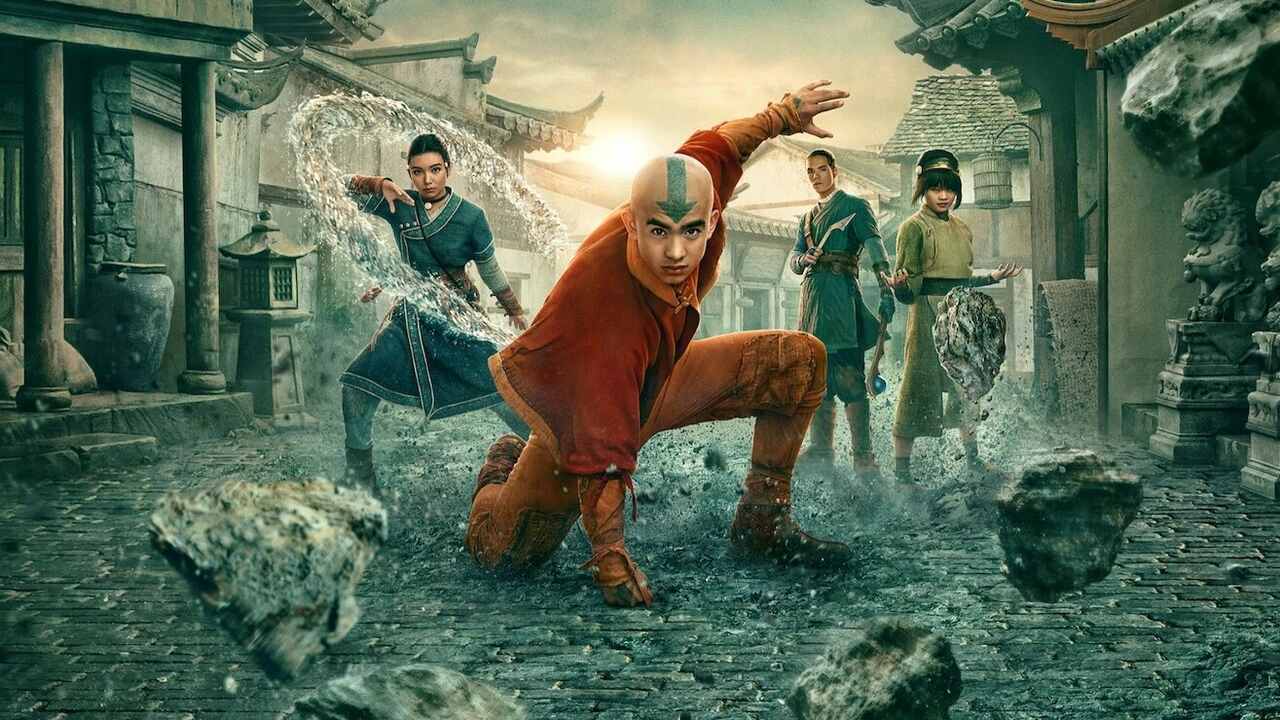
The second season of Avatar: The Last Airbender drops the fantastical ambitions of the first season—which were lame anyway—to focus on human drama about strained relationships, which is lame anyway. The new batch of seven long episodes is rooted in familial conflict, drawing much of its energy from parents undermining their children and children rebelling against their parents' preconceived notions in order to prove themselves capable. It's a noble idea that gives the show a dramatic heart, but the drama itself—the disputes and strife—is nonetheless boring and bland. This is a story in which the siblings Prince Zuko (Dallas Liu) and Princess Azula (Elizabeth Yu) are conditioned to compete with each other by none other than their own father, Fire Lord Ozai (Daniel Dae Kim). This ruthless ruler of the Fire Nation also holds deeply patriarchal views, which means that despite Azula's immense capabilities, he still refuses to see her as his heir. This only widens the gap between Azula and her brother.
It's not just the men who are backward in their thinking here. Ask Toph Beifong (Miya Cech), and she will vouch that her parents aren't progressive either. Both her mother and father view her as a delicate creature and want to marry her off as soon as possible. Toph may have been born blind, but she doesn't regard it as a weakness. She is, in fact, a gifted, powerful earthbender who can stand her ground in battle. What's more, she ends up becoming Aang's (Gordon Cormier) teacher. Much of the humor in Season 2 comes from Toph's sarcasm and abrasiveness. She makes for better comic relief than Sokka, played by Ian Ousley. Sokka's dim-wittedness doesn't so much make you laugh as prompt you to dismiss it as something cute, something adorable. His "sweet foolishness" is mild next to Toph's caustic, witty insults. It's ultimately Toph and Azula who come across as more alive and volatile than the rest of the characters, who remain trapped in an oppressively static atmosphere.
You can't obviously blame certain characters like, say, Zuko, who's supposed to be gloomy and sad. Still, rather than emotionally connecting with his tragic circumstances, you end up seeing him as a boy draped in depressing shades to give the show a "poignant surface." His arc—from a brainwashed son to a young man trying to change and then reverting to his original state—seems muddled, partly because it's just one of many elements in an overstuffed yet undercooked season. The changes Zuko goes through feel less psychologically motivated and more like plot convenience. The situations he is put through carry a stale odor of familiarity. When he encounters a boy and his sister, who feed him dinner and whose kindness he repays by doing household chores like fixing the roof and washing the dishes, you immediately recognize that this union won't last forever. The series, too, provides a clue in the form of the sister's (Madison Hu) statement about her hatred for the Fire Nation. Avatar: The Last Airbender probably thinks it's preparing us for the heartbreak that will arise from the revelation of Zuko's identity, which would make the siblings hate him and sever all ties with him, but the moment, when it comes, falls flat. Predictability aside, the brother and sister are severely underdeveloped and reduced to a narrow, obvious function. This is why the scene in which they catch Zuko firebending in the streets barely registers.
One can extend that complaint to the entire second season: very little of it lands with any force, any conviction. Avatar: The Last Airbender works with something I would like to call "Drama Lite." It's a situation in which a movie or show contains all the necessary ingredients to become a biting emotional roller coaster, with threads concerning, in this case, interpersonal conflict, ego, unstable friendships, familial tension, world-ending stakes, and personal ambition; and yet, these spicy elements are cooked over low heat and in stale, expired oil because...who cares as long as there is brand recognition? A large section of the audience will tune in anyway. It's not that Season 2 isn't an improvement over the first season (it is!) or that it's lacking in interesting developments. It's admirable how holes are poked in Aang's "savior image" by presenting him as a flawed human being who can be seduced by flattery and sweet-sounding compliments. I was also surprised to find myself reacting somewhat strongly to the tortures and troubles faced by the seemingly replaceable Soo Jee, who comes to represent the loss of individuality in a controlled, oppressive governmental environment.
But even with some of the positives sprinkled here and there, Season 2 of Avatar: The Last Airbender, in the end, undermines its strengths by wrapping them up in a dull, formulaic package. This is most evident in its handling of Aang's inflated ego and the arguments he and his friends go through, which end in their separating from one another. Season 2 never takes Aang to such an extreme that he becomes borderline delusional or tyrannical. Every scene of him behaving arrogantly is followed by an apology. His moral compass is never fully shaken. The show almost touches its prickly edges before running back toward safety for fear of turning off the audience. The problem here is that, by doing this, the season essentially delays the major verbal rupture until the penultimate episode, so that any bad feelings can be quickly resolved in the final episode before the last battle. Avatar: The Last Airbender is scared of making things look truly ugly; it wants to please the fans. As a result, what you get is mostly tame despite the rough, acidulous facets. And after watching the unexciting climax, one is left thinking that Season 2's primary aim was simply to explain why the show has the words "The Last Airbender" in its title. After plenty of lackluster talk, there is no vigorous, eye-catching fight or visual waiting to greet you at the end. All Season 2 does is try to generate anticipation for what's to come next. It's a long, exhausting advertisement—alas, it serves as a seven-hour-long teaser for the third and final season.
Final Score - [3.5/10]
Reviewed by - Vikas Yadav
Follow @vikasonorous on Twitter
Publisher at Midgard Times


Hi Everyone, after a due consideration, we have decided that we will be open for donations to help us in managing our website. We will be greatful for any kind of amount we receive. Thanks!
— Midgard Times 🎬 (@Moviesr_net) January 4, 2026
PayPal- [email protected] pic.twitter.com/DlNNz5Npm5
Get all latest content delivered to your email a few times a month.
Bringing Pop Culture News from Every Realm, Get All the Latest Movie, TV News, Reviews & Trailers
Got Any questions? Drop an email to [email protected]



 © Copyrights MOVIESR.NET All rights reserved