

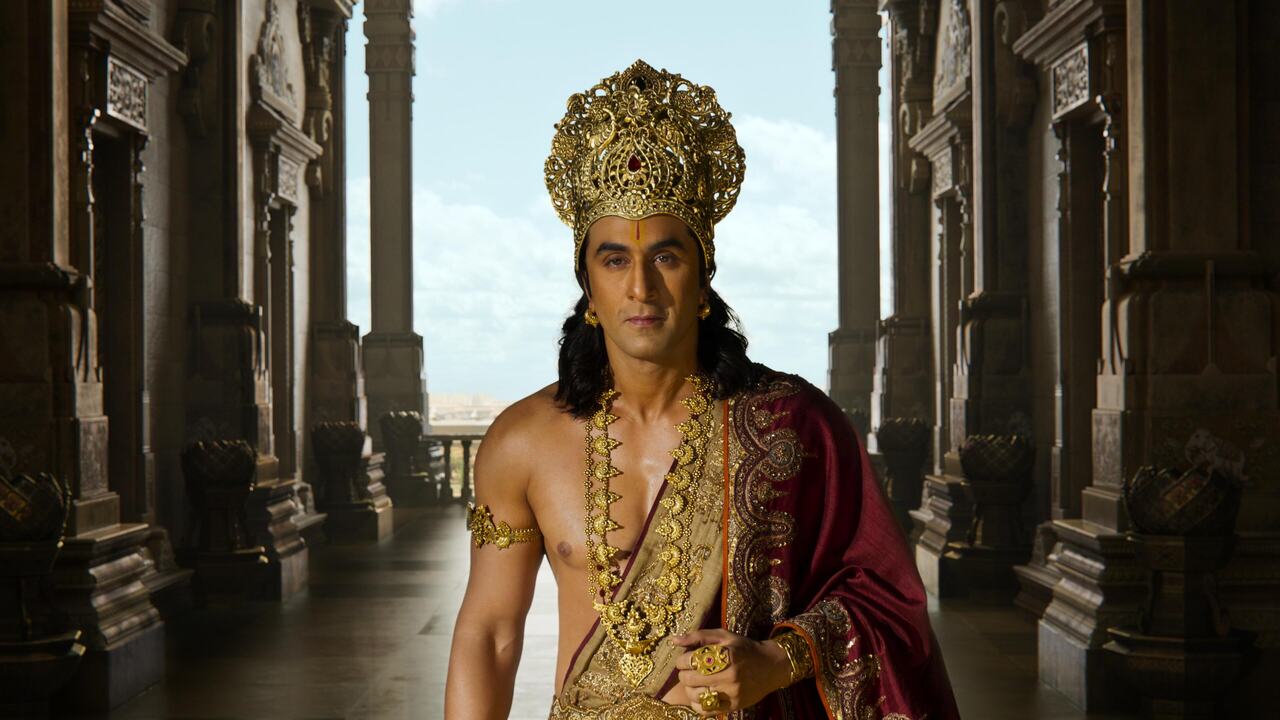
Most people seem to believe that what our Indian epics, the Ramayana and the Mahabharata, need most to become successful screen adaptations is expensive VFX technology. More often than not, the basic debate almost always boils down to an adaptation's visual effects—were the locations, sets, and magical sequences convincing? Some people post screenshots from Western period dramas to emphasize the level of VFX India needs to achieve to make a brilliant Indian epic out of its own mythologies. For this audience, Nitesh Tiwari's Ramayana: Part 1 would be an accomplished piece of moviemaking. Shiny graphics are what they wanted, and shiny graphics are what they get from Tiwari's mythological epic. Brahma is rendered on a cosmic scale, his face filling the sky from top to bottom, while Vishnu appears underwater, his face filling the water from top to bottom. The movie then opens with Asuras fighting Devas, the latter led by Indra (Kunal Kapoor). Immediately, Tiwari sets up your expectations: be prepared to be dazzled by expensive graphics. And these graphics, on their own, are the only things that seem dazzling because Tiwari never, throughout the film, develops a style or an aesthetic distinctive enough to make these images look like anything other than "overpriced."
The action sequences are shot with your usual conventional choreography, where things and people leap at each other in anger, in slow motion, and are thrown around like balls of paper flying across the screen in different directions. Jailer 2, by comparison, was more imaginative with its gory choreography. Tiwari, it seems, doesn't want you to be distracted by nimble limbs and the primal force of an arrow piercing skin. All the adrenaline rush is channelled through the big-budget visual effects that, combined with colorful costumes and gold jewelry, are also meant to be awe-inspiring. This heavy emphasis on money does make this Ramayana a producer's film, which helps explain why it has so often been referred to as Namit Malhotra's Ramayana rather than Nitesh Tiwari's. This generates a contradiction—and a delicious irony—at the very heart of the film. The epic celebrates a great, mighty figure named Ram, who doesn't mind giving up worldly comforts, treasures, money, and the title of king because he isn't attached to wealth and luxury. However, a movie that claims to celebrate such a legendary avatar is itself primarily enamoured of wealth and vanity. Throughout its 3 hours and 15 minutes, what this version of the Ramayana mainly screams is, "Look how impressively that monster and that forest is rendered!" and "Look how beautiful this frame looks with all those dresses and glowing jewelry!"
When Ram (Ranbir Kapoor), Lakshman (Ravi Dubey), and Sita (Sai Pallavi) leave for their 14-year exile, only their chariot is lit, so the surroundings are darkened and dimmed. As they move through the crowd, the camera, for a few seconds, observes the view from above, and it seems as if a glowing ball of light—or rather, a jugnu—is moving in a straight line through the night. It's a beautiful shot, but the beauty robs the moment of its emotional grandeur; Tiwari fails to listen to a father's mournful cries. King Dasharath (Arun Govil) mourns and collapses while calling Ram, but we are busy admiring the rich, elegant colors and lights. My position is not as simple as "So the solution is to settle for cheap CGI." No, I am not against good graphics. But those graphics shouldn't undermine the real substance of what's arguably one of the most breathtaking epics. And what makes the Ramayana truly breathtaking isn't only its cosmic splendor but also the depth and complexity of its characters. The latter is what's majorly absent from this adaptation, which is, in all the wrong ways, simplified. Every book-to-movie adaptation is bound to go through its own set of elisions and tweaks, though these very changes can reveal the filmmaker's intentions—note what he has chosen to retain or remove from his own script, and you can understand his relationship with the source and how he sees it.
In Tiwari's case—or rather, Malhotra's—what mostly emerges is an opportunity to showcase that Indians also know how to throw plenty of money at their films. This is why so much of what makes Valmiki's Ramayana absorbing and fascinating is severely compressed and modified in this retelling. In the original text, when Ram accepts his 14-year exile, Sita decides to follow him, but he initially tries to dissuade her. What follows is not a single brief exchange but an extended, emotionally charged argument that unfolds across several passages. Sita becomes "saṃkruddhā"—angry, and specifically described as becoming angry out of love—and proceeds to challenge Rama's reasoning. He tells her about the dangers and hardships of forest life; she counters him by arguing that those supposed hardships become bearable in his company and that separation from him would be agonizing. She invokes her marriage, her duty, her capacity to endure hardship, and even insists that she cannot be prevented from accompanying him. Rama continues trying to dissuade her, describing hunger, darkness, wild animals, snakes, and the general misery of the forest, while Sita keeps answering him and eventually overwhelms his resistance. This is important because the exchange reveals Sita not merely as a devoted wife but as a formidable speaker who can reason, argue, challenge, and refuse to be patronized. Her strength is intellectual and emotional before it is anything else.
Tiwari, on the other hand, merely establishes Sita's intellectual capacity through one expository line, and, to establish her physical strength, throws in two or three brief shots of her swinging a blade, either to impress a few girls or to fight the enemies. As far as the "I am going with you for the exile" moment is concerned, she simply reminds Ram about their marriage vows, calmly and a little assertively, and he accepts it. The compression doesn't merely shorten the scene; it changes what the scene tells us about Sita. Valmiki's Sita argues until Rama's position changes. Tiwari's Sita makes a point and waits for Rama to agree.
That debate reveals another crucial thing: these epic figures are not interesting because they float above humanity; they are interesting because the text repeatedly allows them to experience and express recognisably human feelings. Rama can be wounded, frightened, angry, confused, and overwhelmed. Sita can be loving, furious, stubborn, eloquent, and uncompromising. Their greatness does not require the suppression of those emotions. If anything, the presence of those emotions makes their greatness more comprehensible to the humans reading about them. That is precisely what makes these epic texts so meaningful, so relevant, so... epic.
Tiwari, however, fumbles here as well by evoking restrained, disciplined performances from Kapoor and Pallavi—the kind of clichéd acting that hacks use to portray reverential characters in biopics. Valmiki's Rama does not respond to Sita's abduction with a single dignified tear. In the Aranya Kanda, he becomes frantic, repeatedly lamenting and searching for her, asking trees, deer, elephants, and other elements of the natural world where she is. He even appears "like a madman" as he runs around searching for her. Tiwari's Ram, though, gives the bland one-tear-rolling-down-the-eye. That's also a terrible waste of Kapoor's acting skills, given that explosive emotions can be glimpsed simmering beneath his measured demeanor. If Tiwari had any good sense, he would have allowed those emotions to erupt feverishly on the screen instead of restraining Kapoor and Pallavi, instead of constraining them to his shallow, unoriginal, and idiot notions of what an exemplary person should look like.
Tiwari, nonetheless, fares somewhat better when dealing with Ravan (Yash). This character is allowed to exude charisma, courage, authority, pride, greed. And when we meet his "ten heads," this Ravan also expresses sentimentality, lust, determination, and sound advice. Credit where it's due: props to Tiwari for finding a visually striking metaphor in the ten heads. Rather than treating them simply as a supernatural anatomical fact, the film turns them into a visual expression of an extraordinary intellectual capacity that exists alongside an inability to bring that capacity under a higher principle. The original epic straightforwardly describes Ravana as ten-headed, but Tiwari's visualization makes the metaphor legible on screen.
In Ravan, Tiwari finds a meaty character, and in Yash, he finds a terrifying, majestic actor. The fact that he doesn't find the same meatiness and majesty in Ram is quite telling. No wonder, thanks to its curious character allegiance and CGI emphasis, Tiwari's Ramayana comes across as the filmmaker's own "sone ki Lanka." It revels in its opulent accomplishments and seems to side with the villain. This is Ravanaya, so to speak.
I laughed when the credits thanked a gold company. And I ultimately walked away from this misconceived interpretation with good memories of Sheeba Chaddha's Manthara, who looks just too perfect as a hunchback witch. I laughed whenever she came on the screen, and I would have loved to see her cackling with delight. At the same time, Chaddha's wily, bitter words got to me, and I hated her thoroughly. Chaddha has almost created a benchmark for playing this character fantastically. She elevates a small role into an actor's showcase, which only proves how excellent she is. Oh, great, so another villain ends up shining in this film? No wonder the whole movie comes across as a soulless exercise in being empty and lavish.
Final Score - [4/10]
Reviewed by - Vikas Yadav
Follow @vikasonorous on Twitter
Publisher at Midgard Times



Hi Everyone, after a due consideration, we have decided that we will be open for donations to help us in managing our website. We will be greatful for any kind of amount we receive. Thanks!
— Midgard Times 🎬 (@Moviesr_net) January 4, 2026
PayPal- [email protected] pic.twitter.com/DlNNz5Npm5
Get all latest content delivered to your email a few times a month.
Bringing Pop Culture News from Every Realm, Get All the Latest Movie, TV News, Reviews & Trailers
Got Any questions? Drop an email to [email protected]


 © Copyrights MOVIESR.NET All rights reserved