

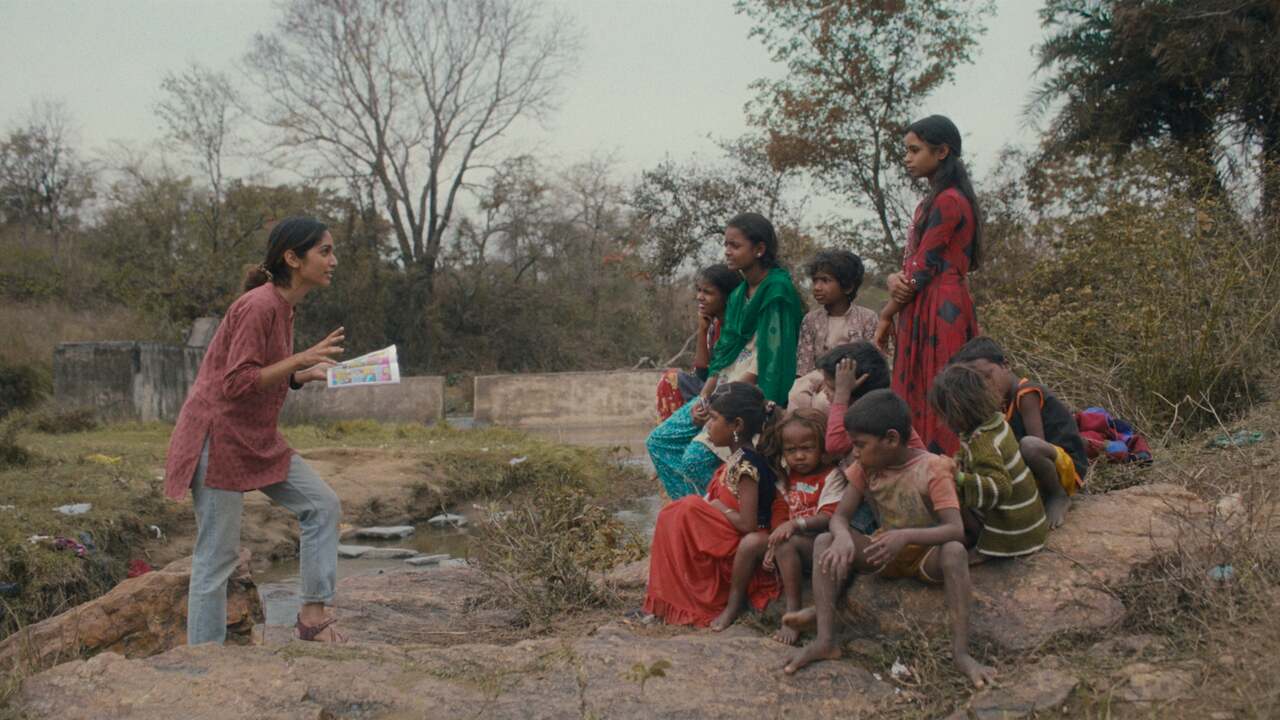
Tanmaya Shekhar, in Nukkad Naatak, very naively, with his heart on his sleeve, extols the virtues of art and its impact on society. If the play within the film encourages slum-dwellers to champion education, then Shekhar hopes the film itself will instill a change in the outlook of his audience. Shekhar is naive, but he isn't entirely building castles in the air. In a mainstream Bollywood message movie, for instance, both Molshri (Molshri) and Shivang (Shivang Rajpal) would have cast aside their cushy career ambitions to start a school for slum children. They would have been introduced as rich, ignorant, high-class students who underwent major transformations after colliding with the poor have-nots. Shivang, given his wealthy background (his father is a doctor who runs his own hospital), could easily have been that typical protagonist.
In Nukkad Naatak, however, Shivang is written as a soft, gentle homosexual who hasn't yet come out of the closet. He has big career goals, but they get derailed once he joins the Abhay club, where he meets Molshri, who quickly takes him under her wing and protects him from bullies. Shivang and Molshri's friendship is the snuggly core that infuses Nukkad Naatak with a plethora of warmth and life. There is an overwhelming amount of compassion and understanding between the two friends, and it gives the movie a sweet, agreeable quality. It's crucial that we are convinced by this companionship because of the scene in which Molshri ropes Shivang into a Robin Hood-style revenge plot against the owner of the college canteen. An unconvincing relationship would have rendered the scene merely a catalyst for the developments involving the education of slum kids. But here, you believe Shivang would actually help Molshri, even if he instantly regrets saying yes to her.
The key to understanding Nukkad Naatak lies in the scene where the college director (Danish Husain) is shocked to learn that Molshri and Shivang never visited the nearby slum, even for research on a play they performed about child labor. This is nothing less than criticism directed at crowd-pleasing message movies that supposedly speak for the underprivileged without ever getting in touch with their world, their routines, or their beliefs. Shekhar, though, is aware of ground realities, and he depicts them through details that take shape as stumbling blocks, hitting the characters when they try to enroll Chhoti (Nirmala Hajra). First, Shivang and Molshri must change the father's attitude by bribing him. Then they bribe a school principal to admit Chhoti. The principal, however, asks for ID proof to complete the admission process, so Shivang and Molshri fill out a form and secure the college director's signature to legitimize it. When Chhoti finally goes to school, she is placed in the sixth grade, which proves problematic since she isn't even familiar with first-grade basics. Forget educational fundamentals—Chhoti doesn't even know how to hold a pencil properly.
Throughout this process, Shekhar never loses sight of Shivang and Molshri's own realities. Shivang is fixated on leaving India for a well-paying job abroad, and for him, getting slum children enrolled in school is initially just a task he must complete to re-enter college and fulfill his own dreams. This doesn't make him a bad person. Shekhar simply presents him as someone with his own fears to conquer—to embrace his sexuality—and his own goals to accomplish. And if Molshri becomes the character who eventually dedicates her life to children like Chhoti, it's because she is portrayed from the beginning as rebellious, hot-headed, kind, and sensitive. As president of the Abhay club, she uses nukkad to preach. She has the drive to change society, and her impassioned intentions find appropriate expression in her efforts to teach underprivileged children. The difference between Shivang and Molshri lies in their internal wiring and social conditioning. It's what motivates one to pursue a cushy job and the other to dedicate her life to poor kids.
I was quite taken aback by Molshri—her performance is one of this year's best surprises for me. According to IMDb, the actor has previously worked in some short films and one episode of a TV series (Raita). But she looks absolutely comfortable in front of the camera and gives the impression of someone vibrantly alive. Shivang is asked to act too coy, too cute, but paired with Molshri, he gets to bounce that cuteness off her fiery streak, making their chemistry a cozy platform on which the whole story rests—for the most part—smoothly.
If I had the power to remove anything, I would take out the framing device. It's silly and unnecessary. The story could be told with the same effectiveness without Shivang's voiceover, which comes courtesy of emails he writes to his dead grandfather (as I said, it's silly). The movie is, for the most part, sufficiently attuned to the effort it takes to convince and educate poor communities, which is why the pat-on-the-back ending feels so contrived and polished. It's not just that the parents agree to send their children to school, but that within two months, we find Molshri running her own school successfully with 45 students. By eliding the practical difficulties of such a massive task, the film presents it as a fairy-tale ending. If the film criticizes Shivang and Molshri for never visiting the slums even for research—and critiques Bollywood crowd-pleasers for representing poor communities from a safe distance within the confines of vanity—then its ending can be criticized in similar terms for being out of touch with reality. Shekhar opts for vague, motivational-quote-like final scenes that suggest dedication and willpower can achieve anything. It's earnest but also fairly unconvincing; it occupies the same territory as the superficial message movies it seeks to critique.
The major issue, though, is that for a movie titled Nukkad Naatak, this drama remains strangely incurious about the art form and its essential specifics. How long does it take to write a nukkad naatak? What is the script's formal structure? Does the writer take input from the team? How long is a typical rehearsal? What exercises does the group do to maintain spontaneity and protect a live street performance from disruption? It's easy to see the film itself as a well-intentioned nukkad naatak, but that would mean overlooking its flaws as a movie. Shekhar is definitely sincere—that sincerity, though, yields a benign drama that never soars to great heights and never attempts to be visually sophisticated or daring. At a time when most mainstream movies look like products of creative bankruptcy, one expects bolder risks from the indie realm. The overall safeness of Nukkad Naatak, in such circumstances, can be disappointing, but Shekhar at least offers enough substance to make you appreciate his film. And then there is, of course, Molshri. The real disappointment, perhaps, would be if someone like her never gets her break in the industry. She is intense, she is energetic, and she deserves to be recognized.
Written by - Vikas Yadav
Follow @vikasonorous on Twitter
Publisher at Midgard Times



Hi Everyone, after a due consideration, we have decided that we will be open for donations to help us in managing our website. We will be greatful for any kind of amount we receive. Thanks!
— Midgard Times 🎬 (@Moviesr_net) January 4, 2026
PayPal- [email protected] pic.twitter.com/DlNNz5Npm5
Get all latest content delivered to your email a few times a month.
Bringing Pop Culture News from Every Realm, Get All the Latest Movie, TV News, Reviews & Trailers
Got Any questions? Drop an email to [email protected]



 © Copyrights MOVIESR.NET All rights reserved