

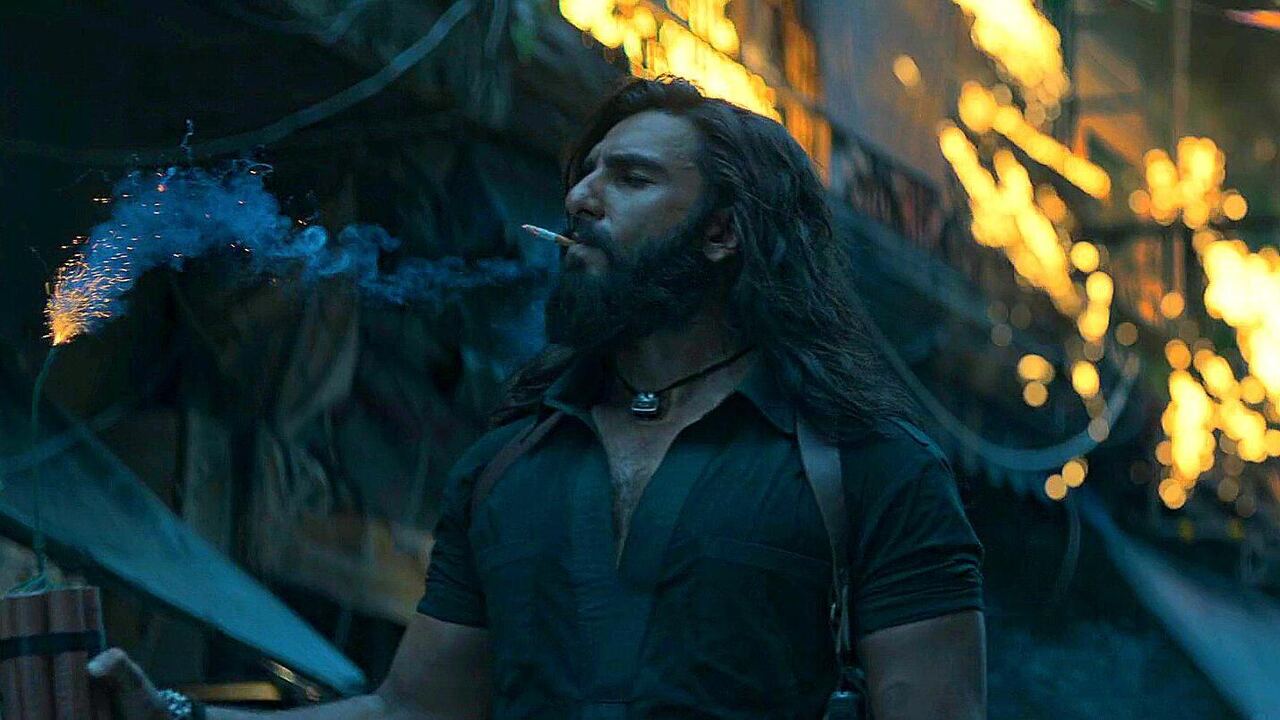
Writer-director Aditya Dhar drops all subtlety in Dhurandhar: The Revenge. He unambiguously identifies himself as an admirer of Prime Minister Narendra Modi. Sure, the Rajit Kapur character in Uri: The Surgical Strike was modeled after Modi, and in Dhurandhar, R. Madhavan's Ajay Sanyal eagerly awaits an honest politician with the guts to tackle fake currency. But in Dhurandhar 2, Dhar stops nudging, winking, and gesturing toward his idol—his "honest politician." Instead, he brings him directly to the screen through both news footage and dialogue that openly applauds Modi's bravery.
We first see the prime minister in 2014, on television, during the swearing-in ceremony. After this, there are several lines in which terrorists are shown trembling as they grapple with the "chaiwala's" retaliation techniques—demonetization and the construction of the Ram Mandir.
A quick search reveals that demonetization had only a short-term impact on terror financing networks and the circulation of fake currency. Within one to two years, militant activity returned to previous levels, and new Rs. 500 and Rs. 2000 notes began appearing. Dhar, however, moves in a single direction. He doesn't mind depicting the horrors of the Kandahar hijack under the early BJP government or the brutality of the 26/11 attacks under Congress, but he doesn't allow the same severity to register during the Modi regime. The 2016 Uri attack is framed through the lens of the surgical strike, shifting the focus away from the pain inflicted on Indian soldiers—and the nation at large—and toward the retaliatory operation. Even the impact of demonetization on ordinary Indians—long queues, economic disruption, unemployment—goes unmentioned.
According to Dhar and Dhurandhar 2, India gains a decisive upper hand over militants once Modi comes to power. The villains are portrayed as resentful of the prime minister for disrupting their networks through his policies. It isn't a stretch, then, to say that Modi emerges as the film's second hero after Jaskirat/Hamza (Ranveer Singh). For some on the left, this makes Dhar a "Modi bhakt," though I suspect—and I could be wrong, since I don't know the filmmaker personally—that he is more of an opportunist. He aligns himself with the prevailing national mood, channeling it into slick filmmaking that earns him visibility and opens doors to larger opportunities.
And yet, Dhar is undeniably an artist. He has a stylish, sensational voice that invigorates what might otherwise be routine action movies. Never would one expect the song "Tamma Tamma" to underscore an action sequence—and yet here it is in Dhurandhar 2, lending a rhythmic pulse to a "follow the car silently and attack" sequence involving Sanjay Dutt. The choice carries a playful meta-layer, given that the original "Tamma Tamma" belongs to Thanedaar, which also starred Dutt.
Dhar also conveys a genuine emotional investment in the sacrifices made by soldiers, most evident in a moving ending where Jaskirat is torn between home and duty. It cannot be overstated how terrific Ranveer Singh is across both films. The emotional density he brings to Jaskirat is palpable and electrifying—his performance almost leaps off the screen. His expressions in Dhurandhar, particularly during the 26/11 sequence, were striking, and he delivers something equally powerful in the sequel when forced to kill a friend/colleague. The shift between Hamza the Baloch and Jaskirat the Hindustani—between cold detachment and emotional vulnerability—is handled with remarkable precision by Singh.
One of the biggest surprises in Dhurandhar was how dialogue-heavy it was for an action film. It wasn't just verbose—it was densely packed with details, drawn from reality and woven into a fictional framework with impressive coherence. The reveal of the Mumbai terror attack came as a genuine shock. Ironically, that strength now works against the sequel, as the element of surprise is diminished. Dhurandhar 2 remains dialogue-driven, but less so. In many ways, it resembles what audiences initially expected the first film to be.
Dhar exercised control over violence in the original, deploying it with restraint and precision. Here, he rarely holds back. Bullets fly, bodies pile up, and the result is far less surprising. Apart from a few twists, the narrative feels familiar—at times even generic. The action, too, loses its impact; what begins with some momentum eventually collapses under the weight of excessive gore. I found myself missing the verbal richness of the earlier film.
More disappointing is Dhar's continued reluctance to fully explore the psychological dimensions of his story. In Dhurandhar, he failed to realize the emotional potential of the "brotherly betrayal" when Hamza killed Rehman Dakait (Akshaye Khanna). In the sequel, he similarly neglects to provide a meaningful payoff for Jaskirat's "abandonment" of Uzair (Danish Pandor), who is reduced to a fall guy. A more layered version of this story would have delved into Jaskirat's inner conflict—the moral ambiguity of living for years among people who treated him as family.
Dhar also introduces an intriguing idea early on, only to abandon it. Jaskirat expresses resentment that his family was assaulted by goons while he was away training for the army. The question raised is compelling: why should soldiers protect a nation in which citizens harm one another, including the families of those very soldiers? But the film doesn't pursue this line of inquiry. If Jaskirat is troubled by such violence, what does he—and by extension Dhar—make of the harassment and assaults faced by Indian Muslims? Many of these individuals have family members serving in the armed forces, and such incidents fall well within the film's timeline.
One could also bring up protests by students, farmers, and wrestlers, but Dhar's definition of patriotism remains as thin as the one promoted in Border 2. To quote my review of that Anurag Singh blockbuster: "In films like Border 2, patriotism simply equals bashing Pakistan—a disturbingly thin definition of something that deserves far greater depth. By the film's standards, the man who spits tobacco on a wall, the mother who lets her child defecate on a railway track, the rapist, and the politician who gathers votes through grand promises while destroying basic infrastructure can all refer to themselves as patriots." Replace Border 2 with Dhurandhar 2, and the sentiment holds.
Most viewers, however, are unlikely to dwell on these concerns. Their euphoric reactions to the violence and plot twists will drown out dissenting voices. One only wishes Dhar had resisted the easier path—that he had shaped this material into something more complex rather than catering to superficial expectations and box-office calculations.
Dhar may be an artist, but his work has yet to fully mature. His films are glossy and vigorous, but not particularly challenging—polished, rather than probing. Now that he has gained the visibility he sought, it may be time for him to move beyond opportunism and embrace the deeper responsibilities of filmmaking. In other words, he should strive to match his technical flair with intellectual rigor to grow as an artist.
Final Score- [5/10]
Reviewed by - Vikas Yadav
Follow @vikasonorous on Twitter
Publisher at Midgard Times

Hi Everyone, after a due consideration, we have decided that we will be open for donations to help us in managing our website. We will be greatful for any kind of amount we receive. Thanks!
— Midgard Times 🎬 (@Moviesr_net) January 4, 2026
PayPal- [email protected] pic.twitter.com/DlNNz5Npm5
Get all latest content delivered to your email a few times a month.
Bringing Pop Culture News from Every Realm, Get All the Latest Movie, TV News, Reviews & Trailers
Got Any questions? Drop an email to [email protected]


 © Copyrights MOVIESR.NET All rights reserved