


Watching Cosmic Princess Kaguya! feels like opening twenty browser tabs at once, letting them all autoplay, and somehow still being emotionally invested. This movie is loud, frantic, tender, chaotic, heartfelt, occasionally exhausting, frequently charming, and just self-aware enough to know when it’s being ridiculous. It reimagines the classic Japanese folktale of Princess Kaguya as a futuristic romcom-meets-idol-musical-meets-sci-fi fever dream, and then turns every creative dial to maximum. Sometimes that works beautifully. Sometimes it results in narrative whiplash. Most of the time, it’s wildly entertaining, even when it’s actively annoying.
The story centers on Iroha, a 17-year-old high school student who lives alone, works part-time, studies obsessively, and basically carries the emotional posture of someone who hasn’t slept properly since middle school. She’s practical to the point of emotional constipation, which makes her the perfect anchor for a movie that absolutely refuses to sit still. Her life revolves around surviving school, rent, and exhaustion, until she stumbles upon a glowing lamppost that contains, casually, a baby. Naturally. That baby becomes Kaguya, who grows at an alarming speed into a hyperactive, impulsive, moon-born chaos engine with no concept of personal space, emotional boundaries, or indoor voice levels.
Kaguya’s arrival detonates Iroha’s carefully organized life. What begins as reluctant caretaking quickly turns into a partnership fueled by music, ambition, and the shared desire to escape loneliness. Their bond is the emotional spine of the film, and thankfully, it mostly works. Iroha’s slow thaw from guarded introvert into someone capable of reckless joy feels earned, while Kaguya’s own arc, from runaway novelty to emotionally complex character, gives the story its necessary weight. Their dynamic is funny without being shrill, tender without being syrupy, and occasionally messy in ways that feel genuine rather than manufactured.
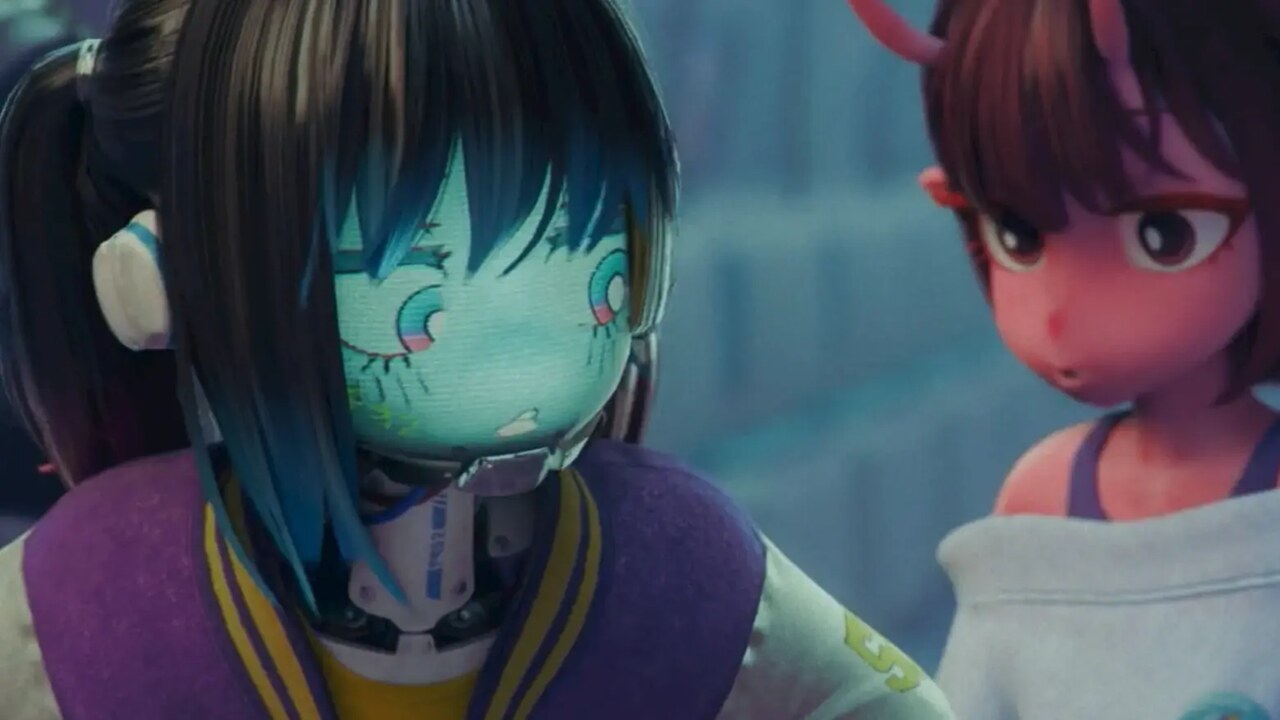
Where the film really flexes is in its setting: Tsukuyomi, a hyper-saturated virtual world built around music, streaming culture, and digital performance. This is where the movie becomes both its most exhilarating and most exhausting. Tsukuyomi is an assault of color, motion, emojis, glitch effects, and visual noise that makes even seasoned anime viewers question their screen settings. It’s dazzling, inventive, and clearly the product of artists who were given far too much creative freedom and decided to use all of it. When it works, it creates sequences of musical storytelling that feel genuinely new. When it doesn’t, it becomes sensory overload that borders on narrative sabotage.
The central plot revolves around Kaguya convincing Iroha to chase fame by competing for a chance to perform alongside Yachiyo, a virtual pop megastar who operates somewhere between idol, influencer, and digital deity. The competition structure provides momentum, stakes, and plenty of excuses for musical set pieces, but it also exposes the film’s biggest weakness: pacing. The movie barrels forward at breakneck speed, tossing emotional beats, character development, and plot twists into a blender and hitting turbo. Important moments barely have time to breathe before the next visual explosion demands attention. As a result, some scenes that should hit harder emotionally barely land before the story sprints onward.
That said, the musical sequences themselves are often excellent. The soundtrack leans heavily into Vocaloid-inspired pop, electronic beats, and emotionally earnest lyrics, and while not every song is memorable, the overall soundscape fits the film’s hyper-digital identity perfectly. Several numbers manage to balance spectacle with genuine feeling, particularly those that explore Iroha’s anxiety and Kaguya’s longing for belonging. The film understands that in stories like this, music isn’t just decoration, it’s emotional communication, and it largely uses it well.
Visually, the film is relentless in its ambition. The real-world scenes are grounded, warm, and quietly detailed, giving emotional weight to Iroha’s solitude and exhaustion. In contrast, Tsukuyomi is pure visual chaos, layered with textures, floating interfaces, glowing avatars, and aggressive color palettes. The contrast between these two spaces cleverly mirrors Iroha’s internal struggle between safety and freedom, control and surrender. Still, the movie frequently mistakes visual density for emotional depth, piling on effects even when simplicity would have served the moment better.
Comedically, Cosmic Princess Kaguya! thrives on absurdity. Kaguya’s complete lack of social calibration provides consistent laughs, particularly in her interactions with Iroha’s painfully structured routines. The film isn’t afraid to lean into self-aware humor, poking fun at idol culture, parasocial relationships, and the relentless grind of digital performance. Some jokes hit sharply, while others overstay their welcome, especially when repeated character gags start feeling less like comedy and more like noise.
Narratively, the film occasionally trips over its own ambition. It wants to be a coming-of-age story, a critique of online celebrity, a sci-fi fantasy, a romcom, and a musical spectacle, all at once. While these elements mostly coexist rather than collide, there are moments when the film seems unsure which emotional lane it wants to occupy. Tonal shifts can be abrupt, with scenes jumping from slapstick to existential reflection in seconds. When this works, it feels bold. When it doesn’t, it feels like creative indecision wearing flashy animation.
Yet, for all its chaos, the movie has a sincere emotional core. At its heart, this is a story about isolation, ambition, fear, and connection in a world that rarely slows down. Iroha’s exhaustion and Kaguya’s restlessness are two sides of the same emotional coin, and their evolving relationship captures something truthful about young people trying to define themselves amid constant pressure. The film’s quieter moments, though frustratingly brief, offer glimpses of genuine introspection that elevate the story beyond pure spectacle.
By the time the final act arrives, the narrative finally allows itself to slow, reflect, and resolve emotional threads that have been bouncing around like loose wires. While the climax still leans heavily on visual overload, it manages to land its emotional beats with surprising effectiveness. The ending doesn’t completely fix the pacing issues that came before it, but it does offer a satisfying sense of closure, growth, and earned optimism.
Cosmic Princess Kaguya! is not a subtle movie. It does not whisper. It shouts, sparkles, glitches, and dances directly into your sensory system, sometimes without asking permission. Its flaws are obvious: erratic pacing, narrative clutter, and visual excess that occasionally undercuts emotional clarity. But its strengths are just as clear: inventive direction, genuine heart, engaging performances, and a willingness to take creative risks that safer productions would never attempt.
This is a film that feels alive, even when it’s exhausting. It stumbles, overreaches, and sometimes collapses under the weight of its own ambition, but it also delivers joy, humor, warmth, and several moments of genuine emotional resonance. Watching it feels like riding an overenthusiastic roller coaster operated by someone who had too much caffeine and access to advanced animation software. You may want to get off halfway through, but by the end, you’re glad you stayed.
In the increasingly crowded world of animated romcoms and sci-fi fantasies, Cosmic Princess Kaguya! stands out not because it is perfect, but because it is unapologetically itself: messy, bright, heartfelt, chaotic, and strangely sincere. It’s the kind of movie that dares you to either keep up or get left behind, and while it occasionally trips over its own shoelaces, it never stops running.
Final Score- [6.5/10]
Reviewed by - Anjali Sharma
Follow @AnjaliS54769166 on Twitter
Publisher at Midgard Times


Hi Everyone, after a due consideration, we have decided that we will be open for donations to help us in managing our website. We will be greatful for any kind of amount we receive. Thanks!
— Midgard Times 🎬 (@Moviesr_net) January 4, 2026
PayPal- [email protected] pic.twitter.com/DlNNz5Npm5
Get all latest content delivered to your email a few times a month.
Bringing Pop Culture News from Every Realm, Get All the Latest Movie, TV News, Reviews & Trailers
Got Any questions? Drop an email to [email protected]



 © Copyrights MOVIESR.NET All rights reserved