

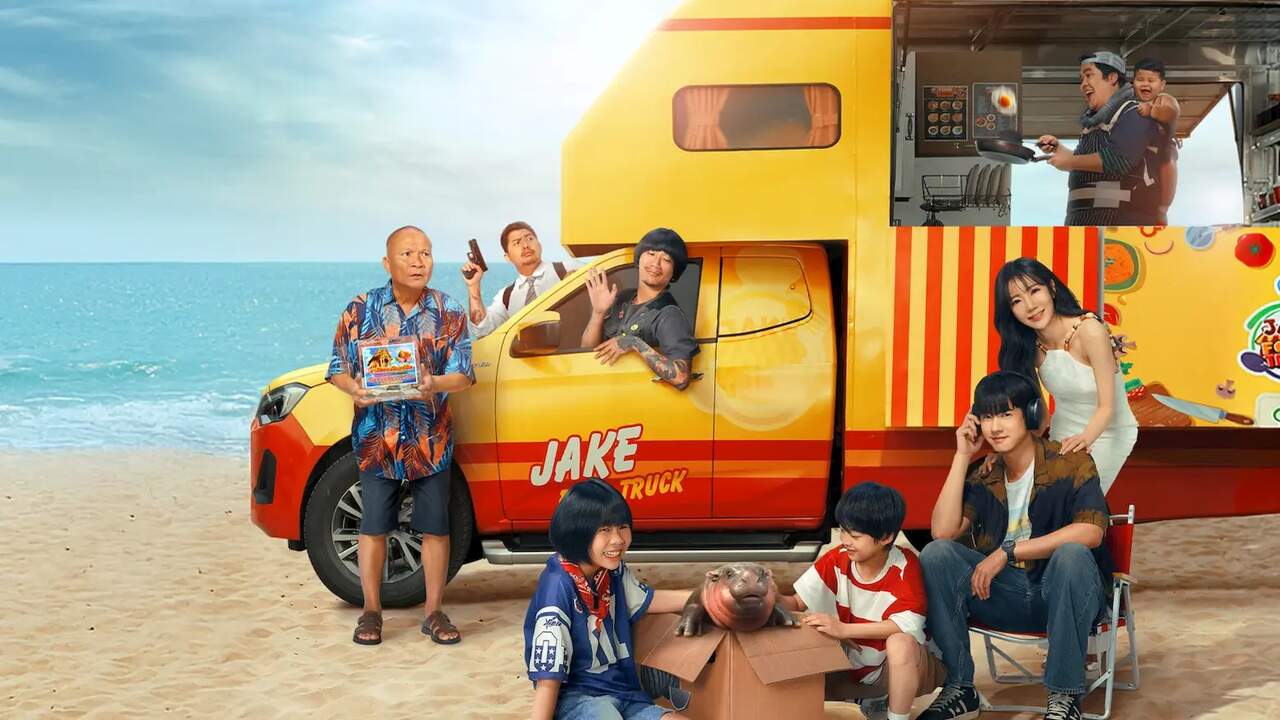
Some movies slowly become strange over time. And then there’s Food Truck: Stolen Love... and Moo Deng, which arrives onscreen already behaving like it consumed six energy drinks in the parking lot before the opening credits. I genuinely do not know how to properly describe this movie to another human being without sounding like I hallucinated parts of it during a fever dream. And honestly? That’s both the film’s biggest problem and its weirdest charm.
Directed by Watcharapong Pattama and Chaleumpol Tikumpornteerawong, this Thai comedy-road-trip-family-drama-romance-chaos-object somehow manages to combine emotional abandonment, influencer culture, runaway-child drama, old romantic regret, slapstick absurdity, food-truck bonding, and an actual pygmy hippo celebrity into one narrative. The fact that it functions at all deserves a small award. The fact that it occasionally becomes genuinely heartfelt surprised me even more.
Mario Maurer plays Mamiew, a former sound technician who now survives as an ASMR influencer, which already tells you exactly what kind of modern emotional disaster this character is. Mamiew spends most of the film looking like a man who accidentally became trapped inside somebody else’s increasingly unhinged road trip while privately realizing his own life may also be collapsing. Maurer is honestly the main reason the movie remains watchable during its messier stretches. He understands the tone better than almost anyone else in the cast. Importantly, he never plays Mamiew like a cartoon. In a movie this ridiculous, grounding the emotional center matters enormously, and Maurer gives the character enough sincerity that the audience continues emotionally following him even when the plot starts behaving like it was assembled by raccoons with editing software.
Mamiew’s connection to Sarang, the neglected Korean child who sneaks onto the food truck, becomes the emotional backbone of the film. Chun Pachchunhiranprateep is genuinely very good as Sarang because the performance avoids becoming overly cute or artificially sentimental. The movie wisely understands that children are funniest onscreen when they behave like actual chaotic little people instead of miniature screenwriters delivering “adorable” dialogue. Sarang spends much of the film quietly exposing how emotionally immature the adults around him are.
The food-truck dynamic itself is probably the strongest part of the movie. Chaleumpol Tikumpornteerawong as Jake and Padung Songsang as Bobby bring exactly the kind of exhausted-friendship energy this story needs. Their chemistry feels lived-in and messy in a believable way. These characters clearly care about each other, but they also communicate like men who have spent years aggressively avoiding serious emotional conversations through sarcasm and bad planning. So naturally, they end up driving around Thailand with a runaway child and unresolved emotional baggage while being pursued by increasingly confused authority figures.
Visually, the movie actually looks pretty great at times. The road-trip cinematography gives the film a warm, wandering atmosphere that helps smooth over some of the screenplay’s more chaotic structural decisions. Street markets, highways, cramped truck interiors, roadside stops, and late-night conversations all carry a slightly messy but charming realism. The food scenes are also excellent. At several points, the movie accidentally transforms into food-porn cinema so effective that I briefly stopped caring about the plot entirely and started emotionally investing in grilled meat and noodles instead. That may honestly have been the healthiest part of the experience.
The comedy is extremely inconsistent, but when it works, it really works. Some of the funniest moments come from the film simply allowing characters to behave awkwardly rather than forcing punchlines every thirty seconds. The movie’s understanding of embarrassment, exhaustion, and adult emotional incompetence often lands better than its louder comedic material. There’s one argument inside the truck that slowly escalates from mild irritation into complete emotional nonsense, and it genuinely feels like listening to old friends who know each other too well to argue normally anymore. That scene worked far better than half the broader slapstick sequences.
Unfortunately, the broader slapstick is where the movie starts running into trouble. Because Food Truck: Stolen Love... and Moo Deng desperately wants to be emotionally sincere and completely absurd at the same time, and the tonal balancing act doesn’t always hold together. One minute, the film is exploring parental neglect and unresolved regret with surprising emotional honesty. The next minute, somebody is screaming while zoo staff chases people around because of a hippo-related misunderstanding. And after a while, the film’s refusal to emotionally settle down becomes exhausting rather than charming.
At a certain point, I stopped trying to predict the movie and simply accepted that it was spiritually committed to confusion. There’s also a major pacing problem in the middle stretch. The film keeps circling emotional revelations without fully landing them, largely because every serious conversation gets interrupted by another comedic escalation or logistical disaster. I understood what the filmmakers were aiming for tonally — life is messy, grief is messy, relationships are messy — but structurally the movie sometimes feels like it’s actively avoiding momentum. And some jokes absolutely do not work.
A few sequences feel like rejected TikTok sketches somehow wandered into the final cut, and nobody had the emotional strength to remove them. There are stretches where the humor becomes so aggressively random that the movie briefly resembles a group chat brought to life by sleep-deprived film students. Still, I can’t fully dislike this movie because it’s trying so hard to be emotionally open underneath all the nonsense. That sincerity matters.
Underneath the hippo chaos, influencer satire, screaming adults, road-trip disasters, and wildly unstable tonal shifts, the movie is really about emotionally lost people trying to reconnect with versions of themselves they abandoned years ago. Mamiew’s arc works because Mario Maurer never loses sight of the sadness underneath the absurdity.
The film also deserves credit for avoiding cynicism. Even when the story becomes ridiculous, it never mocks vulnerability itself. The characters are emotionally immature, selfish, confused, and occasionally spectacularly dumb, but the movie still fundamentally believes they’re capable of growth. That optimism helps hold the entire thing together. By the final act, the emotional material lands more successfully than I expected, largely because the performances stay sincere even while the screenplay continues threatening to drive directly into chaos at any moment. The ending doesn’t completely resolve every tonal imbalance or structural issue, but it leaves behind genuine warmth.
Food Truck: Stolen Love... and Moo Deng is messy, overstuffed, tonally unstable, and occasionally ridiculous in ways that feel almost scientifically engineered to confuse audiences. But it’s also weirdly likable, powered by a committed performance from Mario Maurer, strong chemistry between the central cast, surprisingly heartfelt emotional themes, and enough chaotic energy to remain entertaining even when the movie is clearly losing control of itself. Some comedic sequences feel painfully overextended, the pacing drifts badly in places, and the screenplay occasionally behaves like it was rewritten during a group sugar rush, but the film’s sincerity ultimately saves it from collapsing entirely. Honestly, I’ve seen far more polished movies feel much less alive.
Final Score- [6.5/10]
Reviewed by - Anjali Sharma
Follow @AnjaliS54769166 on Twitter
Publisher at Midgard Times



Hi Everyone, after a due consideration, we have decided that we will be open for donations to help us in managing our website. We will be greatful for any kind of amount we receive. Thanks!
— Midgard Times 🎬 (@Moviesr_net) January 4, 2026
PayPal- [email protected] pic.twitter.com/DlNNz5Npm5
Get all latest content delivered to your email a few times a month.
Bringing Pop Culture News from Every Realm, Get All the Latest Movie, TV News, Reviews & Trailers
Got Any questions? Drop an email to [email protected]



 © Copyrights MOVIESR.NET All rights reserved